Queen bed frames with a storage headboard — What it adds to the room
The Wooden Stars is a participant in the Amazon Services LLC Associates Program. We may earn a commission when you buy through links on our site, at no extra cost to you.
A storage headboard is a bookcase with a mattress in front of it. That is not a criticism — it is the most honest way to describe what you are buying, and it explains both what it is good at and the three things it does to the room.
It adds shelves where a wall was doing nothing. It also adds up to a foot to the length of the bed, moves your pillows forward, and puts whatever is on those shelves directly above your head.
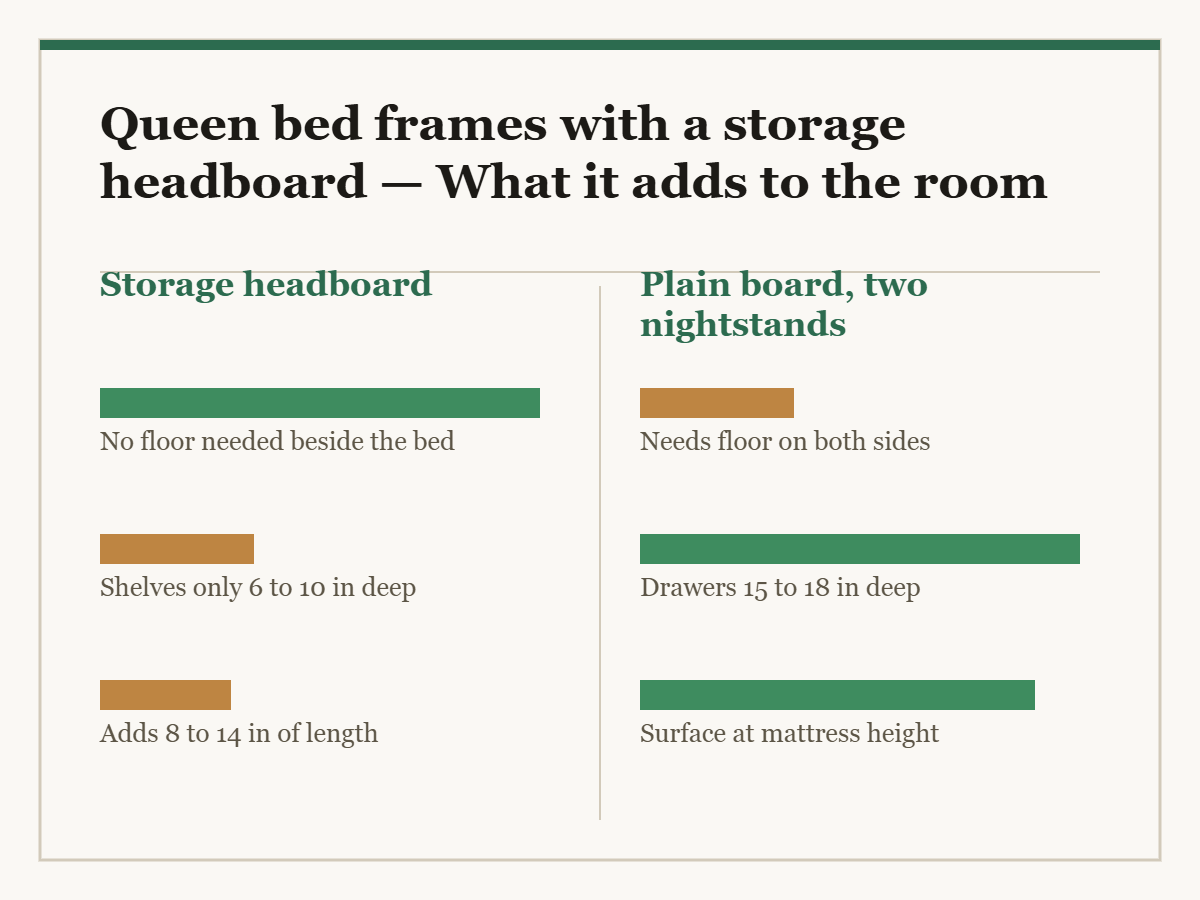
A queen mattress is 60 × 80 inches. A storage headboard adds 8 to 14 inches to the overall length, so plan for a footprint of about 60 × 90 rather than 60 × 80. The shelves are 6 to 10 inches deep — enough for paperbacks, a phone and a glass, not for anything the size of a hardback laid flat. Two things to check: whether the frame includes centre support (a queen deck needs it and storage frames often route it around drawers), and whether the headboard has a lip or rail on the shelves, because an open shelf above a sleeping head is where a glass of water eventually goes.
What the headboard actually adds
Storage headboards come in three depths, and they behave very differently.
Shallow bookcase, 6 to 8 inches
Open cubbies or a single shelf. Takes paperbacks upright, a phone, glasses, a lamp base. Adds 8 to 10 inches to the bed length.
This is the useful version for most rooms: enough to replace a nightstand’s worth of surface without dominating the wall.
Deep bookcase with doors, 10 to 14 inches
Closed compartments, sometimes with sliding doors. Real volume — 3 to 5 cubic feet — and it adds 12 to 16 inches to the bed length.
In a small bedroom this can genuinely replace both nightstands, which is a net saving of floor even though the bed is longer.
Panel headboard with a shelf on top
A flat shelf across the top of a solid headboard, 4 to 6 inches deep, at about 48 inches from the floor. Almost no storage, but a good place for a lamp, and it adds nothing to the footprint.
The length problem
This is the measurement people forget. A queen bed is planned as 60 × 80, the room is measured on that basis, and then the headboard adds most of a foot at the head end.
In a bedroom where the bed runs along the short wall with a door or a wardrobe at the foot, that foot is the difference between a walkway and a squeeze. Measure the overall length from the listing, not the mattress size.
There is a related effect indoors: the pillows move forward with the headboard, so the sleeping position shifts too. If the bed is under a window or a sloping ceiling, check where your head actually ends up.
| Type | Shelf depth | Adds to length | Holds |
|---|---|---|---|
| Panel with a top shelf | 4 to 6 in | Nothing | A lamp, a book |
| Shallow bookcase | 6 to 8 in | 8 to 10 in | Paperbacks, phone, glasses |
| Deep bookcase | 10 to 12 in | 12 to 14 in | 3 to 4 cu ft |
| Deep with sliding doors | 12 to 14 in | 14 to 16 in | 4 to 5 cu ft, closed |
| Bookcase plus base drawers | Both | 12 to 14 in | Replaces both nightstands |
What actually stays on the shelves
Six to 10 inches sounds generous until you put things on it.
- Paperbacks upright: fine at 6 inches.
- Hardbacks upright: want 8 to 9.
- A glass of water: fits anywhere, and is the thing most likely to come down. A front lip solves it and most shelves do not have one.
- A phone on a charger: fine, provided there is a cable route. Many storage headboards have a notch at the back; check, because threading a cable over the top of the shelf every night is how you stop using it.
- A lamp: depends on the base diameter. Measure before ordering; a 7-inch base on a 6-inch shelf overhangs.
Centre support, which storage frames get wrong
A queen deck is 60 inches across. Slats spanning that width need support in the middle, or the mattress dips along the centre line and the slats eventually break.
A plain frame does this with a centre rail carried on one or two legs to the floor. A storage frame often cannot put a leg where it belongs, because that is where a drawer goes, so the rail is carried at the ends only — or routed around the drawer bays.
Check the listing for a centre support leg and where it lands. This is the single most common structural failure in storage beds, and it shows up as a sag six months in. The background is in bed frame centre support legs, and slat spacing — which does not change just because there are drawers underneath — in bed slat replacement and spacing.
Height, and what sits above your head
A storage headboard is typically 42 to 50 inches from the floor at the top. With a 12-inch mattress and a deck at 12, the pillow line is around 24, so the shelves sit between roughly 28 and 48 inches — that is, above the sleeper.
Two consequences. First, a front lip or rail on the shelf is worth more than it sounds. Second, the headboard should be bolted to the frame rather than free-standing behind it; a bookcase headboard that is only leaning is a bookcase that can be nudged.
For the alternative approach — a headboard fixed to the wall instead of the frame — see wall-mounted headboards, and for headboard height generally, how tall a queen headboard should be.
What it is made of
The headboard carries books on shelves that cantilever from the uprights, and the frame carries a mattress and two people.
Solid timber or plywood holds shelf pins and bolts under repeated load. Particleboard works when new and loosens where the shelf meets the upright, which on a headboard is above someone’s head. The distinctions are in what engineered wood actually is.
For the frame itself, wood bed frames in queen, and what to check covers the joints, and hardwood bed frames in queen the material.
Worth adding
- Bed frame centre support leg A queen deck sags without support in the middle
- Bed frame brackets Storage frames have more joints, and rail joints carry the load
- Shelf lip rail An open shelf above a sleeping head wants an edge on it
- Under-bed storage bags For the space the headboard does not use
What to buy


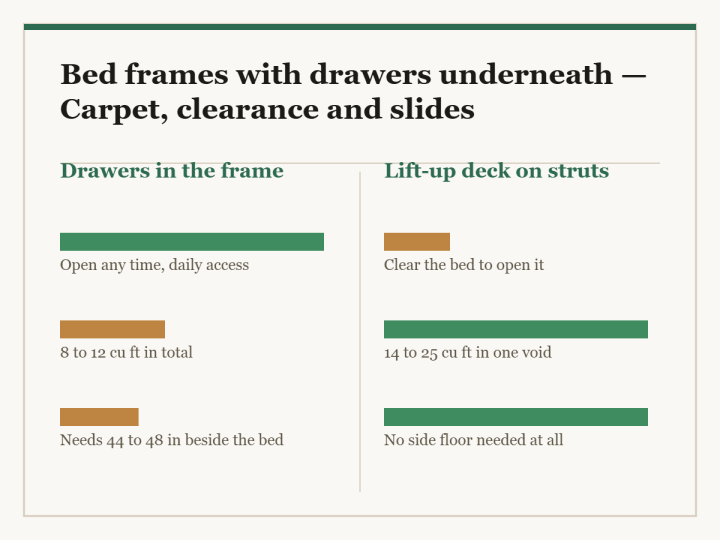
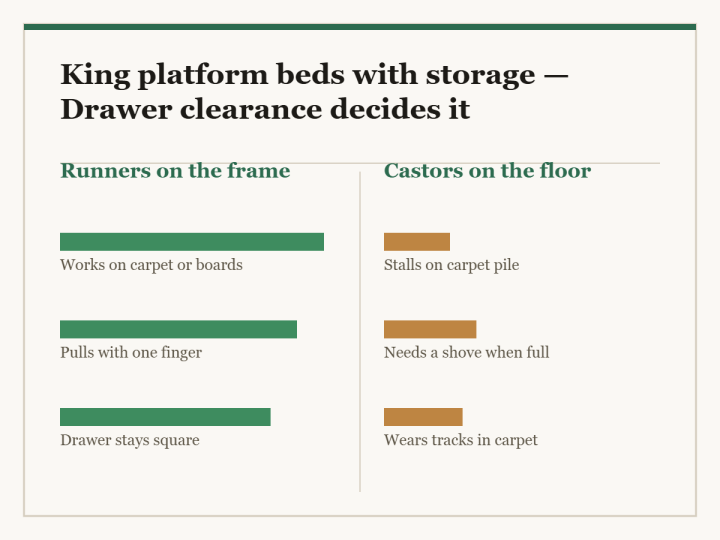
If the storage would be better underneath, see bed frames with drawers underneath and king platform beds with storage. For a nightstand instead, round bedside tables with storage and how tall a nightstand should be. Frame options are in queen bed frames.
Questions we get asked
How much length does a storage headboard add?
Eight to 14 inches. Plan the room around roughly 60 × 92 for a queen rather than 60 × 80.
How deep are the shelves?
Six to 10 inches. Paperbacks stand up fine, hardbacks want 8 to 9, and nothing lies flat.
Can it replace nightstands?
In a small room, yes — a deep version with doors holds 4 to 5 cubic feet. You lose drawer depth and a surface at mattress height.
Does a queen storage frame need a centre support?
Yes. Sixty inches of slat span sags without it, and storage frames often route the support around the drawers. Check where the leg lands.
Will things fall off the shelves?
A glass of water will, eventually. Look for a front lip or rail, or add one.
Should the headboard bolt to the frame?
Yes. A bookcase headboard standing loose behind the bed can be nudged, and it is above where you sleep.