Platform bed against box spring — What each one is actually for
The Wooden Stars is a participant in the Amazon Services LLC Associates Program. We may earn a commission when you buy through links on our site, at no extra cost to you.

A platform bed and a box spring are not alternatives to each other in the way the phrase suggests. A platform bed is a bed frame. A box spring is a foundation that sits inside a frame. The real question is whether your frame needs one.
And the answer, for almost every mattress sold today, is no — with one expensive exception that catches people out.
A platform bed supports the mattress directly on slats or a solid deck, so it needs no box spring. A box spring is a wooden or metal frame in fabric that sits inside a traditional bed frame and supports the mattress from underneath. Modern foam and hybrid mattresses need continuous support, which slats under 3 inches apart provide and a bare perimeter frame does not. The trap: a frame designed for a box spring looks identical to a platform frame in photographs, and putting a foam mattress on one without the foundation leaves the middle unsupported. Check the listing for a required foundation.
What each one actually is
A platform bed
A frame with slats or a solid deck built in. The mattress goes straight on it. Nothing else is needed, and adding a box spring on top usually makes the bed uncomfortably tall and does nothing useful.
Most bed frames sold now are platform beds, because most mattresses sold now are foam or hybrid.
A box spring
A rectangular timber or steel frame, wrapped in fabric, sized to the mattress. Older ones contained actual springs to add give; most modern ones are simply a rigid foundation with no springs in them at all, despite the name.
It sits inside a traditional bed frame — which is often just a perimeter rail on legs — and raises the mattress to a usable height while supporting it.
Why the mattress decides
An old-fashioned innerspring mattress has a rigid internal structure and can bridge a gap. A modern foam or hybrid mattress cannot: it conforms to whatever is under it, and over a few months it takes a permanent set in the shape of that support.
So the requirement changed with the mattress market:
| Mattress | On a platform bed | On a box-spring frame |
|---|---|---|
| Memory foam | Slats under 3 in apart | Needs the box spring |
| Hybrid | Slats under 3 in apart | Needs the box spring |
| Latex | Slats under 3 in apart, thicker slats | Needs the box spring |
| Traditional innerspring | Fine | Fine, and traditional |
| Any mattress on a bare perimeter frame | Not supported | Not supported |
Most mattress warranties write the slat gap into the terms — commonly 3 inches maximum — and will decline a claim if the base did not meet it. Read your own warranty before choosing the frame; it is the document that governs.
The trap: frames that photograph identically
This is where the money is lost. A platform frame and a box-spring frame can look the same from the front: four rails, a headboard, legs.
The difference is inside. A platform frame has slats across the opening. A box-spring frame has a bare rectangle, sometimes with a couple of cross bars that locate the foundation rather than support a mattress.
Three ways to tell from a listing:
- Look for a slat count. Platform frames state it. Box-spring frames have nothing to state.
- Search the text for “box spring”. Listings say “box spring required” or “no box spring needed” — both are common and both are reliable.
- Find a photograph of the frame empty. If every image has a mattress on it, that is a decision somebody made.
Putting a foam mattress on a box-spring frame without the foundation leaves 60 or 76 inches of mattress middle with nothing under it. The sag appears within weeks and does not recover.
Height, which is the other real difference
Adding a box spring raises the sleeping surface by its own thickness — typically 5 or 9 inches.
Aim for 22 to 26 inches from the floor to the top of the mattress; that is comfortable to sit on and get out of. Do the arithmetic:
- Platform frame 12 in deck + 12 in mattress = 24 in. Comfortable.
- Traditional frame 8 in + 9 in box spring + 12 in mattress = 29 in. A climb.
- Traditional frame 8 in + 5 in low-profile box spring + 12 in mattress = 25 in. Right.
That last line is what low-profile foundations exist for, and the choice between the two heights is set out in low profile against standard box spring.
If you have a box-spring frame and a foam mattress
Three fixes, in order of how well they work.
Buy a foundation. A modern rigid foundation or a slatted “bunkie board” foundation solves it properly. Low profile keeps the bed height sane.
Add a slat kit. Roll-up slat packs sit on the frame rails and convert it into a platform. Cheap and effective, provided the rails have a ledge to carry them.
Add a bunkie board. A thin rigid panel across the frame. It works, but on a wide bed it still needs support under the middle — a centre rail with a leg to the floor, which is discussed in matching a king mattress to the frame.
What does not work is a mattress topper. It disguises the dip while the mattress underneath keeps taking its set.
Does a platform bed still need a centre support?
Yes, on anything wider than a twin. Slats spanning 54, 60 or 76 inches bend under two adults, and the frame racks with them. A full needs one centre leg, a queen two, a king two or three.
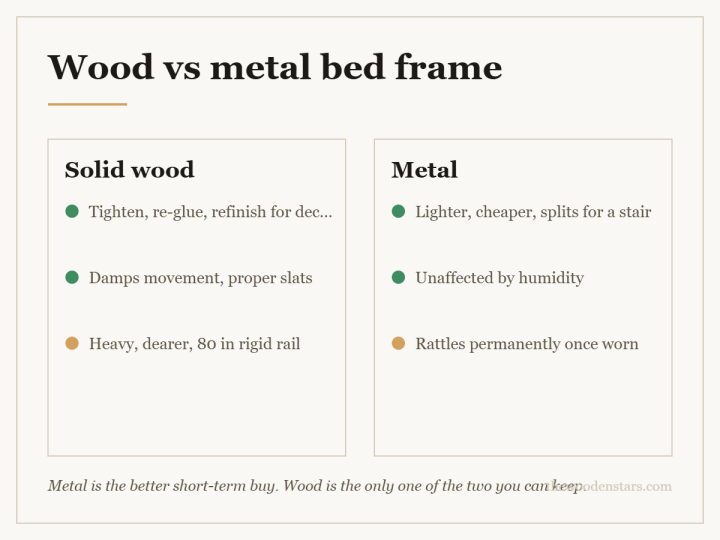
This is independent of the box-spring question and it is the most common omission on cheap frames. The detail is in wood bed frames.
For either setup
- Bed slat roll Converts a box-spring frame into a platform for a fraction of a foundation
- Adjustable centre support bar The real fix for a frame with no centre leg
- Bunkie board Rigid panel for gap problems; not a substitute for centre support
- Tape measure Deck height plus mattress thickness; aim for 22 to 26 in total
What to buy


For the height choice between foundations, see low profile against standard. For frames generally, wood bed frames, and for fit and sagging, matching a mattress to the frame.
Questions we get asked
Do I need a box spring with a platform bed?
No. A platform bed supports the mattress on slats. Adding a box spring makes the bed taller and achieves nothing.
Is a platform bed better than a box spring?
They are not the same category. A platform bed is a frame; a box spring is a foundation for a different kind of frame. For a foam or hybrid mattress, a platform frame is simpler and lower.
Can I put a foam mattress on a box spring?
Yes, if the box spring is a rigid modern foundation with close supports. What fails is a foam mattress on a bare frame with the foundation left out.
How do I know if a frame needs a box spring?
Look for a stated slat count, search the listing for “box spring”, and find a photograph of the frame without a mattress on it.
Do box springs actually contain springs?
Most modern ones do not. They are rigid foundations that kept the old name.
Will a platform bed make my bed too low?
It can. Add the deck height to your mattress thickness and aim for 22 to 26 inches to the top of the mattress.