Bunk beds with storage stairs — Stairs or a ladder
The Wooden Stars is a participant in the Amazon Services LLC Associates Program. We may earn a commission when you buy through links on our site, at no extra cost to you.
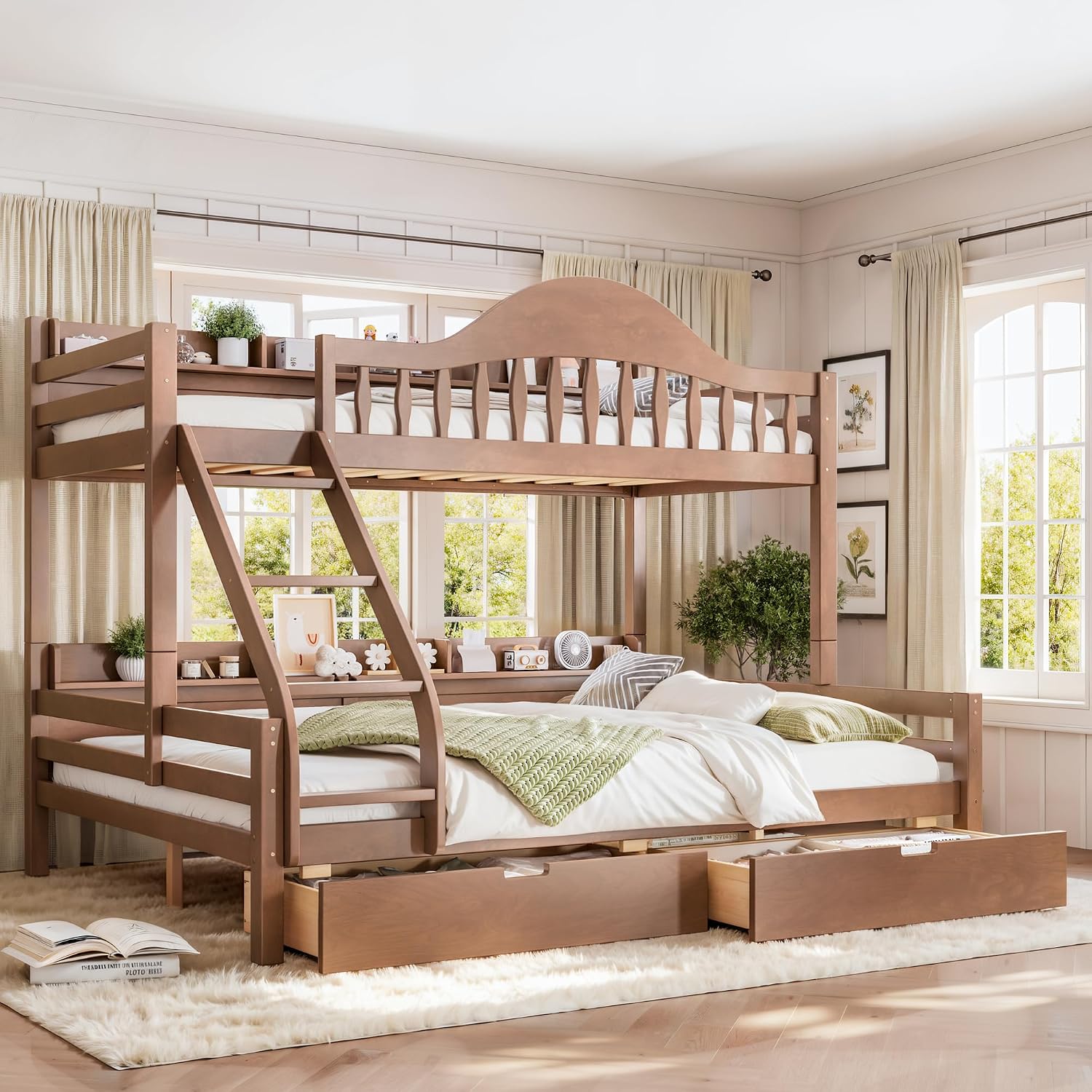
Storage stairs replace a bunk bed’s ladder with a staircase whose risers are drawers. You get safer access and a chest of drawers in the same object, which sounds like a straight win.
It is not free. Stairs project a long way into the room, and on a bunk that is already 60 inches wide, the difference between a ladder and stairs can be the difference between the bed fitting and not.
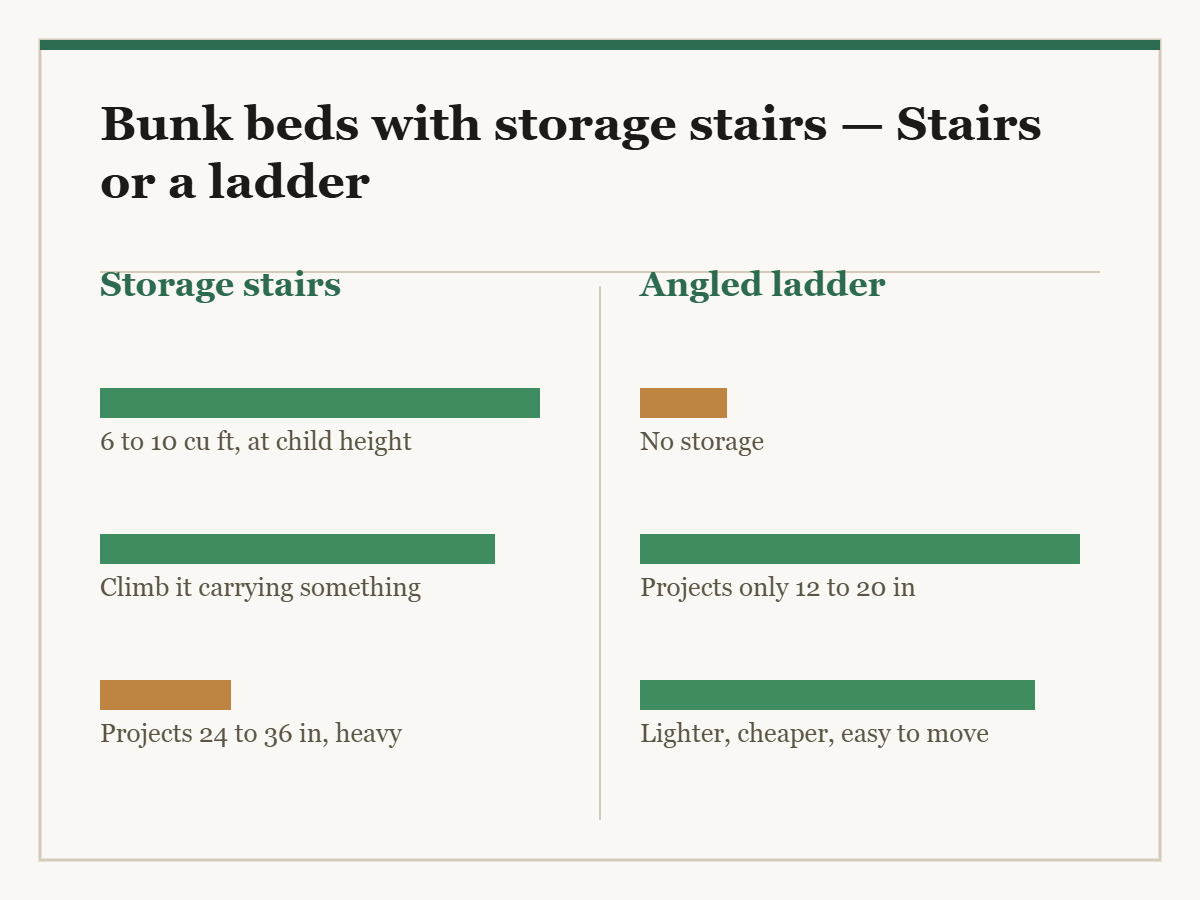
Storage stairs project 24 to 36 inches beyond the bunk’s footprint, against 12 to 20 for an angled ladder and almost nothing for a vertical one. In exchange you get 3 to 6 drawers holding 1 to 2 cubic feet each — 6 to 10 in total — and access a child can use carrying something. Two things to check: whether the stairs are reversible, because a fixed left-hand staircase in a right-hand corner is unusable, and whether the drawer fronts are the treads themselves (which means standing on the drawer) or separate faces below each tread (which is better). Storage stairs also make the bunk much heavier.
The footprint, which is the real cost
Work it out before anything else.
- Vertical ladder: adds nothing. Climbs the end or the side of the frame.
- Angled ladder: projects 12 to 20 inches, usually at the end.
- Storage stairs: project 24 to 36 inches, and they are solid — you cannot walk through them.
A twin over twin bunk is about 42 × 80 inches. Add stairs at one end and it is 42 × 110 — over nine feet long. In a 10-foot room that leaves 10 inches at the end.
Stairs at the side rather than the end make the bed 66 to 78 inches wide instead, which in most children’s rooms is worse.
What the drawers actually hold
Stair drawers are shallow and stepped, so the capacity is less than a chest of the same face area.
- Volume: 1 to 2 cubic feet each, 6 to 10 across a three-to-six-drawer staircase.
- Depth inside: 6 to 10 inches — the riser height minus the tread.
- Length: as deep as the stair tread, so 10 to 14 inches front to back on most.
That suits folded clothes, toys, books and bedding, and does not suit anything tall. The top drawer is usually the smallest and the least reachable, because it is at the top of a staircase you have to stand on.
One genuinely useful quality: the drawers are at a child’s height and in a child’s path, which makes them the drawers a child will actually use.
| Type | Projection | Storage | Safety |
|---|---|---|---|
| Vertical ladder | None | None | Hardest to climb barefoot |
| Angled ladder | 12 to 20 in | None | Good with flat treads |
| Stairs, no drawers | 24 to 36 in | None | Best |
| Storage stairs | 24 to 36 in | 6 to 10 cu ft | Best |
| Stairs with a rail | 24 to 36 in | 6 to 10 cu ft | Best, and the rail matters |
Tread drawers or face drawers
This is the construction detail that separates the good staircases from the rest.
Drawer fronts below each tread
The tread is a fixed structural part and the drawer is a separate box underneath it, opening towards the room. You stand on solid timber and the drawer runs independently.
This is the right arrangement. The tread never moves, so it never develops play.
The tread is the drawer lid
The whole step lifts or pulls out. Simpler to make, and it means the surface you stand on is a moving part carried on runners. Over a few years of a child running up them, those runners develop play and the step becomes springy.
Look at the photographs from the side: if you can see a drawer face under each tread, it is the first kind.
Reversibility
A staircase is handed. It goes on the left or the right of the bunk, and a fixed left-hand staircase in a right-hand corner cannot be assembled.
Look for “reversible” or “left or right configuration” in the specification. Reversible frames cost nothing extra and they matter more than usual here, because a bunk with stairs is so long that its orientation is decided by the room rather than by preference.
Work out which hand you need by standing where the bed will go: the stairs want to come out into open floor, not towards a wall or a door swing.
The rail on the staircase
A staircase without a handrail is a set of steps at the side of a six-foot drop, which is worse than a ladder — a ladder at least gives you something to hold.
Look for a rail running up the open side of the stairs, and check it continues to the top so there is something to hold at the point you step onto the bunk. A rail that stops one tread short leaves the transition unprotected, which is exactly where a child reaches out for something that is not there.
Weight, and what it means in practice
A staircase of drawers adds 60 to 120 lb to a bunk bed. Consequences:
- It arrives in more, heavier boxes. Plan the route in.
- You will not move it to hoover behind. That is fine; just know it.
- The floor takes a concentrated load at the stair base, which on a soft floor means dents unless there are proper feet.
- Assembly is longer — usually two to four hours rather than one.
What it is made of
The stairs are a structural staircase carrying a child, and the drawers are pulled while standing on it.
Solid hardwood treads do not develop a springy feel. Particleboard treads with a laminate face do, and the failure is in the fixing at each end rather than the panel — what engineered wood actually is.
The drawer boxes take the usual test: dovetailed or grooved sides survive, stapled boxes loosen and then jam — when a drawer will not slide, how to measure drawer slides.
Everything about the bunk frame itself still applies — species, post section, bolted joints and slats: wooden bunk beds, bed slat replacement and spacing, and why a wooden bed frame squeaks. A bunk with stairs has more joints than one with a ladder, so it has more places to creak.
With the frame
- T-handle hex key More joints than a ladder bunk, and they all want annual torque
- Anti-tip wall strap Heavier and taller, and children climb the stairs at speed
- Felt glides Concentrated load at the stair base dents a soft floor
- Drawer liner Stair drawers are shallow, and contents slide forward on every open
What to buy



For the bunk frame itself, see wooden bunk beds and by size twin over twin, twin over full and full over full. If floor space is tight, bunk beds for small spaces or L-shaped bunk beds. For storage under a normal bed instead, bed frames with drawers underneath.
Questions we get asked
How much space do storage stairs take?
They project 24 to 36 inches beyond the bunk, against 12 to 20 for an angled ladder. On a twin bunk that turns an 80-inch bed into about 110.
How much do the drawers hold?
One to 2 cubic feet each, 6 to 10 in total, and 6 to 10 inches deep inside. Folded clothes and toys, nothing tall.
Are stairs safer than a ladder?
Yes, clearly — they can be climbed carrying something and a child uses them without thinking. Check there is a handrail that runs all the way to the top.
Should the tread be the drawer?
No. Prefer a fixed tread with a separate drawer face beneath it. A tread carried on drawer runners develops play and feels springy after a few years.
Do the stairs go on the left or the right?
Whichever the room needs — so look for a reversible frame. A fixed-hand staircase in the wrong corner cannot be assembled.
How much heavier is it?
Sixty to 120 lb more than the same bunk with a ladder, in more boxes, with a longer assembly.