West Elm and RH dresser alternatives — Midcentury without the markup
The Wooden Stars is a participant in the Amazon Services LLC Associates Program. We may earn a commission when you buy through links on our site, at no extra cost to you.

The midcentury dresser look — walnut tone, tapered splayed legs, a long low case, visible floor underneath — is the most copied design in bedroom furniture. It is also the easiest to copy badly, because three of its four signals are cosmetic and one is not.
Knowing which is which lets you buy a cheaper piece that holds up rather than one that merely photographs well.
The look is: tapered, slightly splayed legs; a long low case, 55 to 65 inches wide and around 30 tall; warm mid-brown walnut tone; and visible floor beneath. Three of those are easy to buy cheaply. The one that is not is the leg-to-case joint — a tapered leg works at an angle, and on a cheap piece it is screwed into the underside of a panel, which loosens and then wobbles. Look for legs bolted into a solid corner block. Also expect walnut to be a stain or veneer at this price, which is fine if the listing says so.
The four signals
| Signal | Detail | Easy to match? |
|---|---|---|
| Legs | Tapered, splayed a few degrees outward | Yes |
| Proportions | 55 to 65 in wide, about 30 tall | Yes |
| Colour | Warm mid-brown walnut tone | Yes, usually stain or veneer |
| Visible floor | Case raised 5 to 8 in on legs | Yes |
| Leg joint | Bolted into a solid corner block | No — this is where it fails |
| Drawer boxes | Dovetailed solid timber | No — this is where price shows |
The first four rows are what you see. The last two are what you own in ten years.
The leg joint, which is the real weak point
A tapered splayed leg is not a vertical post. It carries the corner load at an angle, which means the joint sees both compression and a bending moment every time somebody leans on the case or pushes it across a floor.
Three ways manufacturers make that joint:
Bolted into a solid corner block. A hardwood block glued into the corner of the case, with a threaded insert or a hanger bolt. This is the right way. It can be re-tightened for the life of the piece.
Screwed into a mounting plate fixed to the underside. Acceptable if the plate is screwed into something solid. Check what is behind it.
Screwed directly into the underside of a particleboard panel. The failure case. The screws enlarge their holes, the leg develops play, the play becomes a wobble, and there is no clean repair.
Listings rarely state this, but photographs of the underside sometimes show it, and the shipping weight is a proxy: a case built with solid corner blocks is heavier.
Walnut, and the three things the word means
At mid-market prices, “walnut” is usually not solid walnut, and that is not dishonest — but it is worth knowing which of the three you are buying.
Solid walnut is timber throughout, heavy, and priced accordingly. Rare on a 60-inch dresser below a certain price.
Walnut veneer is a real walnut face over a stable core. On wide drawer fronts this is better engineering than solid, because a wide solid panel moves seasonally. It refinishes once or twice.
Walnut finish is a stain on rubberwood, ash or particleboard. There is no walnut in it, and a scuffed edge shows the pale material underneath.
All three are reasonable purchases at the right price. The way to tell them apart in ten seconds is in walnut dressers, and why walnut is priced as it is in walnut against oak.
Spotting a genuine midcentury design
Beyond the dresser, the style has a consistent vocabulary, and pieces that only wear one signal are easy to identify once you know the set: tapered splayed legs, slim plain fronts with no applied moulding, visible floor beneath, and warm mid-brown timber.
A chest with tapered legs and a heavy moulded front is a contemporary piece wearing one detail. That is not a criticism of the furniture — only of the label. The full set is in midcentury modern bed frames, and the timber question in midcentury bed frame woods.
The construction checks that always apply
- Drawer boxes: dovetails at the front corners; dowels acceptable; staples into particleboard not.
- Drawer bottoms captured in a groove on all four sides, not pinned underneath.
- Runners: full-extension steel slides. A plastic centre rail is the bottom of the market.
- Case sides that hold a screw where the runners mount.
- Shipping weight against size: a 60-inch six-drawer chest in solid and plywood is 150 to 250 lb; in particleboard, 80 to 120.
The reasoning behind each is in wood dressers.
Two cheap upgrades that matter
Felt pads under tapered legs. A tapered leg concentrates the whole corner load onto a small contact patch, which dents soft floors and sinks into carpet. Pads on hard floors, hardwood coasters on carpet.
Threadlocker on the leg bolts. Because the joint works at an angle, it loosens sooner than a vertical one. A drop at assembly saves the wobble.
Anchor it
A loaded top drawer puts the centre of gravity in front of the case, and a piece raised on legs has a smaller effective base than one sitting on a plinth. Anchor into a stud on assembly day — see tall wood dressers.
Closing the gap
- Felt pads Tapered legs concentrate load; essential on a hard floor
- Threadlocker Leg bolts work at an angle and loosen sooner
- Furniture anti-tip kit Required on every chest, into a stud
- Cast metal drawer pulls Simple slim pulls suit the style and lift a budget piece
What to buy

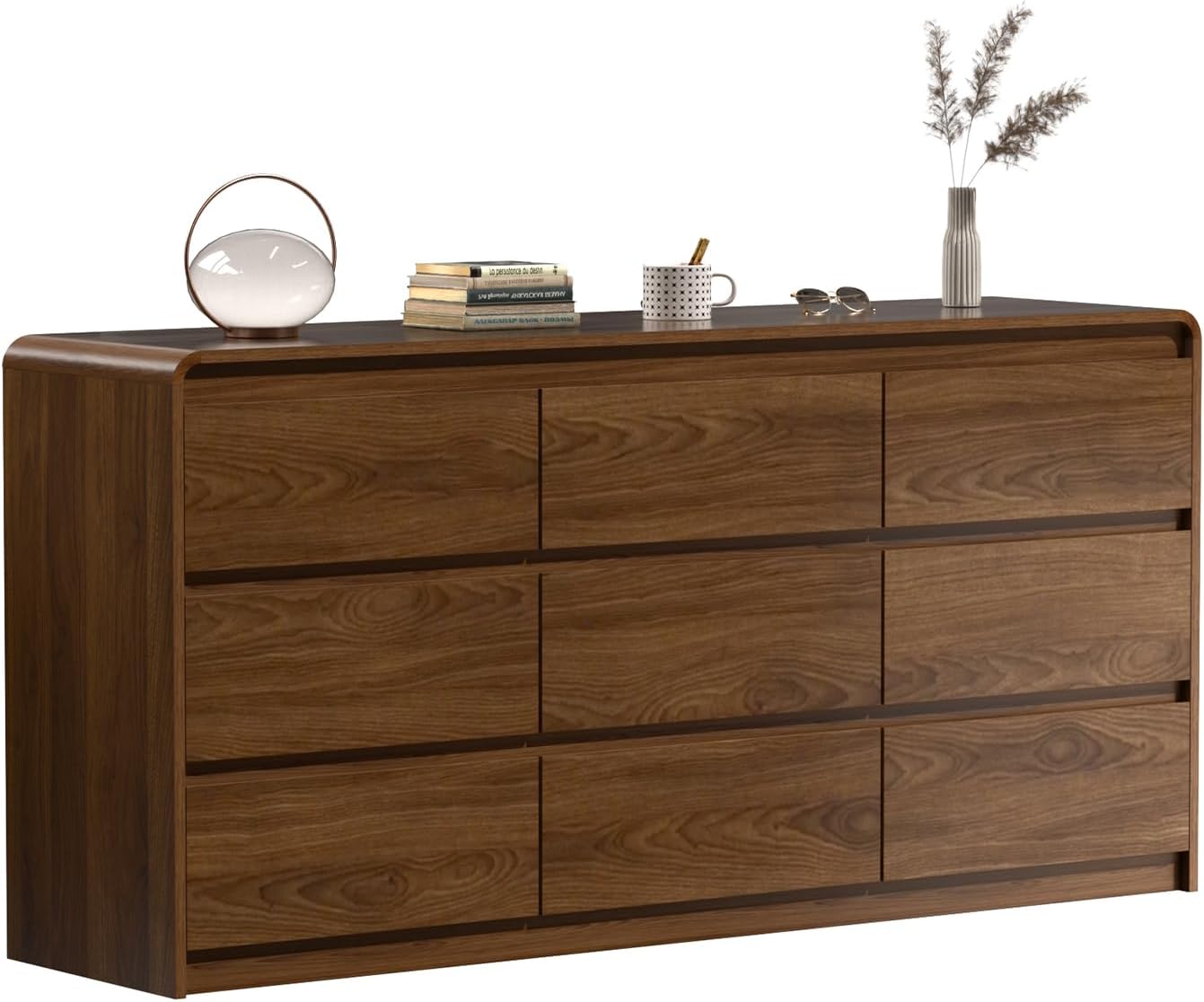

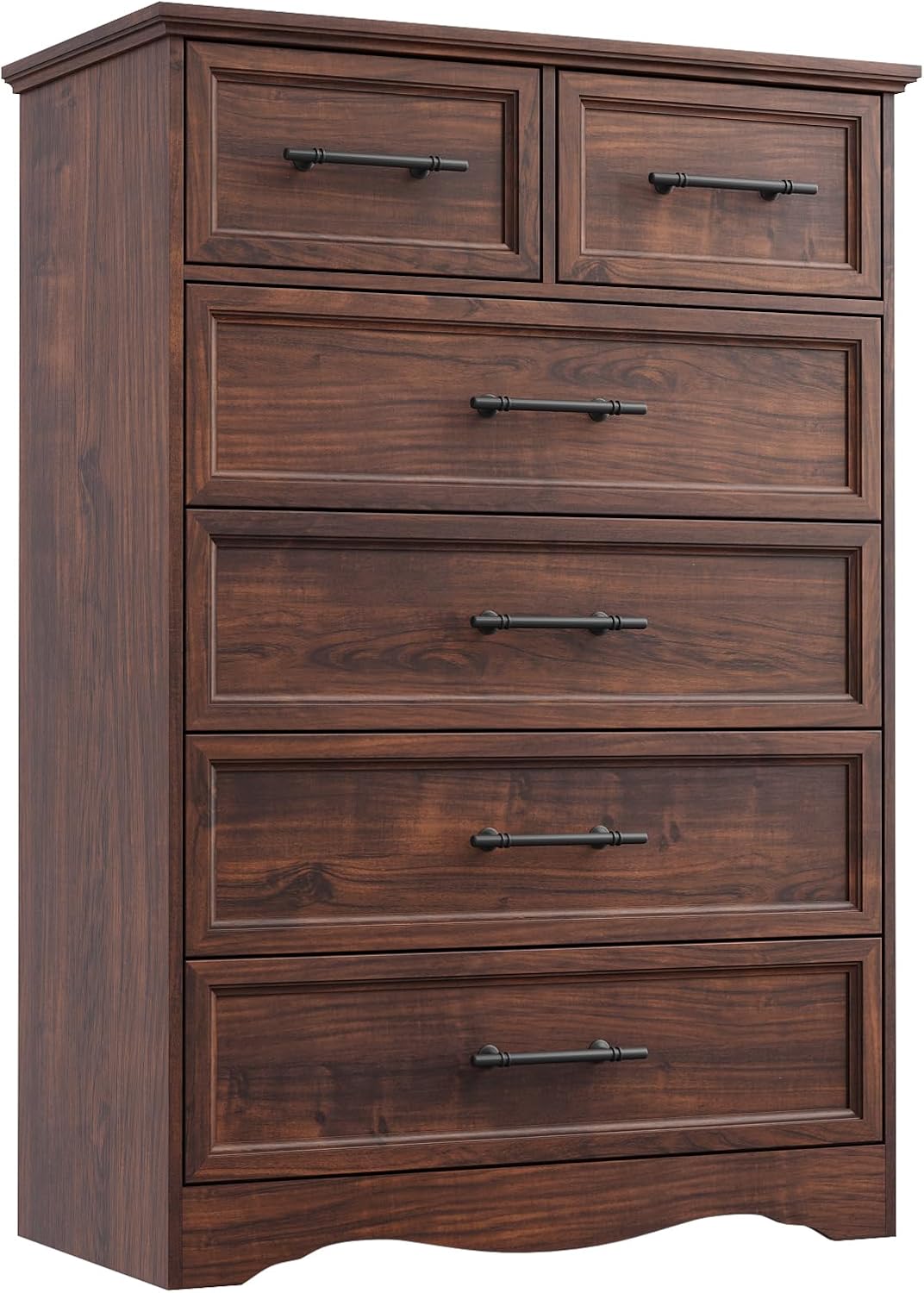
For the style itself, see midcentury modern bed frames. For the walnut question, walnut dressers; for construction, wood dressers; and for the traditional look instead, Pottery Barn dresser alternatives.
Questions we get asked
What makes a midcentury dresser look right?
Tapered, slightly splayed legs; a long low case; warm mid-brown timber; and clear space under the frame.
Why do tapered legs go wobbly?
They carry the corner load at an angle. If the leg is screwed into a particleboard underside rather than a solid corner block, the screws enlarge their holes.
Is “walnut” at this price real walnut?
Usually a veneer or a stain. Both are legitimate; the listing should say which, and the shipping weight will confirm it.
What is the single best check before buying?
Compare shipping weight with size. Solid timber and plywood are heavy; particleboard is not.
Should I use felt pads on tapered legs?
Yes on hard floors, and hardwood coasters on thick carpet. The small contact patch concentrates a lot of load.
Does a dresser on legs still need anchoring?
Yes, and arguably more — legs give it a smaller effective base than a plinth does.