Armoire closets with drawers — Wardrobe or chest, or both
The Wooden Stars is a participant in the Amazon Services LLC Associates Program. We may earn a commission when you buy through links on our site, at no extra cost to you.
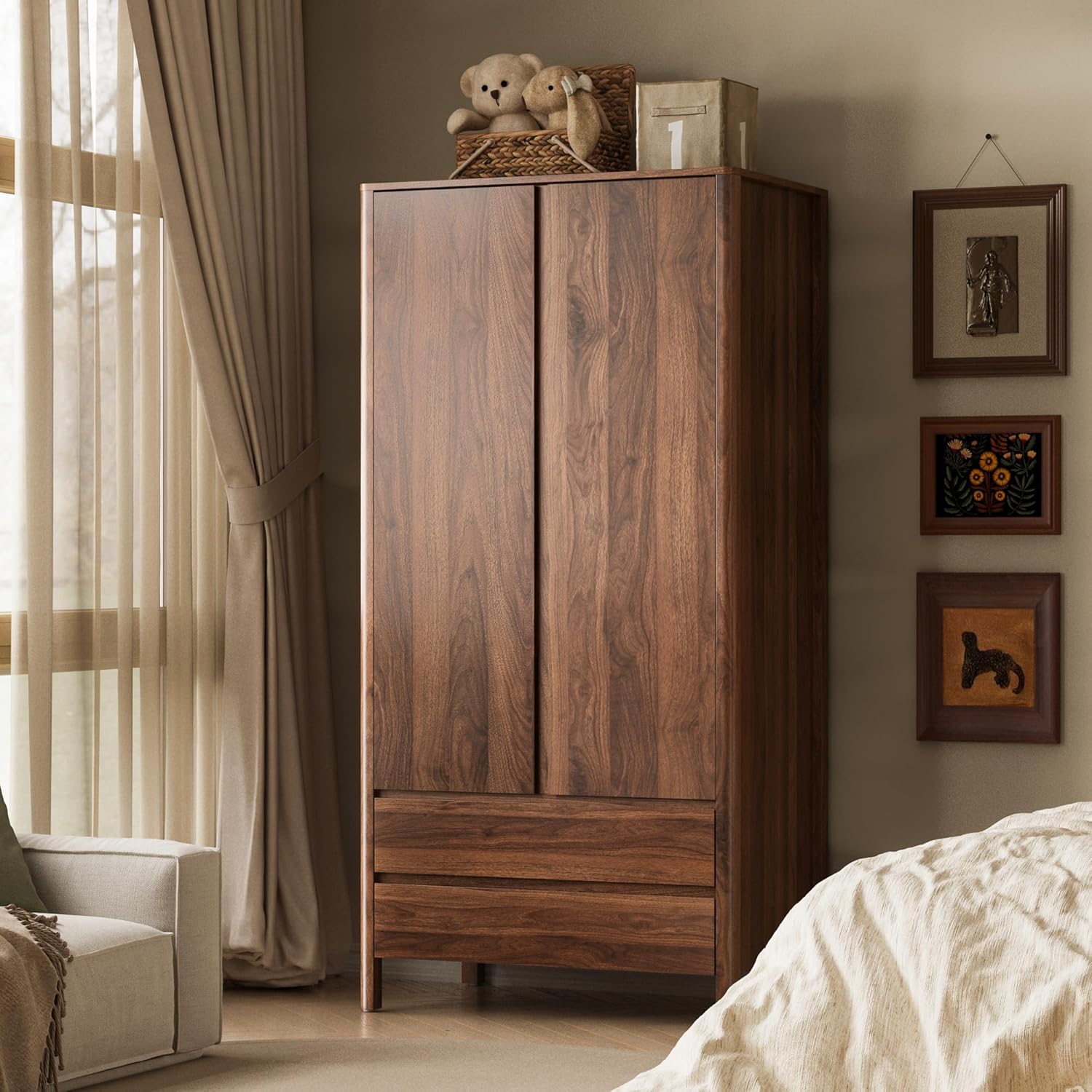
An armoire closet is what you buy when the room has no built-in wardrobe. It has to be the whole storage solution for one person’s clothes in one carcase, which is a lot to ask of a box about three feet wide.
The drawers are what make it plausible. They are also what make the hanging section too short for half of what you own, and the balance between the two is the entire buying decision.
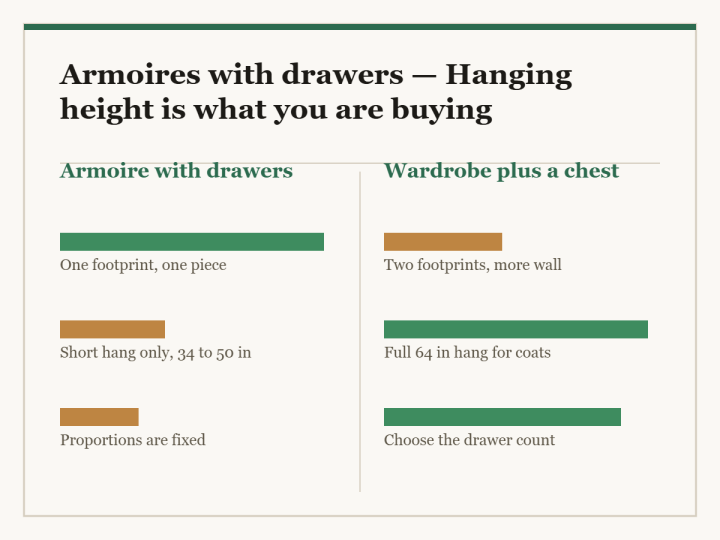
An armoire closet is typically 36 to 48 inches wide, 19 to 24 inches deep and 65 to 78 inches tall. Add drawers at the base and the clear hanging height falls to 34 to 50 inches — enough for shirts and jackets, not for coats or dresses, which need 60. The layout that works best in one cabinet is double-hang on one side (two rails at about 40 inches each) with drawers under a single long-hang section on the other. Check internal depth of 21 inches or the doors press on hangers, check the rail is supported in the middle on anything over 36 inches wide, and anchor it to the wall.
The layout that gets the most out of one cabinet
A single full-height rail wastes the bottom 20 inches under everything except long coats. The layouts worth having all address that.
Double-hang on one side
Two rails, one above the other, at roughly 40 inches of clear height each. Shirts, jackets and folded trousers all fit in 40, so this doubles the capacity of that half of the cabinet.
This is the single biggest capacity gain available, and it costs nothing but a second rail.
Drawers under a long-hang section
The other side keeps one rail with 60 inches of clear height for coats and dresses, with the drawers below only where they do not interfere — which usually means a shallower bank.
Drawers across the whole base
The common configuration and the most limiting. Every rail above becomes short-hang, so nothing long fits anywhere in the cabinet.
Hanging heights, in numbers you can check
- Shirts and blouses: 36 inches of clear rail.
- Jackets and suits: 38 to 40.
- Trousers folded over the bar: 44.
- Trousers full length on a clip hanger: 52 to 56.
- Dresses and long coats: 60 to 68.
Now work down from the cabinet. A 72-inch armoire has about 3 inches of top structure, so the rail is at 68 or so. Two drawers at the base take 16 to 20 inches including runners and the dividing rail. What is left is 46 to 50 — short-hang.
That is not a fault. It is the trade, and it is fine if you own shirts and jackets. It is a problem the day you try to hang a winter coat.
| Clear rail | Fits | Does not fit |
|---|---|---|
| 36 in | Shirts, blouses | Jackets on a full hanger |
| 40 in | Shirts, jackets, folded trousers | Long trousers, dresses |
| 50 in | Most things | Coats, evening dresses |
| 60 in | Coats, dresses | Nothing much |
| 68 in | Everything | Nothing |
Depth, and why doors stop closing
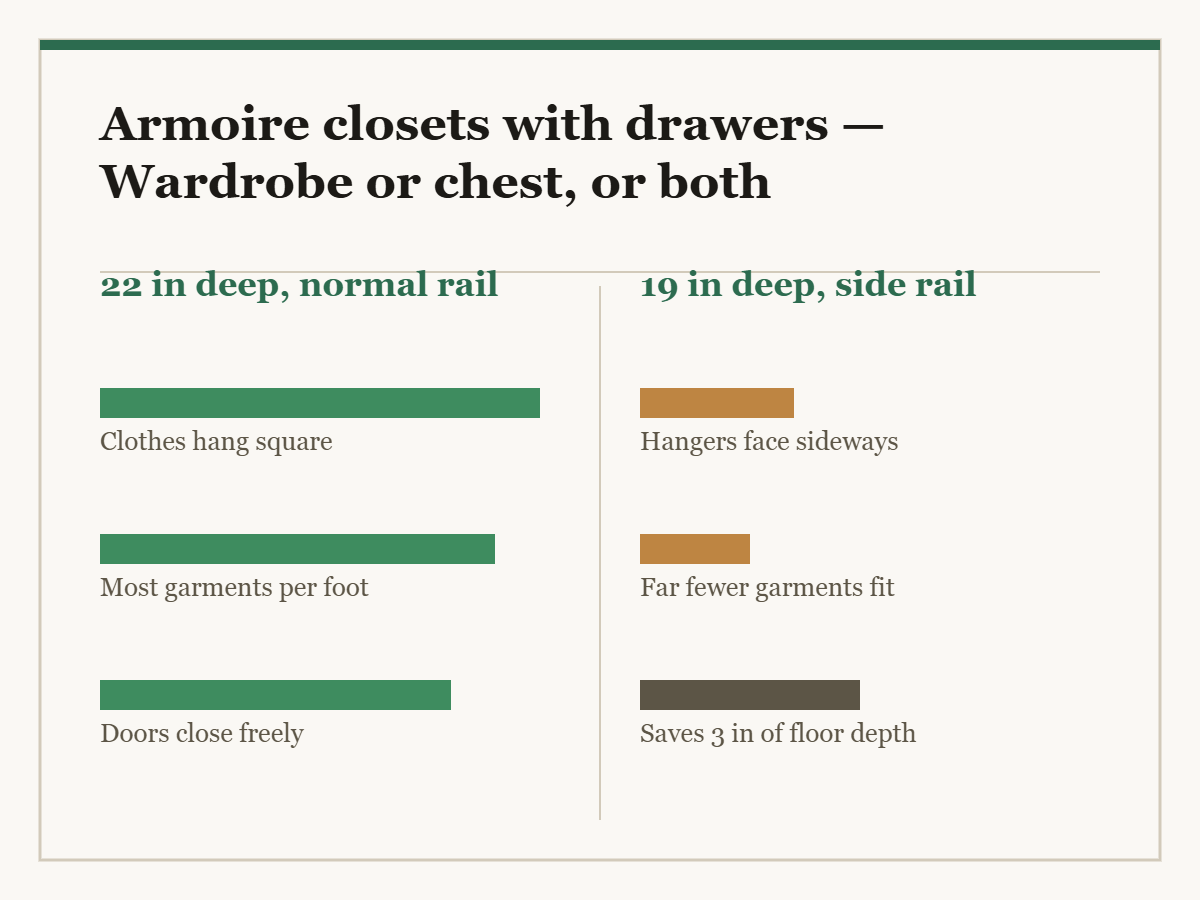
A coat hanger is about 17 inches across, and a jacket’s shoulders add to that. Hung square to the back, clothes need 21 to 24 inches of internal depth before the doors close without pressing.
Many armoires are 19 or 20 inches deep externally, giving 17 or 18 inside. Those are designed for a pull-out side rail — a short bar running front to back, holding hangers sideways. It works, and it holds far fewer garments per foot of width, so a 40-inch cabinet with side rails is not equivalent to a 40-inch cabinet with a full rail.
If depth is not stated internally, external minus about 2 inches is a fair estimate.
The rail, and the sag nobody mentions
A rail spanning 36 inches, loaded with winter coats, deflects. Over 44 inches it deflects visibly.
Look for a centre support — a small bracket from the rail up to the cabinet roof — on anything wider than 36 inches, or a rail in steel rather than aluminium. Neither costs anything and their absence is the thing you notice in year two.
The rail ends land in the cabinet sides, so those sides want material that holds a screw. This is the same argument as everywhere else in casework, and the terms are in what engineered wood actually is and what “all wood” actually means.
Tipping, and why this one matters
Tall, narrow, drawers heaviest at the bottom, doors that swing wide. Open both doors and pull a loaded drawer and the weight moves forward over a base perhaps 20 inches deep.
Anchor it to a stud on assembly day. The strap and the method are the same as for a chest of drawers — anti-tip kits for dressers — and the geometry argument is in tall chests of drawers.
Level it before loading. A cabinet this tall turns a dip in the floor into doors that swing open on their own, and levelling feet and glides fix it in minutes.
Where the names differ
Armoire, wardrobe, chifferobe and closet cabinet all describe overlapping things, and the distinctions matter when you are comparing listings — a chifferobe in particular is exactly this hybrid of hanging space and drawers.
The definitions are in armoire against wardrobe, chifferobe against armoire and armoire against dresser.
Before you load it
- Anti-tip strap Tall, narrow, and heaviest at the bottom drawers
- Closet rod centre support A rail over 36 inches sags under winter coats
- Second hanging rail Turns one 68-inch bay into two 40-inch bays
- Cedar blocks A closed cabinet carries more moth risk than an open rail
What to buy



For the larger, furniture-grade version of the same piece, see armoires with drawers. If drawers are what you actually need, tall chests of drawers and solid wood dressers. Hardware is in brass dresser hardware.
Questions we get asked
How much hanging space is left after the drawers?
Usually 34 to 50 inches of clear rail. That takes shirts, jackets and folded trousers, and not coats or dresses.
What is double-hang and is it worth it?
Two rails one above the other at about 40 inches each. It roughly doubles the capacity of that bay and costs nothing but a second rail.
How deep does an armoire closet need to be?
At least 21 inches inside for a normal rail. Shallower cabinets use a side rail that holds hangers sideways and fits far fewer clothes.
Will the rail sag?
Over about 36 inches of span, under coats, yes. Look for a centre support bracket or a steel rail.
Does it have to be anchored?
Yes. Both doors open plus a loaded bottom drawer puts the weight forward over a base only about 20 inches deep.
Is this the same as a chifferobe?
Very nearly. A chifferobe is specifically the hybrid of a hanging section and a bank of drawers, which is what this is.