Nightstand vs side table — Height is the difference
The Wooden Stars is a participant in the Amazon Services LLC Associates Program. We may earn a commission when you buy through links on our site, at no extra cost to you.
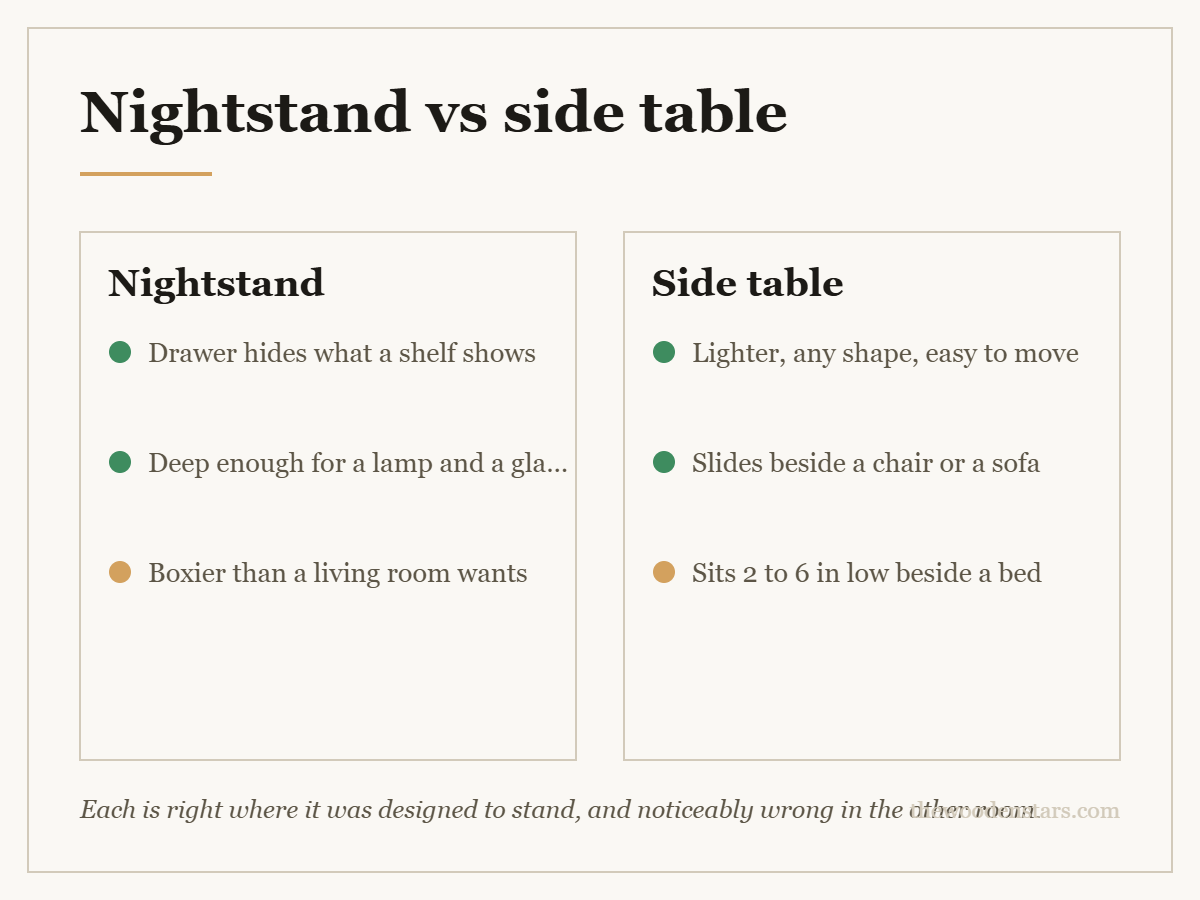
Nightstand vs side table is mostly a height question. A nightstand is built to match a mattress; a side table is built to match a sofa arm. Those are six inches apart, and the gap is why one looks wrong in the other’s room.
The rest — drawers, depth, what goes on top — follows from where each one stands.
A nightstand stands 24 to 28 inches tall, to sit level with the top of a mattress, and is 16 to 20 inches deep with at least one drawer. A side table stands 22 to 26 inches — level with or just below a sofa arm — and is usually shallower, often open or with a shelf rather than a drawer. Use a side table beside a bed and it will sit 2 to 6 inches low, which is the difference between reaching for a glass and groping for it. The other real difference: a nightstand hides things, a side table displays them.
Nightstand vs side table: the height rule for each
A nightstand is measured from the mattress. The top should be level with the top of the mattress, give or take an inch. That is what puts a glass, a book and a phone where your hand falls when you are lying down.
Mattress-top height varies enormously — a platform bed with a 10-inch mattress gives about 24 inches, a frame with a box spring and a thick mattress gives 32. So the “standard” 24 to 28 inches is only a starting point; the real number comes from your own bed. The full method is in nightstand height.
A side table is measured from the sofa arm. Level with the arm, or up to 2 inches below. Sofa arms run 22 to 26 inches, which is where the side table’s range comes from.
Both rules exist for the same reason: you put things down without looking.
| Measure | Nightstand | Side table |
|---|---|---|
| Height | 24 to 28 in | 22 to 26 in |
| Measured from | Top of the mattress | Sofa arm |
| Depth | 16 to 20 in | 14 to 20 in |
| Storage | Drawer, often a cupboard | Shelf, sometimes a drawer |
| Top holds | Lamp, glass, book, phone | Lamp, drink, remote |
| Cable route | Needed, for charging | Rarely |
| Sold as | A pair | Singly |
What a nightstand has that a side table usually does not
A drawer. Bedside clutter is private clutter — medication, glasses, chargers, whatever else. A side table’s open shelf displays all of it.
Depth for a lamp. Sixteen to 20 inches takes a lamp base and still leaves room for a glass in front of it. A 14-inch side table takes the lamp and nothing else.
A cable route. The better nightstands have a notch or grommet at the back, because a phone charges there every night. Very few side tables do — though a desk grommet can be fitted in ten minutes.
A pair. Nightstands are designed and sold in twos, which matters if the bed has two sides.
What a side table has that a nightstand does not
Lightness. A side table is meant to be moved — pulled towards a chair, pushed against a wall. Many are open-framed or on a pedestal precisely so they read as light in a room that is already full of upholstery.
Shape freedom. Round, oval, triangular — a side table has no requirement to sit flush against a headboard, so it can be any shape. A round side table in a walkway is the same argument as a round coffee table.
A C-shape option. Tables whose base slides under the sofa put the top over your lap. Nothing equivalent exists for a bed.
Can you use one as the other?
A side table beside a bed: often yes, if the height works out. Measure your mattress top first. If the table comes out 2 inches low it is fine; 4 to 6 low and you will feel it every night, because you reach down rather than across.
Where this works well is with a low platform bed, which brings the mattress top to 22 to 24 inches — exactly side-table height. It works badly with a tall frame and a thick mattress.
A nightstand beside a sofa: usually no. It stands proud of the arm, and its closed box reads heavy next to upholstery. The exception is a nightstand used as an end table against a wall, where it becomes a small chest.
A related and equally common substitution is putting a small chest of drawers beside the bed instead — see chest of drawers against dresser.
What to check before buying either
- Measure the thing it sits beside — mattress top or sofa arm — before looking at any listing.
- Top area. A lamp base is 6 to 10 inches across. Add a glass, a book and a phone and you want at least 14 × 14 inches of top.
- Drawer runners. A bedside drawer is opened in the dark, half asleep, at an angle. Full-extension runners or waxed wooden ones, not stapled channels.
- Weight and feel. A light open-frame table gets dragged when you pull the drawer; felt glides fix it — levelling feet and glides.
- Material. Water rings happen on both. What the top is made of decides whether they come out — removing water rings and the best finish for a solid wood top.
For either table
- Desk grommet Adds the charging cable route a side table never has
- Felt floor glides A light table gets dragged every time you open the drawer
- Paste wax What frees a wooden drawer runner opened half asleep
- Clip-on bed light The answer when the top is too small for a lamp
What to buy


For bedside pieces, see nightstand height and round bedside tables with storage. For living room tables, coffee table dimensions and round against rectangular coffee tables. For the hallway version, console table against sofa table.
Questions we get asked
What is the difference between a nightstand and a side table?
Height and storage. A nightstand is 24 to 28 inches to match a mattress and has a drawer; a side table is 22 to 26 to match a sofa arm and usually has a shelf.
Can I use a side table as a nightstand?
If the height works. Measure your mattress top — 2 inches low is fine, 4 to 6 low means reaching down every night.
How tall should a nightstand be?
Level with the top of your mattress, give or take an inch. That depends on your bed, not on a standard.
How big should the top be?
At least 14 × 14 inches if a lamp goes on it, since a lamp base is 6 to 10 inches across on its own.
Do nightstands have to match the bed?
They have to match the mattress height. Matching the timber is a preference, and a deliberate contrast usually reads better than a near miss.
Why does a nightstand look wrong beside a sofa?
It stands proud of the arm and its closed box reads heavy against upholstery. A side table is designed to look light.