Pottery Barn nightstand alternatives — Cayman and the rest
The Wooden Stars is a participant in the Amazon Services LLC Associates Program. We may earn a commission when you buy through links on our site, at no extra cost to you.

A nightstand is a small piece of furniture with a big price range, and the gap between a $150 one and a $600 one is mostly invisible in a photograph. Both have a top, two drawers and four legs.
What separates them is drawer construction, hardware and proportions — and of those three, only one is genuinely hard to buy cheaply.
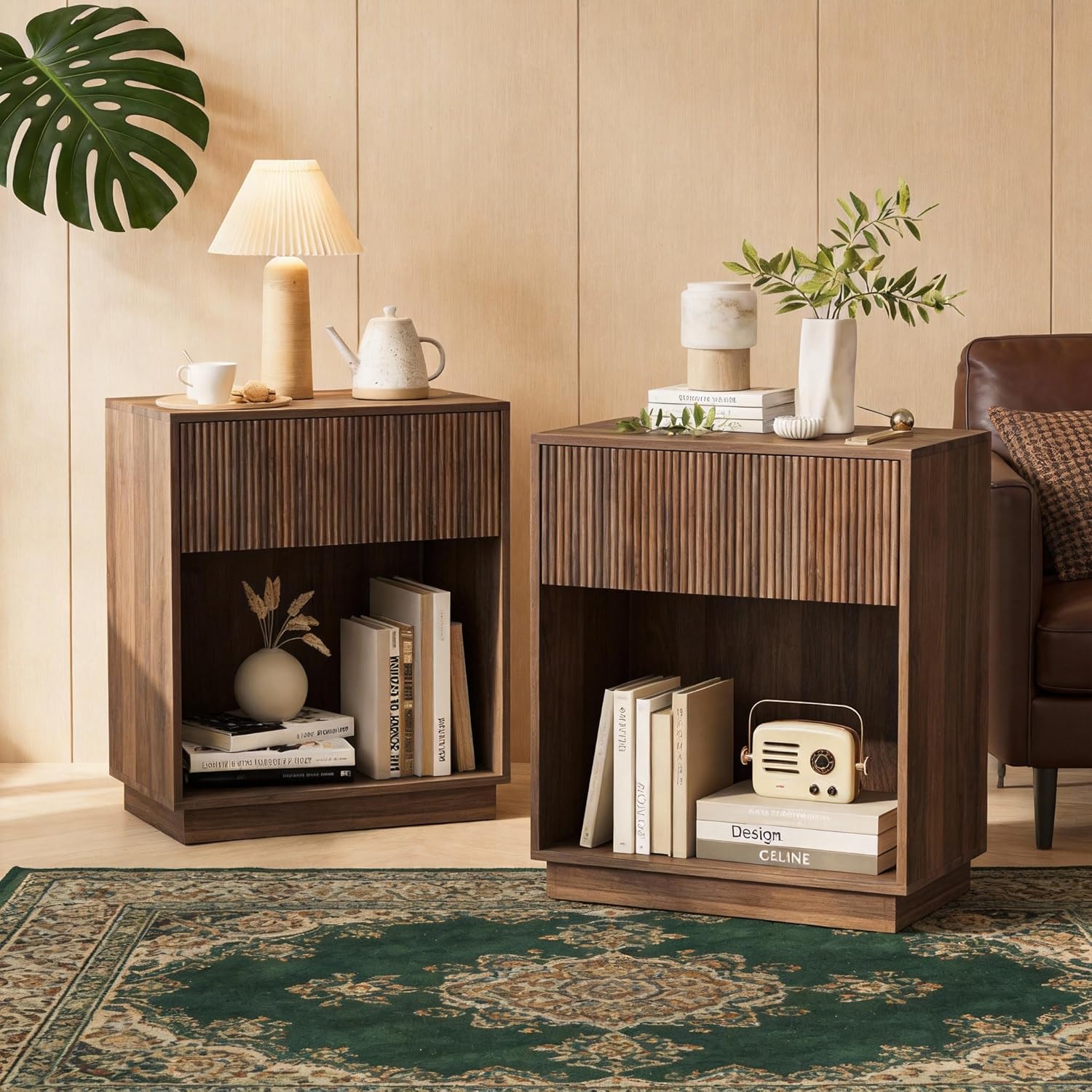
The look is: two drawers (sometimes one plus an open shelf), a warm stained finish over visible grain, turned or tapered legs raising the case off the floor, and substantial metal hardware. Sizes cluster at 18 to 26 inches wide, 16 to 18 deep, 24 to 28 tall. Cheaper versions match all of that. What they usually give up is dovetailed solid drawer boxes, full-extension soft-close slides, and a solid timber top. Height is the thing to get right regardless of brand — the top should sit level with your mattress.
Get the height right first
This matters more than anything on this page, and it is brand-independent.
Measure from the floor to the top of your made mattress. Buy a nightstand within two inches of that number, erring high rather than low. Most are made at 24 to 28 inches, which suits a bed whose mattress top sits at 22 to 26.
A beautifully made nightstand six inches too short is worse than a plain one at the right height, because you reach down for everything in the dark. The full reasoning is in nightstand height.
The look, element by element
| Element | Typical | Easy to match? |
|---|---|---|
| Width | 18 to 26 in | Yes |
| Depth | 16 to 18 in | Yes |
| Height | 24 to 28 in | Yes |
| Drawers | Two, or one plus a shelf | Yes |
| Legs | Turned or tapered, case raised | Yes |
| Finish | Warm mid-brown, grain visible | Yes, on real timber |
| Hardware | Cast metal knobs or cup pulls | Yes, and swappable |
| Drawer boxes | Dovetailed solid timber | No, this is where price shows |
Seven of eight rows are easy. The eighth is the one to inspect.
Why drawer construction matters on something this small
It is tempting to think a nightstand drawer holds so little that construction hardly matters. In practice a bedside drawer gets opened and closed more often than any other drawer in the house — several times a day, often one-handed, often in the dark and at an angle.
That is exactly the loading that racks a weak drawer box. Three things to look for:
Dovetails at the front corners, visible as soon as you open the drawer. They resist the pull directly rather than relying on glue.
A bottom captured in a groove on all four sides, not a thin sheet pinned underneath.
Runners that bolt into something solid. On a narrow case, the runner screws sit close to the edge of the panel, which is where particleboard is weakest.
The full version of this checklist is in wood dressers, and it applies at every size.
Hardware is the cheapest win
More than on any larger piece, because a nightstand has only one or two pulls and they sit at eye level when you are in bed.
Swapping thin stamped knobs for cast metal ones in aged brass or oil-rubbed bronze costs very little and changes the character of the piece completely. Check the existing hole spacing first — most pulls are 3 or 3.75 inches centre to centre, and knobs are a single hole so they fit anything.
Options are in dresser knobs and brass dresser hardware.
The top, and what it has to survive
A nightstand top takes water from a glass, heat from a lamp, and whatever a phone charger drips on it. It is a small surface with a hard life.
Solid timber can be sanded and refinished repeatedly, which on a piece you keep for twenty years is the property that matters.
Veneer over a stable core stays flatter and looks identical, and can be refinished once or twice. Perfectly reasonable on something this size.
Printed foil cannot be repaired at all, and a water ring is permanent. This is the one to avoid on the top specifically, even if the rest of the case is panel — the distinctions are in what engineered wood actually is.
Buying a pair
Two nightstands either side of a bed is the usual arrangement, and there are two things to know.
Buy them together. Stains shift between production batches, and two of the same model bought six months apart can differ visibly.
Check the total width against the wall. Bed plus two nightstands plus clearance: a queen at 60 inches with two 22-inch stands and two inches of gap each side needs about 108 inches of wall. In a narrow room, one nightstand and a wall-mounted shelf on the other side is a better plan than two cramped ones.
For tight bedrooms, the options are in small dressers for a small bedroom.
Charging built in
Common now, and genuinely useful — it removes the cable running across the floor and up the back.
Two checks: the outlet should be on the back or side rather than the top, where a spilled glass would find it, and the lead to the wall needs to be long enough to reach a socket that may be behind the bed.
Closing the gap
- Cast metal knobs The highest-leverage change on a small piece at eye level
- Felt pads Under the legs; nightstands get nudged constantly
- Drawer liners Keeps the drawer bottom clean and quiets small items
- Cable clips Keeps lamp and charger leads off the floor behind the bed
What to buy



Get the height right first: nightstand height. For drawer construction, wood dressers. For the matching chest, Pottery Barn dresser alternatives, and for a tight bedroom, small dressers for a small bedroom.
Questions we get asked
What size should a nightstand be?
Eighteen to 26 inches wide, 16 to 18 deep, and level with the top of your mattress — usually 24 to 28 inches tall.
What is the cheapest way to upgrade a plain nightstand?
New hardware. On a piece this small the pulls are at eye level from the bed and they change the character completely.
How do I tell if the drawer is well made?
Open it. Dovetails at the front corners and a bottom sitting in a groove are visible immediately.
Should I buy two nightstands at once?
Yes. Stains shift between production batches, so two bought months apart may not match.
Is a veneered nightstand top acceptable?
Yes, and it stays flatter than solid. Avoid printed foil on the top specifically, because water rings are permanent.
How much wall do a bed and two nightstands need?
About 108 inches for a queen with two 22-inch stands. In a narrower room, use one stand and a wall shelf on the other side.