Walnut dressers — Solid walnut, walnut veneer and walnut finish
The Wooden Stars is a participant in the Amazon Services LLC Associates Program. We may earn a commission when you buy through links on our site, at no extra cost to you.

“Walnut dresser” is three different products sold under one phrase, at three different prices, and the listing photographs are nearly identical. Only one of them contains American black walnut in any meaningful quantity.
None of the three is a scam. They are all reasonable things to buy. But they age in completely different ways, and knowing which one is in front of you takes about thirty seconds once you know what to read.
Three meanings. Solid walnut: boards of the real timber, heavy and expensive; can be sanded and refinished indefinitely. Walnut veneer: a thin layer of real walnut over plywood or MDF — a genuine walnut surface, correct engineering for wide flat panels, refinishable once or twice. Walnut finish: a stain or a printed foil on pale timber or particleboard, with no walnut in it at all; scuffs reveal the pale material underneath. The word that separates them is the one immediately before or after “walnut”: solid, veneer, or finish.
The three, side by side
| Phrase | Walnut content | Deep scratch | Typical weight, 60 in 6-drawer |
|---|---|---|---|
| Solid walnut | Throughout | Sands out | 180 to 250 lb |
| Walnut veneer | A face layer | Permanent | 110 to 160 lb |
| Walnut finish | None | Reveals pale material | 80 to 120 lb |
The weight column is the most useful test in the whole article, because shipping weight is almost always stated. Real timber is heavy. A 60-inch six-drawer dresser at 95 pounds is not solid walnut, whatever the title says.
What actual walnut is
American black walnut is a mid-brown timber with a grey-purple undertone, straight-grained with occasional gentle figure. It is dense enough to hold a fixing indefinitely, unusually stable for a hardwood, and pleasant to work — which is why American furniture makers reached for it throughout the twentieth century.
One property surprises people: walnut lightens with age under UV, rather than darkening. Most timbers go the other way. A walnut dresser under a window will fade toward a warmer, paler brown over years, and anything left sitting on top will leave a permanent outline.
It is also expensive, and always has been. A dresser is a large piece of furniture, so a genuinely solid walnut one is a premium purchase rather than a mid-market default. If the price does not reflect that, the walnut is somewhere other than the whole case.
Walnut veneer is not a downgrade
Worth saying clearly, because “veneer” reads as a cheat and on a dresser it usually is not.
A veneer is a thin layer of real walnut — often under a millimetre — bonded to a plywood or MDF core. The surface is genuine timber with genuine figure. And on a wide flat panel, a drawer front or a dresser top, veneer over a stable core is better engineering than solid: the core does not move with humidity, so the panel stays dead flat instead of cupping or splitting.
The trade is repairability. A deep scratch goes through to the core and cannot be sanded out, and you get one careful refinish, maybe two. Solid timber can be refinished as often as its thickness allows.
Good furniture has been veneered for centuries. What matters is whether the rest of the dresser is built properly — the detail is in what engineered wood actually is.
“Walnut finish” — the one to understand
This is stain or printed foil on something else. The “something else” is usually rubberwood, pine, ash or particleboard.
It is not dishonest, and a stained rubberwood dresser can be a perfectly sound piece of furniture at a fair price. But three things follow:
- Edges reveal it. A knocked corner or a scuffed drawer edge shows pale material through the colour. Touch-up markers help; they do not fix it.
- It cannot be refinished. Sanding removes the colour, and the timber underneath is a different species entirely.
- The colour is uniform. Real walnut varies board to board. A dresser where every panel is exactly the same tone with no figure variation is telling you something.
Reading a listing in thirty seconds
- Find the word next to “walnut”. “Solid walnut” is a claim. “Walnut veneer” is a claim. “Walnut finish”, “walnut colour”, “walnut-toned” are colours.
- Check the weight against the size. Use the table above. This catches almost everything.
- Look for a second species named. “Walnut finish on solid rubberwood” is an honest and informative description — and a reasonable thing to buy.
- Look at the figure across panels. Real walnut varies. Identical grain on every drawer front means a printed surface or a very consistent veneer.
- Find the edge. On solid timber the grain continues around it; on veneer and panel there is a banding strip.
The wider vocabulary problem is unpacked in what “all wood” actually means.
None of this is the main question
A solid walnut dresser with stapled drawer boxes and plastic centre-rail runners is a worse dresser than a walnut-veneered one with dovetailed drawer boxes and full-extension steel slides.
Species tells you about colour, price and repairability. Joinery tells you whether the thing works in ten years. So use the walnut tests to know what you are buying, then apply the real checks: drawer joints, drawer bottoms captured in a groove, runner type, and solid material where the runners bolt to the case. Those are in wood dressers.
Living with walnut, whichever kind
Keep it out of direct sun, because walnut fades and the fade line under an object is permanent. Dust dry rather than wet. If it is oiled, a light refresh with hardwax oil every couple of years evens out the colour and re-seals the surface; if it is lacquered, leave it alone and use coasters.
And anchor it to the wall, into a stud, on the day it is assembled — that applies to every dresser regardless of what it is made of, and doubly to the tall ones.
For a walnut dresser
- Furniture anti-tip kit Required on every dresser, into a stud, on assembly day
- Hardwax oil For an oiled walnut surface; evens the colour as well as sealing it
- Touch-up markers For stained finishes, where scuffed edges show pale material
- Microfibre cloths Dust dry; avoid abrasive pads near veneer edges
What to buy

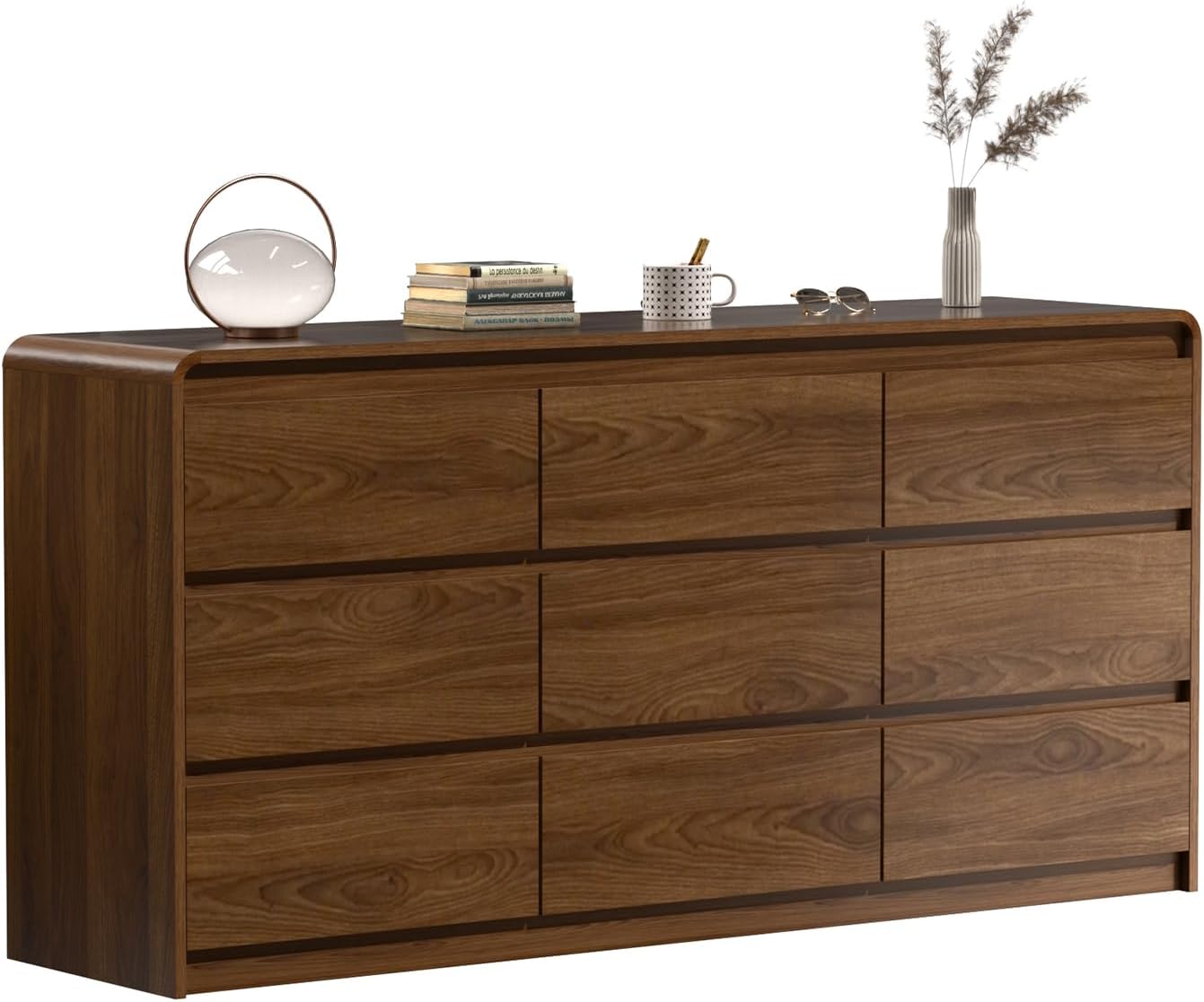
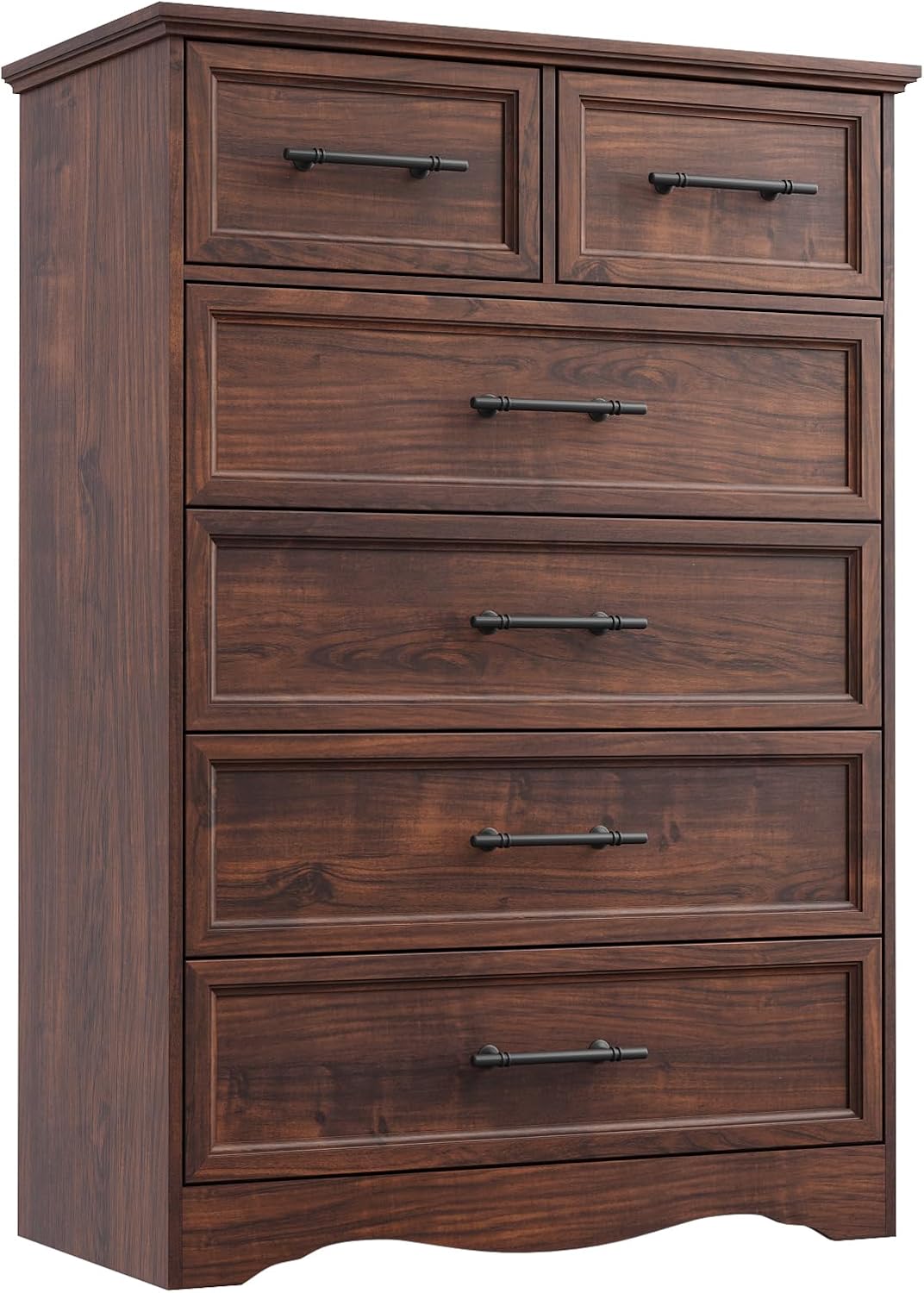

For the construction checks that matter more than species, see wood dressers and solid wood dressers. For the height question, tall wood dressers, and for the same walnut confusion in bed frames, midcentury bed frame woods.
Questions we get asked
What does “walnut finish” mean?
A stain or printed foil in a walnut colour, applied to a different timber or to particleboard. There is no walnut in it.
Is a walnut veneer dresser real wood?
Yes — the surface is genuine walnut. It is bonded to a stable core, which keeps wide panels flat, but it can only be refinished once or twice.
How can I tell if a dresser is solid walnut?
Check the word next to “walnut”, compare the shipping weight with the size, and look at whether the grain varies between panels.
Does walnut furniture get darker over time?
It lightens under UV, unlike most timbers. Anything left on top of a walnut surface in the sun will leave a permanent outline.
Is solid walnut worth the extra?
For repairability over decades, yes. For appearance and flatness, a good veneer is equal or better. Joinery matters more than either.
Can you refinish a walnut veneer dresser?
Once, maybe twice, very lightly. The veneer is often under a millimetre thick and sanding through it is unrepairable.