Round bedside tables with storage — Less surface, same drawer
The Wooden Stars is a participant in the Amazon Services LLC Associates Program. We may earn a commission when you buy through links on our site, at no extra cost to you.
A round bedside table trades surface area for the thing a bedroom actually needs at three in the morning: no corners. In a narrow gap between a bed and a wall, that is worth more than the couple of inches of top you give up.
Adding storage to a round table is harder than it sounds, though, and the ways manufacturers solve it are not equal.
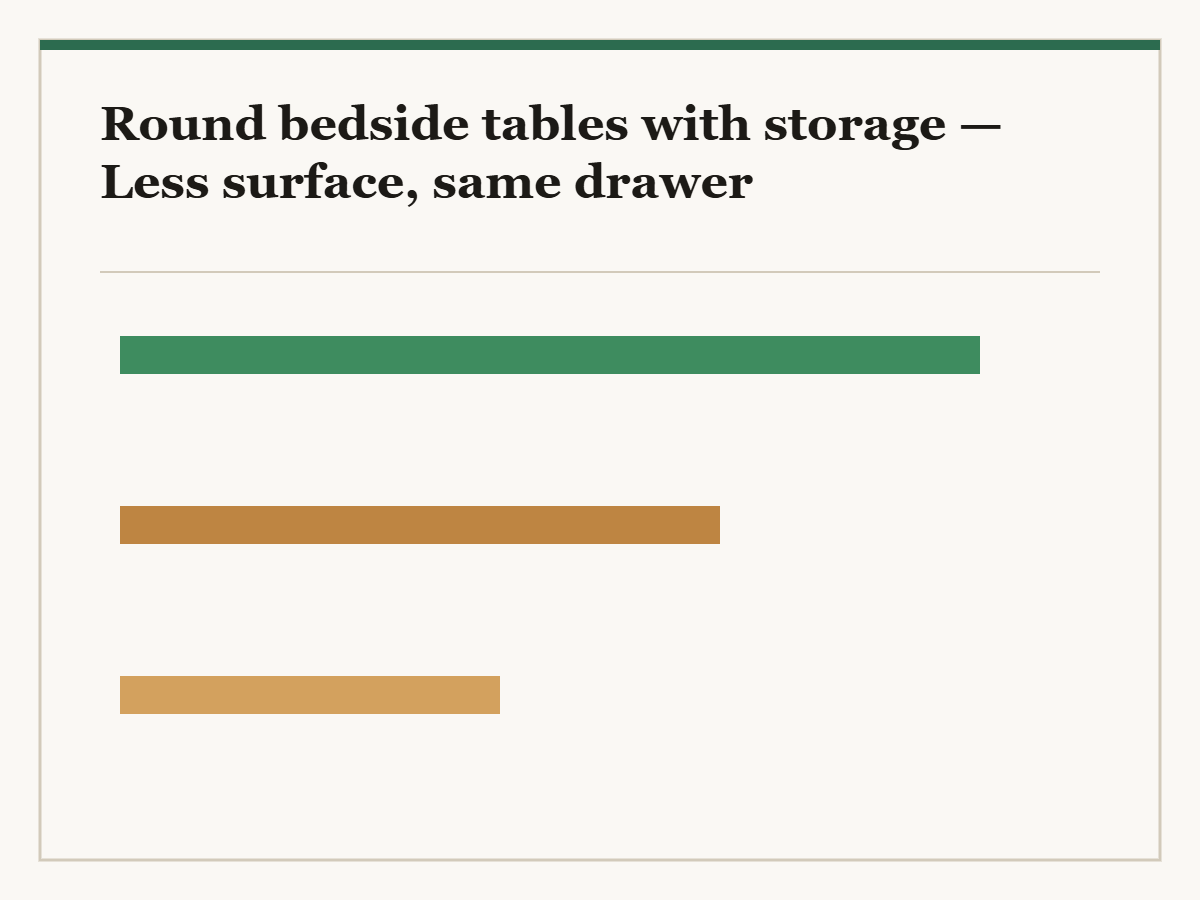
A round bedside table is usually 16 to 20 inches across, against 18 to 24 for a rectangular one — so you lose roughly a third of the surface for the same footprint width. Height should be within 2 inches of the mattress top, which for most beds means 24 to 28 inches. Storage comes three ways: a curved drawer (the most useful, and the most expensive to make), a lower shelf (cheapest, contents on show), or a cylindrical cabinet with a door (most volume, awkward to reach into). A drawer in a 18-inch round table is about 12 inches wide and 10 deep — a book, a charger and a pair of glasses.
Why round, and what it costs
The case for round is specific and practical. A bedside table sits in a walkway beside a bed, at exactly hip height, in a room people cross in the dark. A corner at that height is the most reliably painful piece of furniture in a house.
The cost is surface. A 20-inch round top is about 314 square inches; a 20 × 16 rectangle is 320 — close. But against a 24 × 18 rectangle at 432, the round table gives up more than a quarter.
It also loses the corners specifically, which is where a lamp base wants to sit without being in the middle of everything.
The three ways round tables get storage
A curved drawer
A drawer with a front cut to the curve of the table. It is the version that looks right and the most expensive to make, because the front is a shaped piece and the box behind it is a normal rectangle inside a round carcase.
Usable size in an 18-inch table is roughly 12 inches wide and 10 front to back, 3 to 5 inches deep. A book, a charger, glasses, a tube of hand cream.
Check the runners: a short drawer in a round carcase has less side support than usual, so side-mounted runners matter more here than on a wide drawer.
A lower shelf
An open round shelf below the top. Cheapest, holds the most by area, and everything on it is visible from the bed. Fine for books and a box of tissues, less good for anything you would rather not look at.
A cylindrical cabinet
The whole body is a drum with a door. Most volume of the three — 1.5 to 3 cubic feet — and the most awkward, because a curved door on a curved body opens into the walkway and you reach into a round hole.
| Measure | Range | Note |
|---|---|---|
| Diameter | 16 to 20 in | Under 16 holds a lamp and nothing else |
| Height | 24 to 28 in | Within 2 in of the mattress top |
| Drawer width | 10 to 14 in | Limited by the curve |
| Drawer inside depth | 3 to 5 in | A book, a charger, glasses |
| Shelf clear height | 8 to 12 in | Paperbacks stand up at 8 |
| Cabinet volume | 1.5 to 3 cu ft | Awkward to reach into |
Height, measured against the mattress
The rule is simple and often ignored: the top of the bedside table should sit within 2 inches of the top of the mattress, ideally level or very slightly below.
Too low and you reach down and grope for a glass. Too high and the table is in your eyeline when lying down, and the lamp shines into it.
The complication is that mattress heights vary enormously. A platform bed with a 10-inch mattress puts the top at 22 inches; a storage frame with a 14-inch mattress puts it at 32. So measure your own bed rather than assuming — the full reasoning is in how tall a nightstand should be.
If your bed is a storage frame, the height gap is the thing to check first, because storage decks sit 4 to 6 inches higher than plain ones — see bed frames with drawers underneath.
Stability, which the shape affects
A round table on a pedestal base has a smaller contact patch with the floor than a four-legged one, and it carries a lamp whose cable somebody will eventually catch with a foot.
Two things to check:
- The base diameter relative to the top. A pedestal base should be at least two-thirds the top diameter, or the table tips when you lean on one edge.
- Whether the drawer projects past the base. Pull a drawer out of a pedestal table and the weight goes beyond the foot. A table that is fine closed can rock open.
On an uneven bedroom floor a three-legged base actually beats four, because three points always sit flat. If the table you want has four, levelling feet and glides fix it in minutes.
Cables, the small detail that decides daily use
A bedside table now has to charge a phone. A table with no cable route means the cable comes over the top edge every night, which is the sort of small friction that makes people stop using the drawer.
Look for a notch at the back of the drawer or the lower shelf. It is rare on round tables specifically, because the curved back is harder to notch neatly, and it is easy to add — a small grommet fits, and the sizes are in desk grommets.
What it is made of
A round top is either turned from a glued-up panel or cut from a board, and both are shapes where seasonal movement shows.
Solid timber moves across the grain. A round top fixed rigidly to a base can crack, which is the same mechanism as in when a dining table top cracks at the seams, at a smaller scale. Buttons or slotted fixings rather than rigid screws are what prevent it.
Veneer on a stable core is well suited to round tops, because it does not move and the edge can be banded cleanly.
Laminate over particleboard struggles on a curve: the edge band on a continuous circle is one long unbroken piece with nowhere to hide a joint, and it is the first thing to lift. Definitions are in solid wood against engineered wood against veneer and what engineered wood actually is.
Small improvements
- Levelling feet A pedestal base on an uneven bedroom floor rocks when you lean on it
- Cable grommet Adds the charger route most round tables do not have
- Drawer liner A short drawer in a round carcase lets things slide to the back
- Felt pads A bedside table gets nudged every time the bed is made
What to buy


For the height rule first, see how tall a nightstand should be. If the storage would be better at the head of the bed, queen bed frames with a storage headboard. For a small bedroom generally, small dressers for a small bedroom. Hardware is in dresser knobs.
Questions we get asked
How big should a round bedside table be?
Sixteen to 20 inches across. Under 16 holds a lamp and nothing else.
How tall should it be?
Within 2 inches of the top of your mattress — usually 24 to 28, but measure your own bed, especially if it is a storage frame.
How much does a curved drawer hold?
In an 18-inch table, about 12 inches wide by 10 deep and 3 to 5 inches inside. A book, a charger and glasses.
Is a round table less useful than a rectangular one?
It gives up roughly a quarter to a third of the surface, and the corners specifically. In a walkway beside a bed, most people find that a fair trade.
Will a pedestal base tip?
Not if the base is at least two-thirds the top diameter. Check whether the drawer projects past the foot, because that is when it can rock.
Why do round tops crack?
Solid timber moves across the grain. A round top screwed rigidly to its base has nowhere to go — buttons or slotted fixings prevent it.