“All wood” dresser — What that phrase legally allows
The Wooden Stars is a participant in the Amazon Services LLC Associates Program. We may earn a commission when you buy through links on our site, at no extra cost to you.

“All wood.” “Real wood.” “Wood composite.” “Engineered wood.” “Manufactured wood.” Five phrases that appear on furniture listings, and only one of them means what most shoppers assume.
None of them are lies. They are technically accurate descriptions that happen to be uninformative, and the gap between what they say and what people hear is where the disappointment lives.
“Solid wood” is the only phrase that means boards of timber. “All wood” and “real wood” are true of particleboard and MDF too, because both are made from wood fibres — they distinguish the piece from metal or plastic, nothing more. “Wood composite”, “engineered wood” and “manufactured wood” all mean a board made from wood particles or fibres and glue. “Wood finish” or “oak finish” means a printed surface with no timber in it at all. The phrase to look for is “solid” attached to a named component.
The phrases, decoded
| Phrase | What it guarantees | What it allows |
|---|---|---|
| Solid wood | Boards of timber | Stave lamination, finger joints |
| All wood | Made of wood material | Particleboard, MDF, plywood |
| Real wood | Contains wood | A veneer over anything |
| Wood composite | Wood particles and glue | Particleboard or MDF |
| Engineered wood | A manufactured panel | Plywood, MDF, particleboard, OSB |
| Manufactured wood | Same as above | Same as above |
| Wood veneer | A thin timber face | Any core underneath |
| Wood finish | Nothing about the material | A printed foil, no timber |
Read the right-hand column. “All wood” and “real wood” permit a dresser made entirely of particleboard, and the claim is still true — particleboard is wood, chipped and glued.
Why “all wood” is not a lie
Particleboard is made from wood chips. MDF is made from wood fibres. Plywood is thin layers of actual timber. All three are wood in the sense that the word ordinarily means: they came out of a tree.
What they are not is solid timber — boards sawn from a log and used as boards. And that is the distinction buyers are actually asking about, because it determines two things nothing else does: whether a fixing holds under repeated load, and whether damage can be repaired.
So the phrase is honest and useless simultaneously. The industry knows this, which is why makers who use solid timber write “solid”.
The phrase to look for, and where
“Solid” attached to a named component. Not “solid wood dresser”, which can quietly mean solid legs, but:
- “Solid wood drawer boxes” — the joints that carry the pull of a loaded drawer.
- “Solid wood case sides” — where the drawer runners bolt in.
- “Solid wood top” — refinishable, and it takes the knocks.
Those three, named, tell you the dresser is built properly. A listing that says “solid wood” once, with no component attached, is a headline rather than a specification. Where solid matters and where it does not is set out in solid wood dressers.
The panel family, ranked
Not all engineered panel is equivalent, and treating it as one category is the other common mistake.
Plywood
Thin veneers glued with alternating grain. Holds a screw as well as solid timber, does not move seasonally, and is stronger per pound than either particleboard or solid wood in many directions. Genuinely excellent material, and used by the best furniture makers for exactly that reason.
MDF
Fine wood fibres and resin, pressed. Perfectly flat, machines to a crisp edge, and takes paint better than anything. It holds a screw moderately well in the face and poorly in the edge, and it is heavy. Correct for painted panels and flat fronts.
Particleboard (chipboard)
Coarser chips and resin. Cheapest, lightest, and the weakest at holding a fixing — which is the property that matters on a dresser. Fine for a back panel or a dust panel; problematic where a runner bolts on.
The full technical comparison is in what engineered wood actually is.
Veneer is not a downgrade
A separate confusion worth clearing. “Veneer” means a thin layer of real timber bonded to a core, and it has been used on the best furniture for centuries.
On a wide flat surface — a dresser top, a drawer front — veneer over a stable core is better engineering than solid timber, because a wide solid panel shrinks and swells across the grain and can cup or split. The core does not move; the surface is still real wood.
The limitation is repairs. A veneer is often under a millimetre thick, so a deep scratch goes through and cannot be sanded out. Solid timber can be refinished as many times as its thickness allows.
So: veneer for flatness, solid for repairability. Neither is a cheat, and a listing that says “walnut veneer over plywood” is being more informative than one that says “all wood”.
Three tests that beat any phrase
- Weight. Solid timber is heavy. A 60-inch six-drawer dresser in solid wood is 150 to 250 lb; the same in particleboard is 80 to 120. Shipping weight is nearly always listed.
- The edge. On solid timber the grain continues around the edge and the figure matches the face. On veneer or panel there is a separate banding strip.
- An open-drawer photograph. Dovetails on the drawer side are visible instantly. If no photo shows an open drawer, that was a decision.
What to do with all this
Stop using the material phrase as a quality signal, and use it as a description of where the load can go. Then judge the dresser on its joinery: drawer boxes, drawer bottoms in a groove, runner type, and what the case sides are made of where the runners mount. Those checks are in wood dressers, and they matter more than any word in the title.
Useful either way
- Furniture anti-tip kit Required on every dresser, solid or panel, into a stud
- Touch-up markers Veneer and foil edges are where damage shows first
- Drawer liners Keeps clothing off a raw panel bottom
- Threadlocker Panel cases loosen at bolted joints sooner than solid ones
What to buy

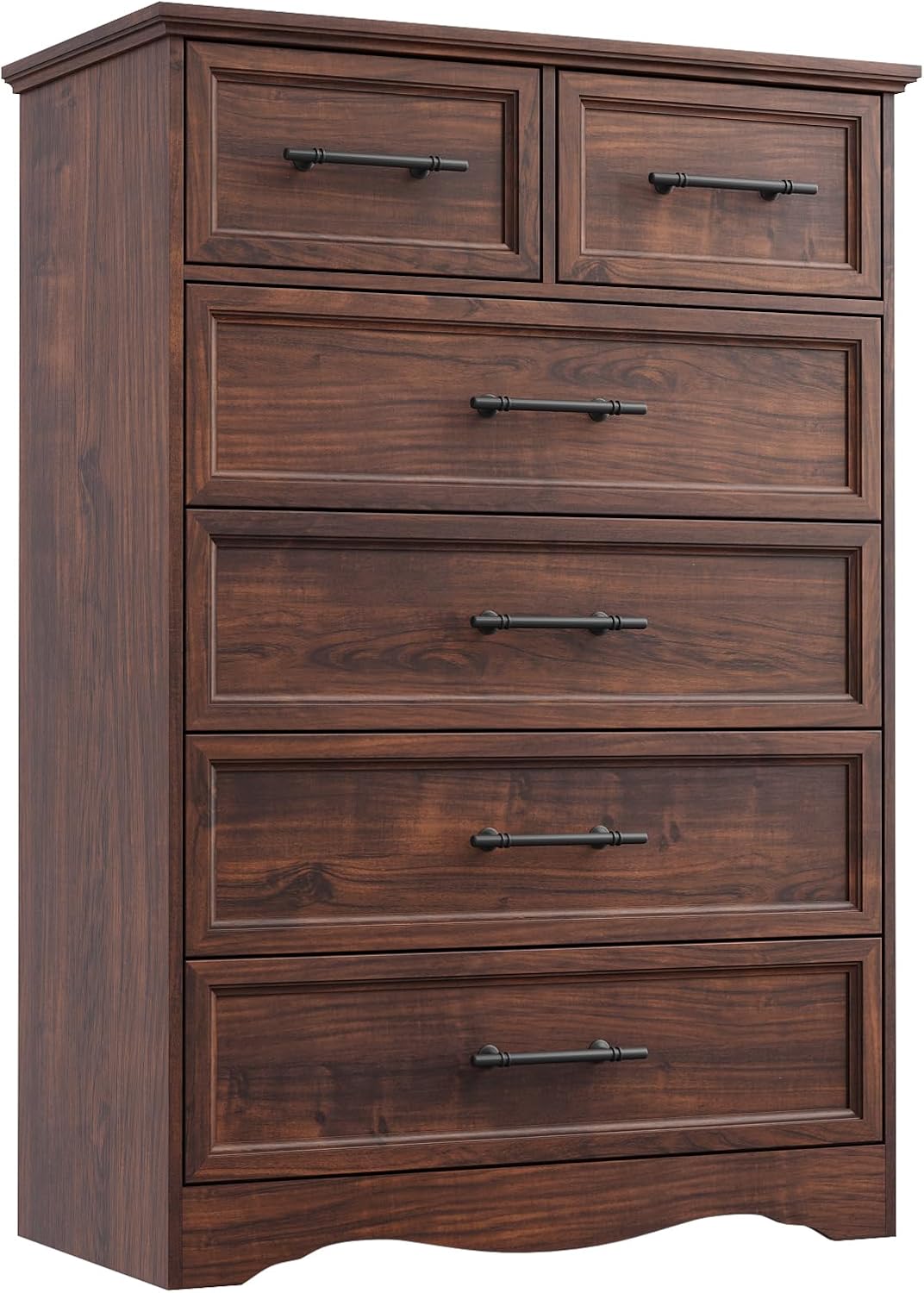


For the construction checklist, see wood dressers; for reading a listing for solidity specifically, solid wood dressers. For height and tipping, tall wood dressers, and for one much-abused species name, walnut dressers.
Questions we get asked
Does “all wood” mean solid wood?
No. Particleboard and MDF are made of wood, so the phrase is true of both. Only “solid wood” means boards of timber.
What is the difference between real wood and solid wood?
“Real wood” only promises that timber is present somewhere, including as a thin veneer. “Solid wood” means the component is timber throughout.
Is engineered wood bad?
No, and plywood in particular is excellent. It depends entirely on which panel and where it sits — particleboard where a runner bolts on is the problem case.
Is a veneered dresser worse than solid?
For flatness, veneer is better. For repairability, solid wins. Both are legitimate; the joinery matters more than either.
What does “wood finish” mean on a listing?
A printed or foil surface designed to look like timber. There is no wood in the surface at all.
How can I check a claim without seeing the furniture?
Compare the shipping weight with the size, look for “solid” attached to a named component, and find a photograph of an open drawer.