Armoire or wardrobe — The difference, and which one your room needs
The Wooden Stars is a participant in the Amazon Services LLC Associates Program. We may earn a commission when you buy through links on our site, at no extra cost to you.

Armoire and wardrobe describe the same object often enough that the two words are used interchangeably in most listings. But they come from different traditions, and where they still differ tells you something useful about what you are buying.
The short version: a wardrobe is defined by its job, and an armoire is defined by its form. Which means every armoire can be a wardrobe, and plenty of wardrobes are not armoires.
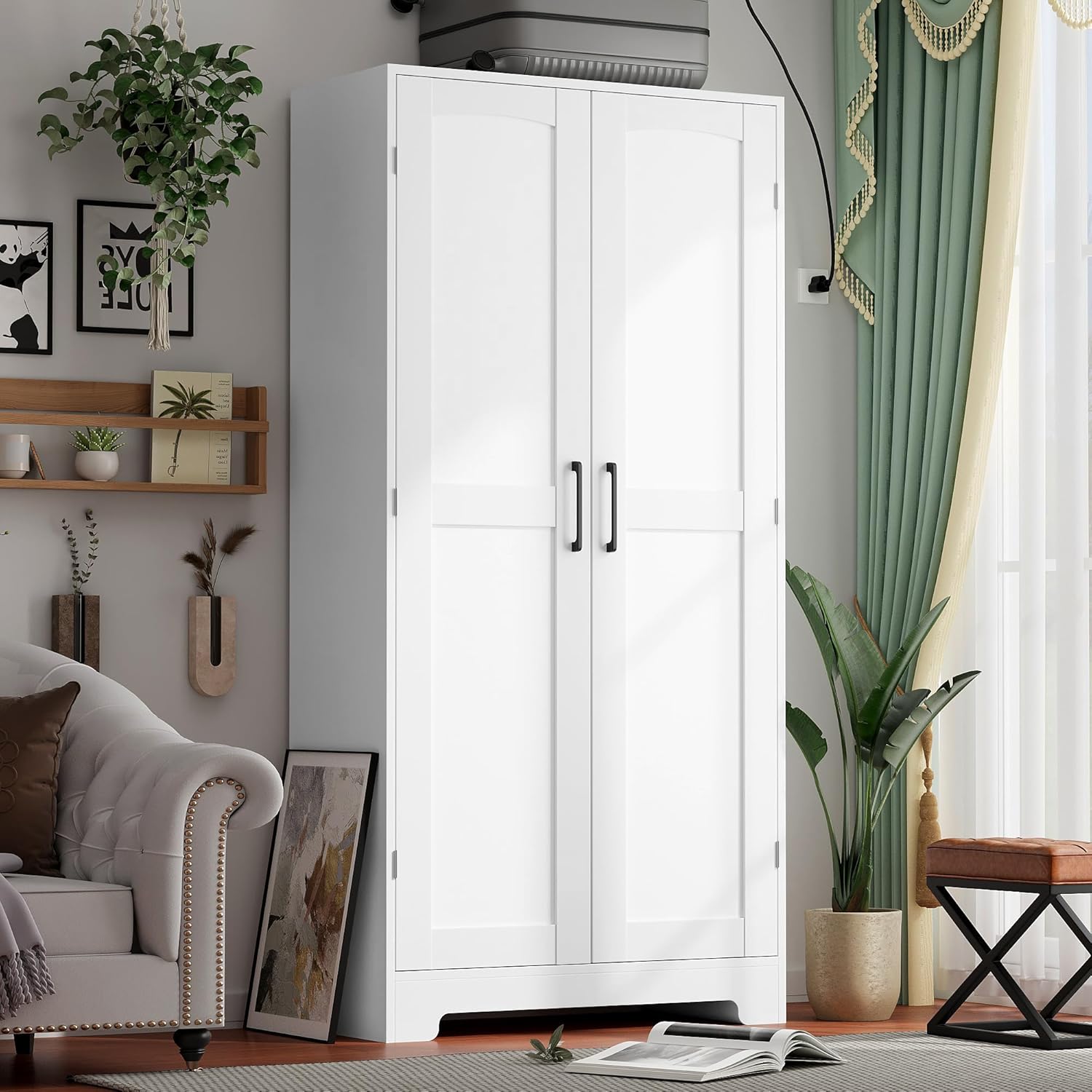
A wardrobe is a tall cupboard for hanging clothes — that is the definition, and it says nothing about how it looks. An armoire is a tall two-door cabinet in a particular traditional form: French in origin, usually with a cornice, panelled doors and feet, and often a drawer or two in the base. So an armoire used for clothes is a wardrobe. An armoire used for a television or linen is not. In practice, on US listings, “armoire” signals the styling and “wardrobe” signals the function. Buy on internal layout — hanging rail height, shelf count, drawer depth — because that is what actually differs.
Where the words came from
Wardrobe is functional and English. It started as the room where a household’s clothes were kept — the “warder of the robes” — and shrank to mean the piece of furniture that replaced the room. Anything tall with a rail in it qualifies.
Armoire is French, from armarium, a cupboard for arms. It arrived describing a large two-door cabinet with a strong architectural presence: a projecting cornice at the top, panelled or mirrored doors, visible feet or a plinth, and frequently one or two drawers below the doors.
Over two centuries the functional word and the formal word converged on the same object, because the object most people wanted a large two-door cabinet for was clothes.
What still differs in practice
| Aspect | Armoire | Wardrobe |
|---|---|---|
| What the word describes | A style and a form | A function |
| Typical height | 65 to 80 in | 65 to 84 in |
| Doors | Two, panelled or mirrored | Two, often plain or sliding |
| Cornice at the top | Usually | Often not |
| Feet or plinth | Usually visible feet | Often flush to the floor |
| Drawers in the base | Common | Less common |
| Interior | Rail plus shelving | Usually mostly rail |
| Also sold for | TV cabinet, linen, bar, craft | Clothes only |
The last row is the useful one. Search “armoire” and you will meet TV armoires, jewellery armoires, bar armoires and craft armoires — the word has become a shorthand for “tall two-door cabinet” regardless of what goes inside. Search “wardrobe” and almost everything has a hanging rail, because the word means clothes.
So if you specifically want hanging space, “wardrobe” is the more reliable search term. If you want the traditional look, “armoire” is.
Buy on the interior, not the word
Four internal measurements decide whether a tall cupboard actually works, and neither word tells you any of them.
- Hanging height under the rail. Shirts and jackets need about 40 inches; dresses and long coats need 60 to 66. A single full-height rail wastes space if you only hang shirts; two short rails double the capacity in the same box.
- Internal depth. A hanger sits about 22 inches front to back on the shoulder. Under about 21 inches of internal depth, clothes hang at an angle or the door will not close on them. This is the single most common disappointment with a slim unit.
- Shelf and drawer split. A drawer in the base is worth more than a shelf for anything that is not folded flat, and it is the detail that pushes an armoire ahead of a plain wardrobe for many people.
- Door swing. Two hinged doors need 20 to 24 inches of clear floor in front. In a small room that can be the deciding factor, and it is why sliding doors exist — at the cost of only ever reaching half the interior at once.
What it is made of, where it matters
A loaded wardrobe is heavy, and all that weight hangs from a rail supported at two points and transfers into the case sides. Three places matter.
The rail supports. Solid timber or plywood holds those fixings for the life of the piece. Particleboard enlarges the hole and the rail eventually drops — usually onto everything below it.
The case sides, for the same reason, plus they carry the door hinges.
The back panel. A thin back fixed all the way round is what stops a tall box racking into a parallelogram. Tacked on at the corners, it does much less.
Everywhere else engineered panel is fine and often better — a wide solid door panel moves seasonally and can split, which is why good doors are a solid frame with a panel infill. The listing vocabulary is decoded in what engineered wood actually is.
Anchor it, whichever word is on the box
A tall cupboard with a door open and clothes hanging on the inside of that door has its centre of gravity well forward of its base. Anchor it to a stud with the strap or bracket supplied, on the day it is assembled.
This is the same requirement as a tall chest of drawers, and for the same reason. If no anchor kit came in the box, buy one — they cost very little.
The third word: chifferobe
You will also meet “chifferobe”, which is a genuine hybrid rather than a synonym: hanging space on one side and a stack of drawers on the other, in one case. It is the answer when a room has space for exactly one piece of bedroom furniture. That one is set out in chifferobe against armoire.
And if what you actually need is drawers rather than hanging space, the comparison is armoire against dresser.
Before you order
- Furniture anti-tip kit A loaded tall cupboard with an open door wants anchoring, into a stud
- Tape measure Internal depth first — under 21 in and hangers will not sit square
- Hanging rod Adding a second short rail doubles shirt capacity in the same box
- Cedar blocks A closed cupboard holds still air; this is where moths find wool
What to buy


For the hybrid with drawers built in, see chifferobe against armoire. If drawers are the real requirement, armoire against dresser, and for the drawer-only options, wood dressers.
Questions we get asked
Is an armoire the same as a wardrobe?
Nearly. A wardrobe is defined by its function — hanging clothes. An armoire is defined by its form, a traditional two-door cabinet, and it can be used for anything.
Which word should I search for?
“Wardrobe” if you specifically need a hanging rail. “Armoire” if you want the traditional styling, because that word is now used for TV and linen cabinets too.
How deep does a wardrobe need to be?
At least 21 inches internally, because a hanger is about 22 inches across the shoulder. Anything slimmer and clothes hang at an angle.
How much hanging height do I need?
About 40 inches for shirts and jackets, 60 to 66 for dresses and long coats. Two short rails hold far more shirts than one long one.
Do armoires have drawers?
Often one or two in the base, which is one of the practical differences from a plain wardrobe. It is worth checking rather than assuming.
Does a wardrobe need to be anchored to the wall?
Yes, into a stud. An open door with clothes hanging on it puts the centre of gravity outside the base.