Anti-Tip Kits for Dressers: How to Fit One Into Solid Wood Properly
The Wooden Stars is a participant in the Amazon Services LLC Associates Program. We may earn a commission when you buy through links on our site, at no extra cost to you.
An anti-tip strap is a two-dollar part that prevents the one furniture accident that kills children. It is also the part most often fitted badly — into plasterboard with no anchor, into the thin back panel instead of the carcass, or into a stud that is not where the fitter assumed it was. A badly fitted strap gives the feeling of safety without the function.
Fitting one into solid wood furniture is actually easier than into flat-pack, because there is real material to screw into. The difficulty is always at the wall end.
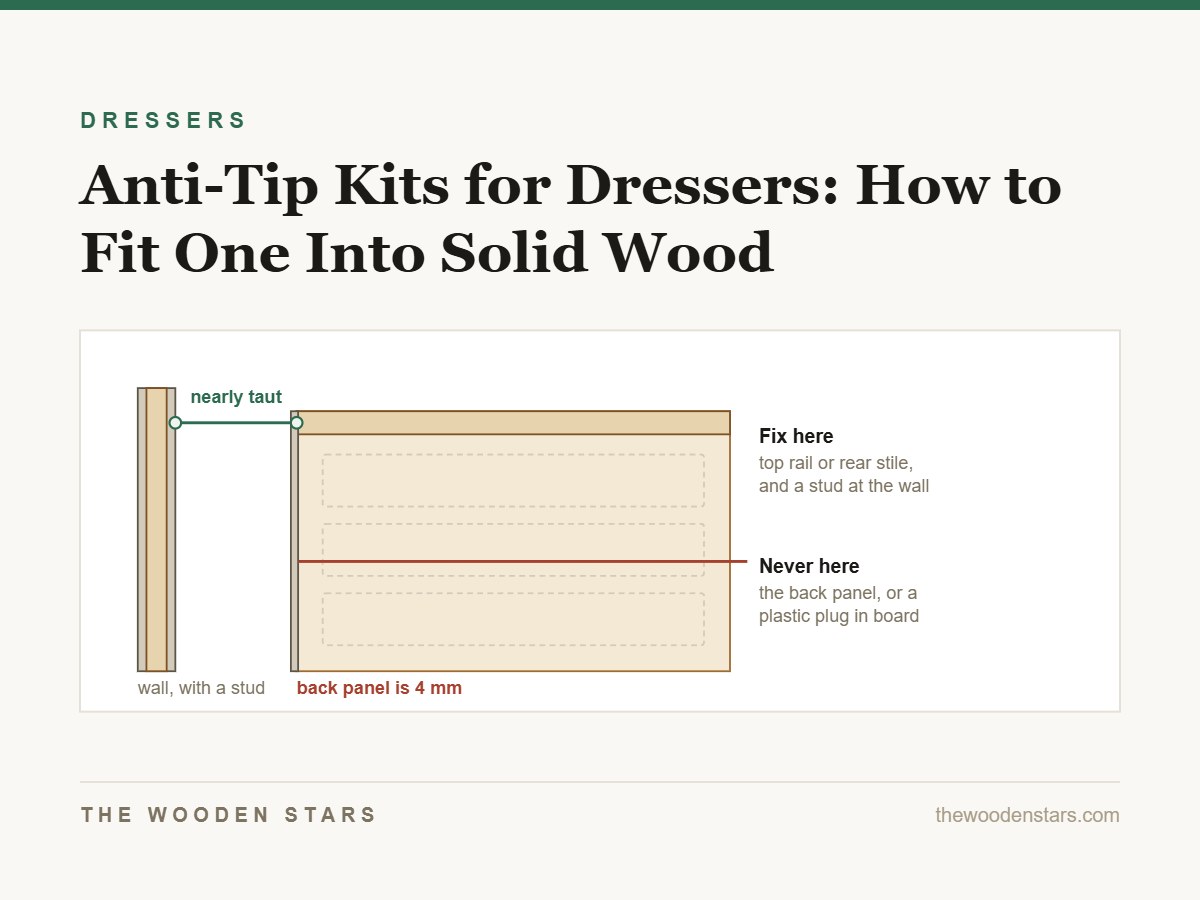
Fix the furniture end into a solid structural part — the top rail, a side panel, or a rear stile — never into the thin back panel. Fix the wall end into a stud where possible; into plasterboard, use a heavy-duty toggle or a self-drilling metal anchor rated for at least 25 kg, never a plastic plug. Use two straps on anything wider than about 60 cm, near each end, and keep them nearly vertical with only slight slack.
Start here: a ten-pack covers every piece in the house, and the strap is the cheap part of this job.

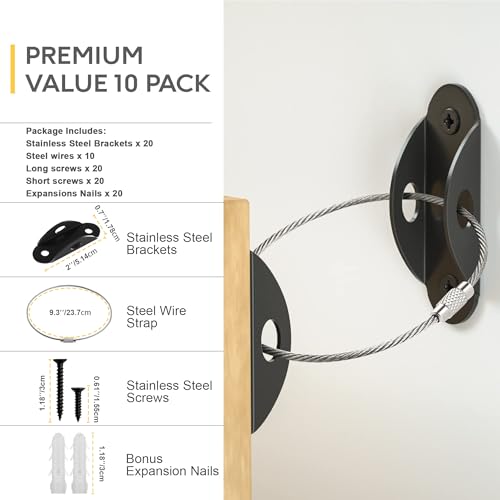
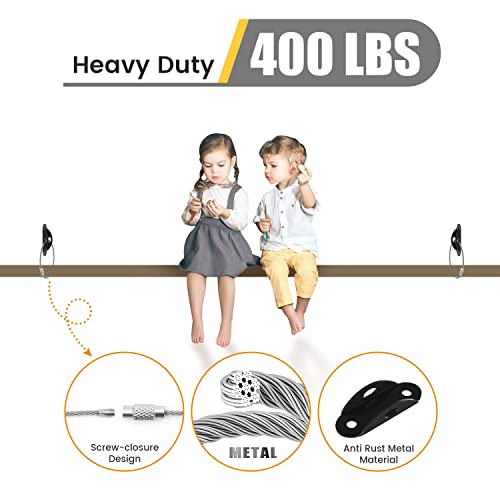
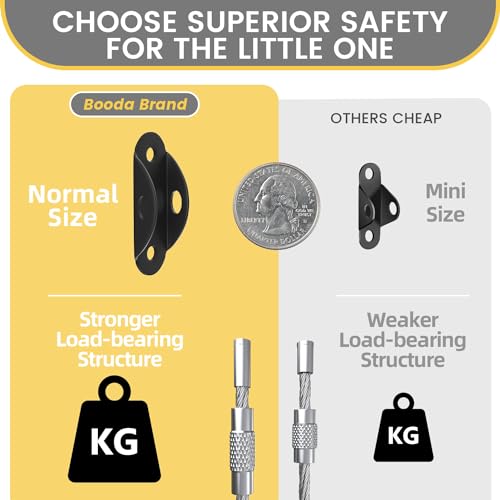
Prime Furniture Anchors 10 Pack, Anti-Tip Earthquake Straps for Baby Proofing


Which pieces need one
The rule of thumb used by safety standards is a piece that can tip when a drawer is opened and weight applied to it. In practice:
| Piece | Risk | Straps |
|---|---|---|
| Tall chest of drawers (over 75 cm) | High — the classic tipping hazard | 2 |
| Dresser, wide and low | Moderate, still real when drawers are open | 2 |
| Nightstand | Low | Optional |
| Bookcase over 90 cm tall | High, especially when loaded top-heavy | 2 |
| Wardrobe / armoire | High | 2, plus check the feet |
| TV on a dresser | Very high — the TV and the case both tip | 2 on the case, 1 on the TV |
| Open shelving unit | High if loaded above waist height | 2 |
Two situations raise the risk sharply and are easy to miss: furniture on carpet, because the front feet sink and the piece already leans forward; and drawers that all open at once, which a child climbing uses as a ladder.
The furniture end: find real wood
Solid wood furniture gives you good options, and one bad one.
- Best: the top rail or the rear stile. On a traditional carcass these are solid timber, 20 mm or more thick, and structurally connected to everything else.
- Good: the side panel near the top, if it is solid or thick plywood.
- Never: the back panel. A 4 mm hardboard or 6 mm plywood back will tear out under tipping load, and it is exactly where the pre-drilled holes in a cheap kit encourage you to go.
Screw length matters. Aim for the screw to penetrate at least two-thirds of the material’s thickness and no further — a screw that breaks through the front of a top rail has ruined a visible surface. Measure the rail before choosing the screw.
In hardwood, drill a pilot hole. Oak, maple and beech will split around a screw driven dry, and a split rail is not a fixing. A 2.5 mm pilot for a #8 screw is about right.
The wall end: this is where fittings fail
Find out what your wall is before you pick an anchor.
| Wall type | Use | Do not use |
|---|---|---|
| Timber stud (found with a detector) | 75 mm screw straight into the stud | Anything else — this is the best case |
| Plasterboard, no stud available | Heavy-duty toggle or self-drilling metal anchor | Plastic expansion plugs |
| Masonry / brick | Frame fixing or sleeve anchor | Plasterboard anchors |
| Plaster over lath | Toggle through into the cavity | Screws into the plaster alone |
| Concrete | Sleeve anchor with a masonry bit | Hammer-in plugs |
The plastic plug is the specific failure. Plastic wall plugs in plasterboard are rated for pictures, not for arresting a falling chest of drawers, and under a shock load they pull through the board taking a cone of plaster with them. A metal self-drilling anchor or a proper toggle costs almost the same and is rated in tens of kilograms rather than a few.
Use a stud detector, then confirm by drilling a small pilot: a stud gives a consistent resistance the whole way, a cavity suddenly gives none. Studs in most homes are at 400 or 600 mm centres, so if you find one, the next is measurable.
Fitting, in order
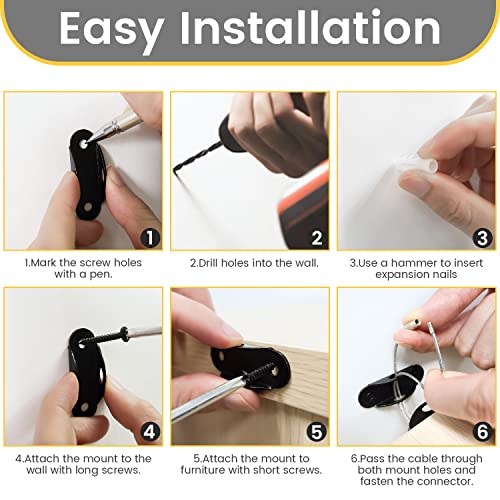
- Empty the drawers and pull the piece away from the wall. You need access and you need it light.
- Locate the wall fixing points and mark them. Two, near the ends of the piece, roughly in line with the strong parts of the carcass.
- Fit the wall anchors and the wall plates.
- Fit the furniture plates into the top rail or stile, with pilot holes.
- Connect with only slight slack. A strap should be nearly vertical and nearly taut — a long loose strap lets the piece tip far enough to throw its contents before it stops.
- Test by pulling firmly forward from the top. It should barely move. Then push the piece back against the wall.
- Re-check after any house move, and once a year.
Do the whole job while the drawers are out — which makes this the natural companion task to any drawer work, such as the back-panel repair in our guide to drawers that will not slide.
What you need
- Furniture anchor straps, 10 pack Enough for several pieces; check the anchors supplied On Amazon →
- Furniture safety straps, metal-reinforced Where the strap itself needs to carry real load On Amazon →
- TV and furniture safety straps For the television as well as the case under it On Amazon →
- Stud detector The difference between a fixing and a decoration
- Heavy-duty plasterboard anchors If, and only if, there is no stud to reach
What to buy
Note what a kit actually includes. Many ship with plastic plugs that should be thrown away and replaced with proper anchors — the strap is the cheap part and the anchor is the part that decides whether it works.
Whatever you buy, throw away the plastic plugs in the box and fix into a stud or a proper metal anchor instead.


Things that help even without a strap
Not substitutes, but they reduce the risk meaningfully:
- Load the bottom drawers heaviest. Free, and it lowers the centre of gravity where it matters most.
- Level the piece, or tilt it very slightly backward. A dresser leaning 1 degree forward on a sloping floor is measurably easier to tip. Levelling feet handle this — see levelling feet and glides.
- Do not put a television on a chest of drawers. A dresser top is above the tipping fulcrum and a television is heavy and high. Wall-mount it or use a low, wide stand.
- Fit drawer stops so drawers cannot be pulled fully out and used as steps.
Questions we get asked
Can I fit an anti-tip kit without drilling into the wall?
Not in any way that works. Adhesive and tension-based solutions do not resist the shock load of a tipping piece of furniture, and the load path has to end somewhere structural. If you cannot drill — a rental with strict terms, for instance — the alternative is to reduce the hazard: choose low, wide furniture, load the bottom heaviest, and keep nothing attractive on top.
How much slack should the strap have?
Almost none — just enough that the piece can sit flat against the wall and that the strap is not under permanent tension. Slack is travel, and travel is how the contents come out even when the piece does not fall over.
Do I need two straps on a narrow chest?
On anything under about 60 cm wide, one centred strap is defensible. Two is still better, because a single fixing lets the piece rotate around the strap and twist off the wall. Two straps triangulate it.
Will the strap damage my solid wood dresser?
Two small screw holes in the back of a top rail, invisible in use, and reversible. Weigh that against what the strap prevents. If the piece is a genuine antique and you are unwilling to drill it, fix the strap to the wall and use a webbing loop around a structural member instead — less elegant, and it does the same job.
Is the furniture-end fixing or the wall-end fixing more likely to fail?
The wall end, by a wide margin, and specifically plastic plugs in plasterboard. Solid wood furniture gives a strong furniture-end fixing almost by default. Spend your attention, and any extra money, on the anchor.