Small dressers for a small bedroom — Width against drawer depth
The Wooden Stars is a participant in the Amazon Services LLC Associates Program. We may earn a commission when you buy through links on our site, at no extra cost to you.

A small bedroom usually has one wall left after the bed, and the chest that goes on it has to earn every inch. The instinct is to buy the narrowest thing available — and that is often the wrong move, because narrow chests waste capacity in a way tall ones do not.
The useful question is not “how small”, but “which dimension can I afford to give up”.
You have three ways to shrink a chest, and they cost different things. Narrower (30 to 40 in wide): loses drawer width, which is the most useful dimension — a drawer under about 24 inches internal will not take a folded jumper flat. Taller (a 5 to 7-drawer chest, 40 to 55 in high): keeps drawer width, uses about a third less floor, and brings a real tipping risk. Shallower (14 to 16 in deep against 18 to 20): the most under-used option, and it costs the least, because most clothes do not need 18 inches of depth. Check the drawer clearance in front too — about 36 inches.
The three dimensions, and what each costs
| Change | Floor saved | What you lose | Verdict |
|---|---|---|---|
| Narrower, 34 in wide | Moderate | Drawer width; jumpers fold awkwardly | Last resort |
| Taller, 6 drawers | About a third | Top drawer above eye level; tips more | Good, if anchored |
| Shallower, 15 in deep | Moderate | Very little for most clothing | Best first move |
| Fewer drawers | A lot | Capacity, obviously | Only if you own little |
Depth is the one people never consider and it is the cheapest saving available. A standard chest is 18 to 20 inches deep; a folded shirt needs about 12 and a folded jumper about 14. Four inches off the depth of a 40-inch chest saves more floor than four inches off its width, and costs you almost nothing.
Why narrow is the worst first move
Drawer width is the dimension that decides what can lie flat.
A folded jumper is roughly 12 by 14 inches. A folded pair of jeans is about 12 by 16. A drawer with 24 inches of internal width takes two folded stacks side by side; one with 18 inches takes one stack and wastes the rest as a gap.
So a 34-inch chest does not hold two thirds of what a 50-inch chest holds — it holds about half, because the layout stops working rather than scaling down. If you can avoid losing width, avoid it.
Tall chests: the right answer, with one condition
A tall chest — 40 to 55 inches high, 30 to 40 wide, five to seven drawers — gives similar capacity in about a third less floor. In a small bedroom that is usually the best trade available.
Two consequences to plan for:
The top drawer is above eye level for many people. On a 52-inch chest the top drawer opening is around 48 inches from the floor. You cannot see into it, only feel. Put things you identify by touch up there — socks, underwear, belts — and keep the heavy items low.
It tips. A loaded open top drawer puts the centre of gravity well outside a narrow base, and tall chests are the highest-risk shape for furniture tip-overs. Anchor it into a stud with the strap supplied, on the day it is assembled. This is not optional, and the full reasoning is in tall wood dressers.
Clearance: the measurement people forget
A chest needs about 36 inches of clear floor in front so a drawer can come fully out with somebody standing at it. Deep drawers on a tall chest sometimes need more.
In a bedroom where the bed is 30 inches from the wall, a chest with 36 inches of drawer travel does not work no matter how narrow it is. Measure the gap, then the chest.
This is also the argument for putting the chest on the wall beside the bed rather than the wall at its foot, where the clearance already exists.
Other formats worth considering
Under-bed drawers. Free floor, if the bed has clearance. Shallow, so they suit flat items. A platform bed with storage built in does this properly.
A chifferobe. Hanging on one side, drawers on the other, in one case. The answer when the room takes exactly one piece and there is no closet — see chifferobe against armoire.
Wall-mounted drawers. A floating chest frees the floor visually and actually, and makes cleaning easier. It has to go into studs, and capacity is limited by the fixings.
A narrow chest plus a wall shelf. Often better than one wider chest, because the shelf takes what does not need a drawer.
Making a small room feel larger
Two details do more than the chest’s size.
Visible floor underneath. A chest on legs lets the eye read the floor as continuous; one with a plinth to the ground stops it. In a room under about 11 feet this is a bigger effect than the colour of the timber.
Keeping the top clear. A chest top at 30 inches is the most useful surface in a small bedroom and the fastest to become clutter. Decide what lives there.
The construction checks still apply
Smaller does not mean simpler. A bedside-sized drawer gets opened more often than any other drawer in the house.
- Drawer joints: dovetails at the front corners; dowels acceptable; staples into particleboard not.
- Drawer bottoms in a groove all round, not pinned underneath.
- Runners: full-extension slides matter more on a narrow chest, because the back of a deep drawer is otherwise unreachable.
- Case sides that hold a screw where the runners mount.
The full list is in wood dressers, and reading a listing for material in solid wood dressers.
For a small bedroom
- Furniture anti-tip kit Mandatory on a tall narrow chest, into a stud
- Tape measure Clear floor in front — about 36 in for full drawer travel
- Drawer organisers Essential in a top drawer you can only reach by feel
- Under-bed storage bags Takes the seasonal clothes out of the chest entirely
What to buy
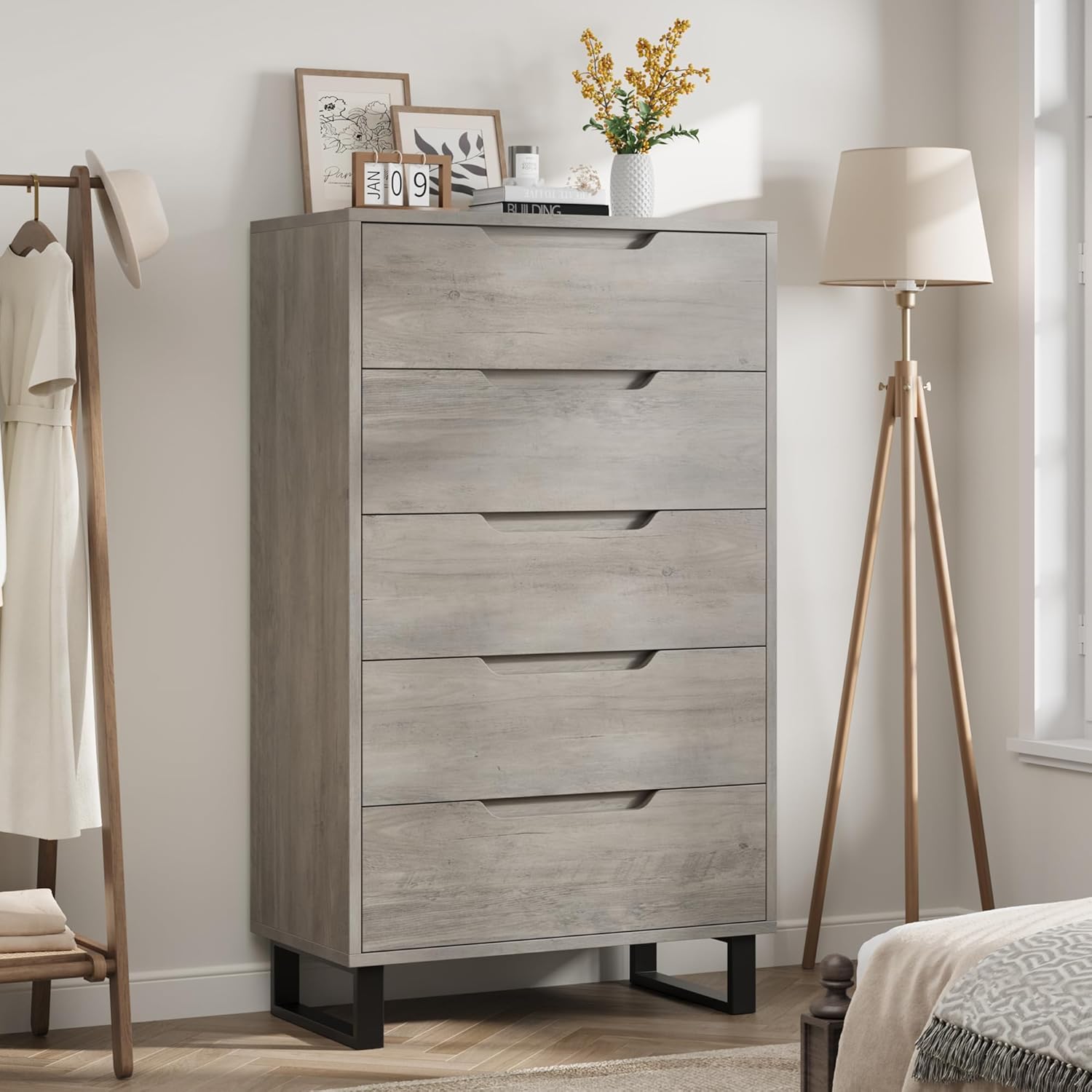


For the height trade in detail, see tall wood dressers. For construction, wood dressers; for the one-piece hanging-plus-drawers option, chifferobe against armoire; and for bedside sizing, nightstand height.
Questions we get asked
What size dresser fits a small bedroom?
Work from the clear floor in front — about 36 inches for drawer travel — then choose depth, then height, and only reduce width as a last resort.
Is a tall chest better than a wide one in a small room?
Usually. It gives similar capacity in about a third less floor. It must be anchored into a stud.
How narrow can a chest of drawers be?
Below about 24 inches of internal drawer width, folded jumpers stop fitting side by side and capacity drops faster than the width does.
How deep should a dresser be?
Standard is 18 to 20 inches; 14 to 16 works for most clothing and is the cheapest floor saving available.
How much space do I need in front of a dresser?
About 36 inches, so a drawer can come fully out with someone standing at it.
Do dressers on legs make a room look bigger?
Yes. Visible floor beneath reads as continuous space, which matters more in a small room than the finish does.