How much hanging space in a wardrobe? Count inches
The Wooden Stars is a participant in the Amazon Services LLC Associates Program. We may earn a commission when you buy through links on our site, at no extra cost to you.
How much hanging space in a wardrobe do you need? Count the garments, not the doors — allow 1 inch of rail per hanging item, and check the drop before anything else.
Wardrobes are sold by width and photographed by style. Neither tells you whether your coats will fit.
Allow 1 inch of rail per garment on wire or slim hangers, 1.5 to 2 inches on wooden ones. A 36-inch single rail therefore holds about 36 shirts or 20 jackets. The number that decides whether it works is the drop — the clear height under the rail: 40 inches for shirts and jackets, 52 for dresses, 66 for long coats and gowns. A wardrobe with a double rail doubles capacity in the same width but caps you at short items. Depth must be 21 to 24 inches or shoulders touch the door.
How much hanging space in a wardrobe: the rail arithmetic
Rail length divided by the width each garment occupies.
- Shirts and blouses on slim hangers: 0.75 to 1 inch each.
- Shirts on wooden hangers: 1.5 inches.
- Jackets and blazers: 1.75 to 2 inches.
- Winter coats: 2.5 to 3 inches.
- Dresses: 1 to 1.5 inches.
So a 36-inch rail holds roughly 36 shirts on slim hangers, 24 on wooden ones, or 18 jackets. A 48-inch rail holds about 48, 32 or 24.
Two practical notes. First, a rail packed to its theoretical maximum is unusable — you cannot see or remove anything. Plan at 80% of the figure. Second, hanger type is the cheapest capacity upgrade there is: swapping wooden hangers for slim velvet ones gains you a third of the rail back.
| Garment | Drop under the rail | Rail width each |
|---|---|---|
| Shirts and blouses | 40 in | 0.75 to 1.5 in |
| Jackets and blazers | 40 in | 1.75 to 2 in |
| Trousers folded over | 40 in | 1.5 in |
| Trousers full length | 48 in | 1.5 in |
| Dresses | 52 in | 1 to 1.5 in |
| Long coats and gowns | 66 in | 2.5 to 3 in |
The drop is the specification that gets hidden
Listings give external height. What you need is the clear height from the rail to whatever is beneath it — a shelf, a drawer top, or the floor of the carcass.
A 71-inch wardrobe sounds tall. Subtract a 4-inch top rail, a 12-inch shelf above and a drawer below, and the drop can be under 40 inches — which means no dresses and certainly no coats.
Ask for, or measure, the drop. If the listing does not give it, the photographs usually do: count the proportion of the door taken by the hanging section.
This is the single most common reason a wardrobe disappoints, and it is invisible until delivery. Related sizing is in armoire closets with drawers.
Double rails: twice the capacity, half the drop
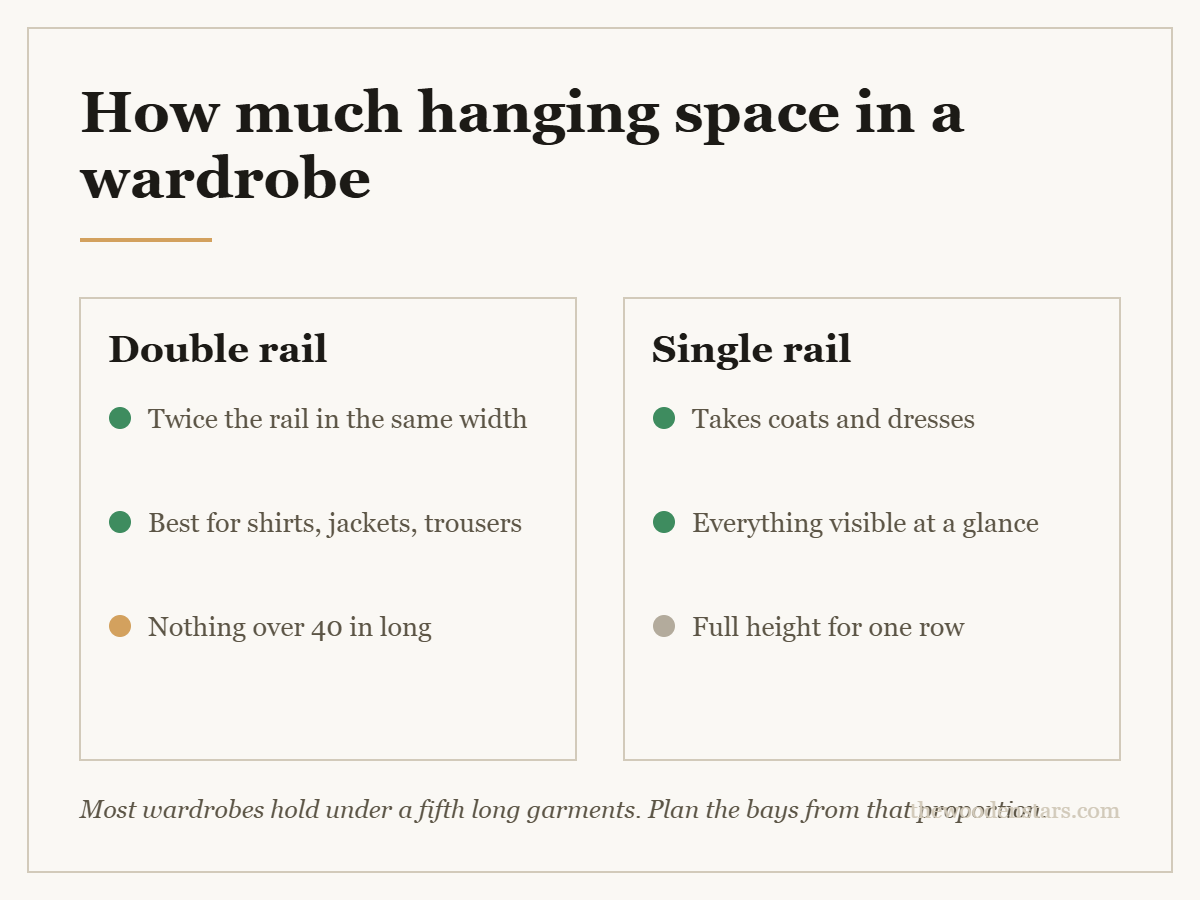
A double-hang section puts two rails one above the other, each with about a 40-inch drop, inside a 84-inch-tall opening.
What it gains: exactly double the rail length in the same width. For shirts, blouses, jackets and folded trousers this is the most efficient use of a wardrobe there is.
What it costs: nothing over 40 inches long can hang in that section. Dresses and coats need their own single-hang bay.
The sensible layout for most people is double-hang on one side, single-hang on the other. If you are buying a single-door wardrobe, work out what proportion of your clothes are long — for most wardrobes it is under a fifth, which argues for double-hang plus one short single bay.
Depth, which decides whether the door shuts
A hanger is about 17 inches across the shoulders, and a jacket on it is closer to 20.
So a wardrobe needs 21 to 24 inches of external depth for a front-facing rail. At 20 inches, shoulders press the door; at 18, the door will not close on a full rail.
Shallower wardrobes get round this with a side-facing rail — a pull-out or a rail running front to back. These work and hold far less: a 20-inch-deep bay holds about 16 inches of rail, whatever its width.
Material and carcass notes are in armoire against wardrobe and what engineered wood actually is.
What else has to fit in the box
Hanging space is only part of it. Before choosing, count the things that are not on hangers:
- Folded knitwear — shelves at 12 to 14 inches apart, 16 inches deep.
- Underwear and socks — drawers, or a dresser instead. Mixing them into a wardrobe eats the drop.
- Shoes — 8 inches of height per row, at the base.
- Bedding and suitcases — the top box above the rail, which is why that 12-inch shelf exists.
If most of your clothes fold rather than hang, a dresser is the better buy and a small wardrobe the supplement — see how deep a standard dresser is and single against double wardrobes.
And whatever you buy, strap it to a stud. A tall wardrobe with a door open and clothes on one side is a tipping load — same reasoning as anti-tip kits for dressers.
Getting more out of the rail
- Slim velvet hangers Recovers about a third of the rail against wooden hangers
- Hanging rail extender Adds a second short rail under an existing one
- Furniture anti-tip strap A tall wardrobe with one door open is a tipping load
- Shelf dividers Stops folded knitwear on a top shelf collapsing sideways
What to buy
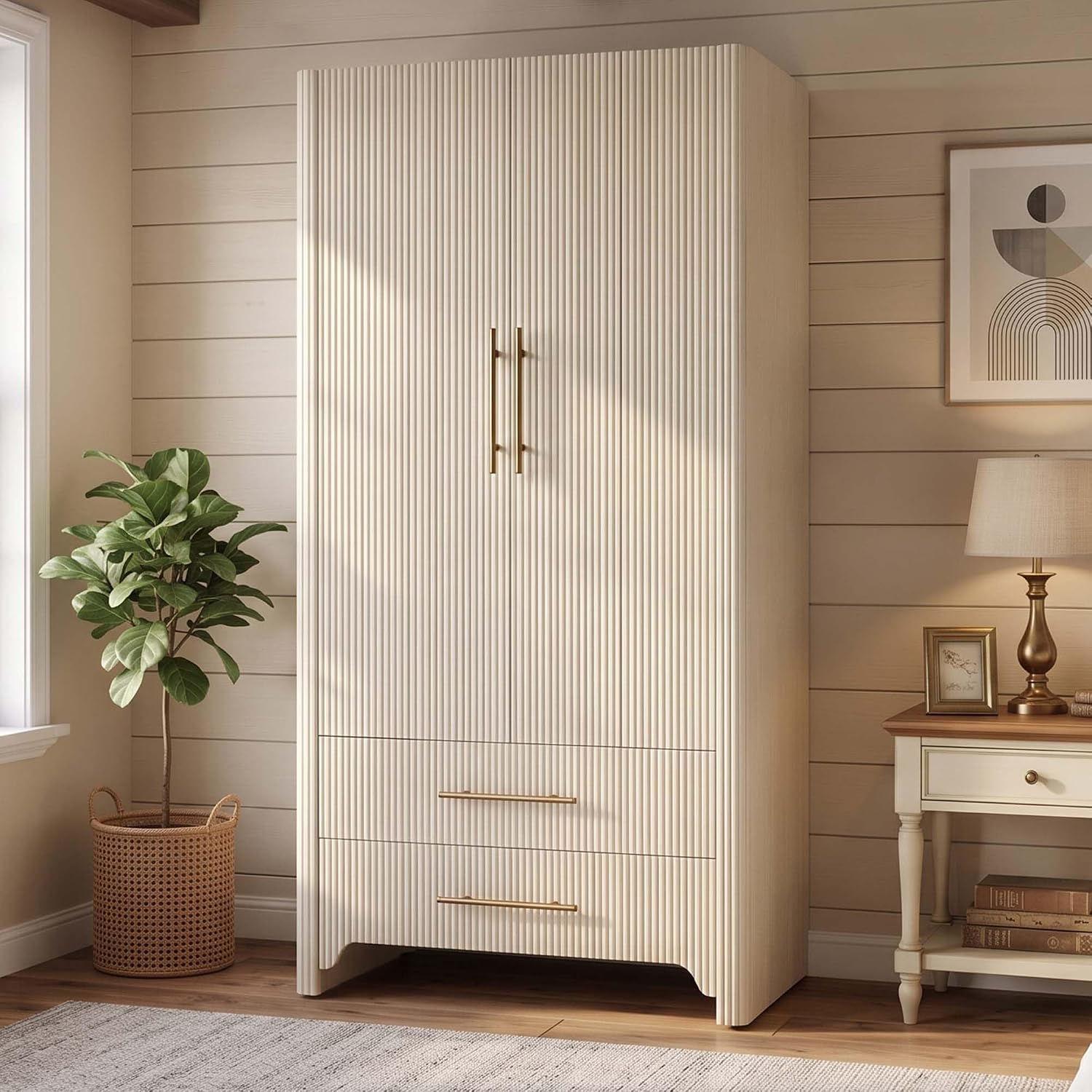


For wardrobes and armoires, see armoires with drawers, armoire closets with drawers and single against double wardrobes. For the naming, armoire against wardrobe and chifferobe against armoire. For folded storage, dresser depth.
Questions we get asked
How much hanging space in a wardrobe do I need?
Allow 1 inch of rail per garment on slim hangers, or 1.5 to 2 on wooden ones. A 36-inch rail holds about 36 shirts or 18 jackets.
What is the drop, and what should it be?
The clear height under the rail. Forty inches for shirts and jackets, 52 for dresses, 66 for long coats.
How deep should a wardrobe be?
Twenty-one to 24 inches for a front-facing rail. A hanger is 17 inches across and a jacket on it nearer 20.
Is a double rail worth it?
For shirts, jackets and folded trousers, yes — it doubles capacity in the same width. Nothing over 40 inches long can hang there.
How do I get more out of an existing rail?
Swap wooden hangers for slim velvet ones. It recovers roughly a third of the rail, and costs almost nothing.
Should I plan the rail to its full capacity?
No — work to about 80%. A rail packed to its theoretical maximum is one you cannot see into or pull from.