Chifferobe against armoire — The hybrid nobody explains
The Wooden Stars is a participant in the Amazon Services LLC Associates Program. We may earn a commission when you buy through links on our site, at no extra cost to you.

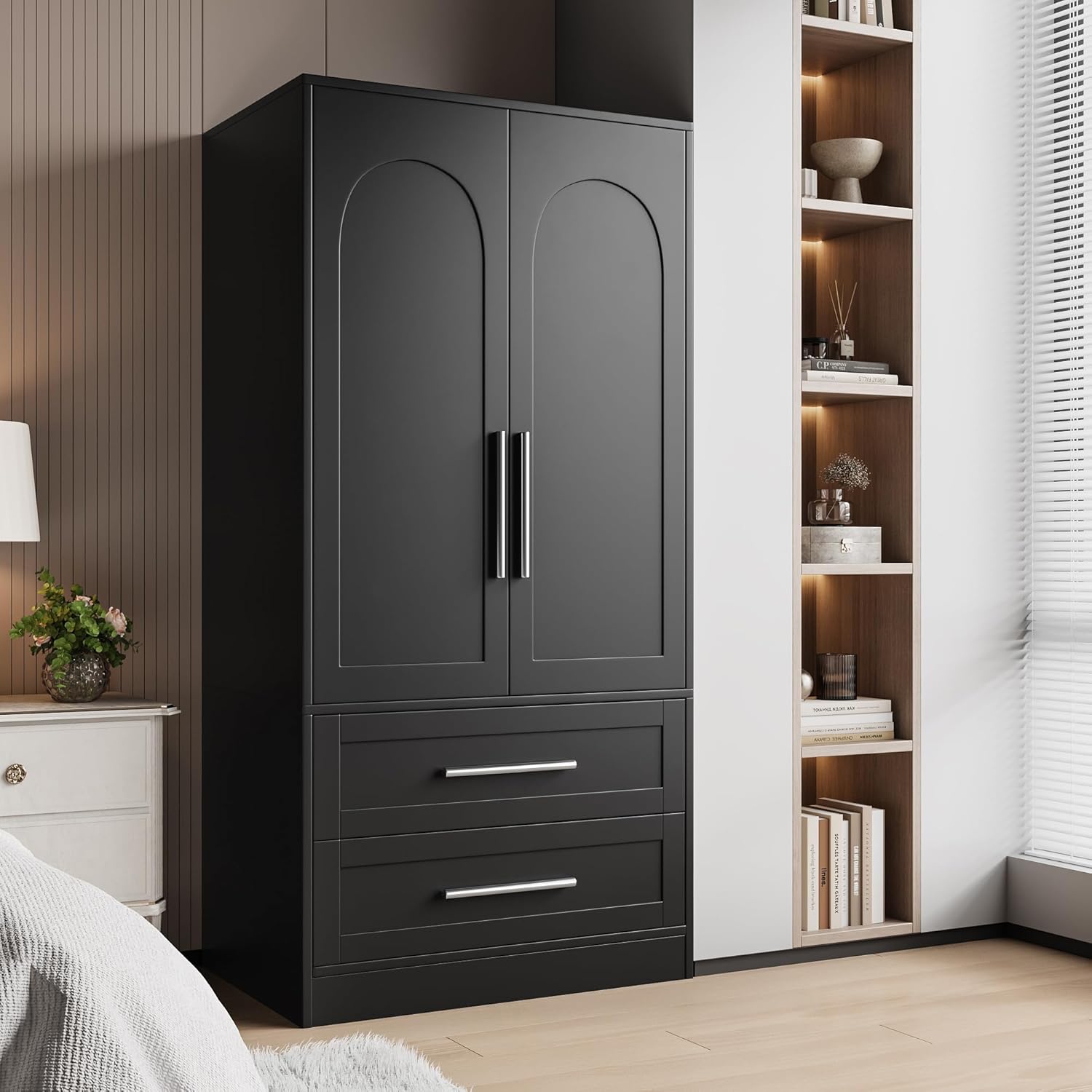
A chifferobe is the piece of furniture that solves a specific problem: a bedroom with space for exactly one thing, which needs to hold both hanging clothes and folded ones.
It does it by putting a hanging section and a stack of drawers side by side in a single case. That is the whole idea, and it is why the word exists separately from armoire and wardrobe.
A chifferobe combines a hanging compartment and a column of drawers in one case — the name is a portmanteau of chiffonier (a tall chest of drawers) and wardrobe. An armoire is a two-door cabinet with a traditional form; it may have a drawer or two in the base, but the interior is one volume rather than two. Buy a chifferobe when the room takes one piece of furniture and you need both storage types. Buy an armoire when you need hanging space above all, or when the room already has a dresser. The chifferobe’s cost is a narrower hanging section — often only 20 to 26 inches wide.
The two layouts
| Feature | Chifferobe | Armoire |
|---|---|---|
| Interior | Split: hanging one side, drawers the other | One volume, sometimes a base drawer |
| Hanging width | Usually 20 to 26 in | Usually the full case width |
| Drawers | 3 to 5, in a column | 0 to 2, in the base |
| Best when | The room takes one piece only | You already own a dresser |
| Typical width | 38 to 50 in | 40 to 60 in |
| Door count | One or two, plus drawer fronts | Two |
The hanging-width row is the trade, and it is worth doing the arithmetic on. A 24-inch hanging section holds roughly 20 to 25 shirts on standard hangers. That is enough for one person’s everyday clothes and not enough for two people, or for a wardrobe with coats and suits in it.
When a chifferobe is the right answer
- A small bedroom with one usable wall. The classic case. One 42-inch-wide piece replaces a wardrobe plus a chest and leaves the rest of the wall alone.
- A guest room. Guests need a few hangers and a drawer, not a full closet. A chifferobe is exactly sized for a few nights.
- A room with no closet at all. Older houses frequently have none, and a single piece that does both jobs reads as intentional rather than as a stopgap.
- A rental you will move out of. One item to move rather than two, and it fits through doors more easily than a full-width wardrobe.
When to buy an armoire instead
You already have a dresser. Then the drawer column is wasted width, and every inch of it would be better spent on hanging space.
You hang long items. Coats and dresses need 60 to 66 inches of clear drop. Some chifferobes shorten the hanging section to fit a shelf above it, which kills that.
Two people share it. Twenty-four inches of rail between two people is not enough, and no amount of tidying fixes it.
The armoire-versus-wardrobe distinction itself is set out in armoire or wardrobe, and the drawers-only option in armoire against dresser.
What to measure before ordering
- Internal depth. A hanger is about 22 inches across the shoulder, so you want at least 21 inches of internal depth. Chifferobes are sometimes built shallower than a full wardrobe to keep the footprint down — check this number specifically, because it is the one that ruins the piece if it is wrong.
- Hanging width and drop. Both, separately. The listing may give overall width and leave you to guess the split.
- Drawer depth. A narrow drawer column means narrow drawers. Jumpers need about 6 inches of internal depth; anything shallower is a sock drawer.
- Door swing. A hinged door needs 20 to 24 inches of clear floor. In the small room that made you choose a chifferobe, that may be the binding constraint.
Construction: two load paths in one case
A chifferobe asks more of its carcase than either of the pieces it replaces, because it carries a hanging rail and a drawer stack in the same box.
The rail supports take the whole weight of the hanging clothes at two points. Solid timber or plywood holds those fixings indefinitely; particleboard enlarges the hole and the rail eventually drops.
The centre divider between the two compartments is structural here, not cosmetic. It carries the inner end of the rail and the inner end of every drawer runner. It should be full-depth and properly housed into the top and bottom, not just screwed to the back.
The drawer runners bolt into the divider on one side and the case side on the other, so both need to hold a screw. This is the same requirement as any chest — the full list is in wood dressers.
Engineered panel elsewhere is fine and often correct; the terms are decoded in what engineered wood actually is.
Anchor it
A chifferobe has the tipping risk of a tall chest and the door-swing leverage of a wardrobe, in one object. An open door plus an open loaded drawer puts the centre of gravity well outside the base.
Anchor it into a stud with the strap supplied, on the day it is assembled. If none came in the box, an anti-tip kit costs very little — the same argument as tall wood dressers.
The name, and why listings are inconsistent
“Chifferobe” is an American word, most common in the South, and it peaked in the early twentieth century. Plenty of modern listings sell exactly this layout as a “wardrobe with drawers”, an “armoire with drawers” or a “combo wardrobe”.
So search for the layout rather than the word: look at the interior photograph and count the compartments. If there is a rail on one side and a drawer stack on the other, it is a chifferobe whatever the title says.
Before you order
- Furniture anti-tip kit Door swing plus loaded drawers is the worst tipping case; use a stud
- Tape measure Internal depth, then hanging width and drop as two separate numbers
- Slimline hangers A 24 in hanging section gains several shirts from thinner hangers
- Cedar blocks A closed compartment holds still air, which is where moths find wool
What to buy


If hanging space is the priority, see armoire or wardrobe. If drawers are, armoire against dresser and wood dressers. For a small bedroom generally, small dressers for a small bedroom.
Questions we get asked
What is a chifferobe?
A single case with a hanging compartment on one side and a column of drawers on the other. The name combines chiffonier and wardrobe.
What is the difference between a chifferobe and an armoire?
The interior. A chifferobe is split between hanging and drawers; an armoire is one volume, sometimes with a drawer in the base.
Is a chifferobe worth it over a wardrobe plus a dresser?
When the room only takes one piece, yes. When you already own a dresser, the drawer column is width that would be better spent on hanging space.
How wide is the hanging section in a chifferobe?
Typically 20 to 26 inches, which holds roughly 20 to 25 shirts. Enough for one person, tight for two.
Do chifferobes still get made?
Yes, but often sold as a “wardrobe with drawers” or “armoire with drawers”. Search by the interior layout rather than the word.
How deep should a chifferobe be?
At least 21 inches internally, because a hanger is about 22 inches across the shoulder. Shallow models force clothes to hang at an angle.