How wide should a nightstand be? 18 to 28 inches
The Wooden Stars is a participant in the Amazon Services LLC Associates Program. We may earn a commission when you buy through links on our site, at no extra cost to you.
How wide should a nightstand be? 18 to 28 inches — and the honest rule is that it should be roughly a third to a half the width of the bed, not whatever fits in the gap.
A nightstand that is too narrow looks like an afterthought. One that is too wide makes the bed look small.
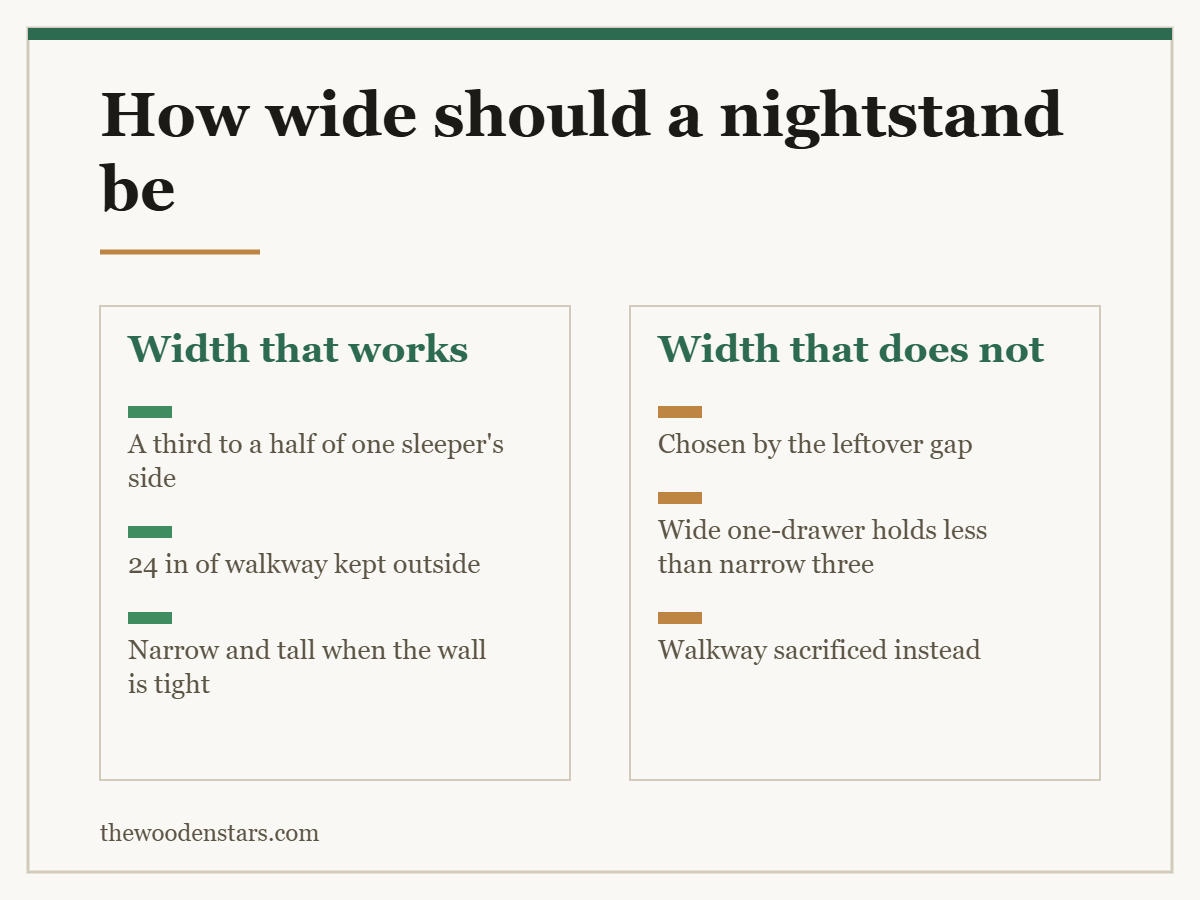
Match the nightstand to the bed: 18 to 20 inches for a twin, 20 to 24 for a full or queen, 24 to 28 for a king. That is roughly a third to a half of half the bed’s width, which is the proportion that reads as deliberate. Then check the room can give it: the nightstand plus 2 to 6 inches of gap to the bed plus 24 inches of walkway outside. If the wall cannot take all three, go narrower and taller rather than squeezing the walkway — a 16-inch three-drawer nightstand holds more than a 24-inch one-drawer and takes less wall.
How wide should a nightstand be for each bed
- Twin, 38 inches wide: nightstand 18 to 20.
- Full, 54: nightstand 20 to 22.
- Queen, 60: nightstand 20 to 24.
- King, 76: nightstand 24 to 28.
- California king, 72: nightstand 24 to 28.
The proportion behind those numbers: a nightstand that is a third to a half the width of one sleeper’s side looks right. On a queen, each side is 30 inches, so 20 to 24 sits in that band. On a king each side is 38, so 24 to 28 does.
Go much narrower and the bed dwarfs it; much wider and the pair of nightstands starts to read as a wall of furniture with a bed squeezed between.
| Bed | Bed width | Nightstand | Depth |
|---|---|---|---|
| Twin | 38 in | 18 to 20 in | 14 to 16 in |
| Full | 54 in | 20 to 22 in | 16 to 18 in |
| Queen | 60 in | 20 to 24 in | 16 to 18 in |
| King | 76 in | 24 to 28 in | 16 to 20 in |
| California king | 72 in | 24 to 28 in | 16 to 20 in |
The wall has to give you three things
Width is not chosen in isolation. Along the wall the bed sits against, you need:
- The bed frame, which is 2 to 5 inches wider than the mattress.
- A gap of 2 to 6 inches each side, so the bedding has somewhere to hang — how far a nightstand should be from the bed.
- The nightstands, plus 24 inches of walkway outside each one.
For a queen that is 64 + 8 + 44 + 48, or 164 inches — 13 ft 8 in of wall to do it properly on both sides. Most bedrooms do not have that, which is why one side usually loses its walkway to a wall or a wardrobe.
When the numbers do not fit, the order to sacrifice is: the walkway on the wall side first, then nightstand width, then the gap. Never the gap — that is the one that causes daily annoyance.
Narrow and tall beats wide and short
This is the most useful thing to know when the wall is tight.
A 16-inch wide, three-drawer nightstand holds noticeably more than a 24-inch, one-drawer one, and takes 8 inches less wall. Storage comes from height and from drawer count far more cheaply than from width.
Three variants worth knowing:
Tall narrow chests — sometimes sold as bedside chests — run 16 to 18 inches wide and 28 to 32 tall. They suit tall mattresses too, which most standard nightstands do not.
Floating nightstands take no floor at all, so the walkway measurement starts at the wall. Useful in a tight room, and they let you set the height exactly — nightstand height.
A small side table instead. Often narrower, usually cheaper, no drawers — nightstand against side table.
Do the two have to match?
Not in width, and often they should not.
If one side of the bed is against a wall or a radiator, a narrower unit there and a full-width one on the open side is more useful than a matched pair that are both compromises. The eye reads the tops being level far more strongly than it reads the widths being equal — so match the height and vary the width freely.
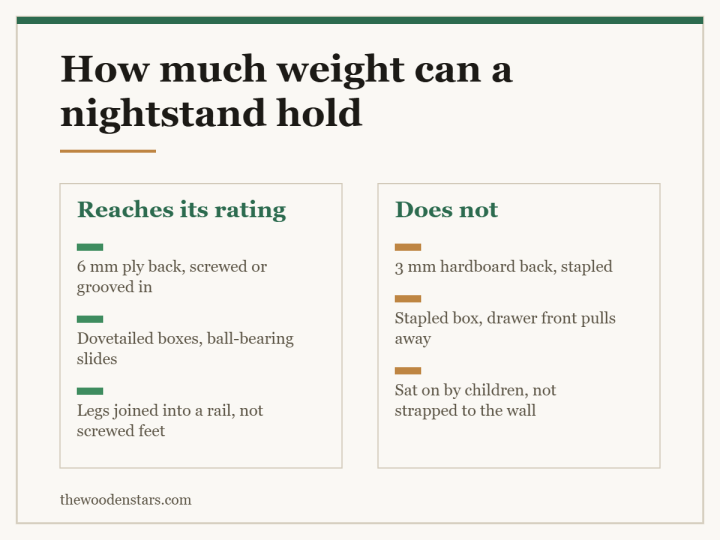
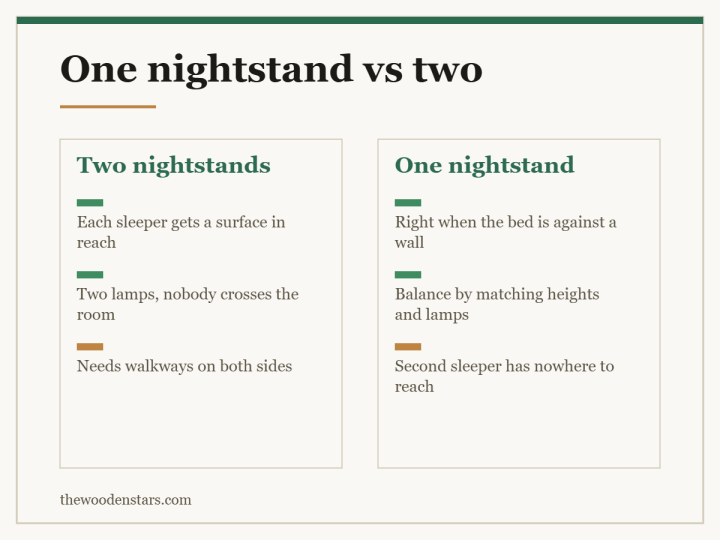
Whether you want two at all is its own question, covered in one nightstand against two. And what the top can carry — a lamp, books, a glass, a charging phone — is in how much weight a nightstand can hold.
Depth is the width question’s quieter twin, and it is the one people discover only after the unit arrives. Most nightstands run 14 to 20 inches deep, and deeper is not better: anything over about 18 inches projects past a standard bed frame and becomes something you walk into in the dark. Match the depth roughly to the bed frame’s own depth at the head end, and if the nightstand must be deeper than the frame, set it back so the fronts line up rather than the backs. A drawer in an 18-inch-deep unit holds noticeably more than one in a 14-inch, so if the wall allows the depth it is a better place to gain capacity than width is.
Measuring the wall
- Tape measure Frame width, gap, nightstand and walkway, in that order
- Painter’s tape Mark the footprint on the floor before ordering
- Furniture levellers A narrow tall nightstand rocks more easily than a wide one
- Anti-tip furniture straps Worth it on anything narrow and tall with drawers
What to buy


For the other dimensions, see nightstand height and how far it should sit from the bed. For the alternatives, nightstand against side table and round bedside table with storage.
Questions we get asked
How wide should a nightstand be?
Eighteen to 28 inches, scaled to the bed: 18 to 20 for a twin, 20 to 24 for a queen, 24 to 28 for a king.
What proportion looks right?
Roughly a third to a half of one sleeper’s side of the bed.
How much wall do two nightstands need?
For a queen with full walkways both sides, about 164 inches. Most rooms sacrifice one walkway to a wall.
Is wider better for storage?
No. A 16-inch three-drawer unit holds more than a 24-inch one-drawer and takes 8 inches less wall.
Do the two nightstands have to be the same width?
No. Match the height so the tops are level; the widths can differ freely.
What if there is no room at all?
Use a floating nightstand fixed to the wall, or a narrow bedside chest at 16 to 18 inches.