Armoire against dresser — Hanging space or drawers
The Wooden Stars is a participant in the Amazon Services LLC Associates Program. We may earn a commission when you buy through links on our site, at no extra cost to you.

An armoire and a dresser both store clothes, and that is where the similarity ends. One gives you vertical hanging space; the other gives you horizontal drawers. They hold completely different things, and a bedroom that has one usually still wants the other.
The real question is rarely “which is better”. It is which one your room and your wardrobe actually need first.
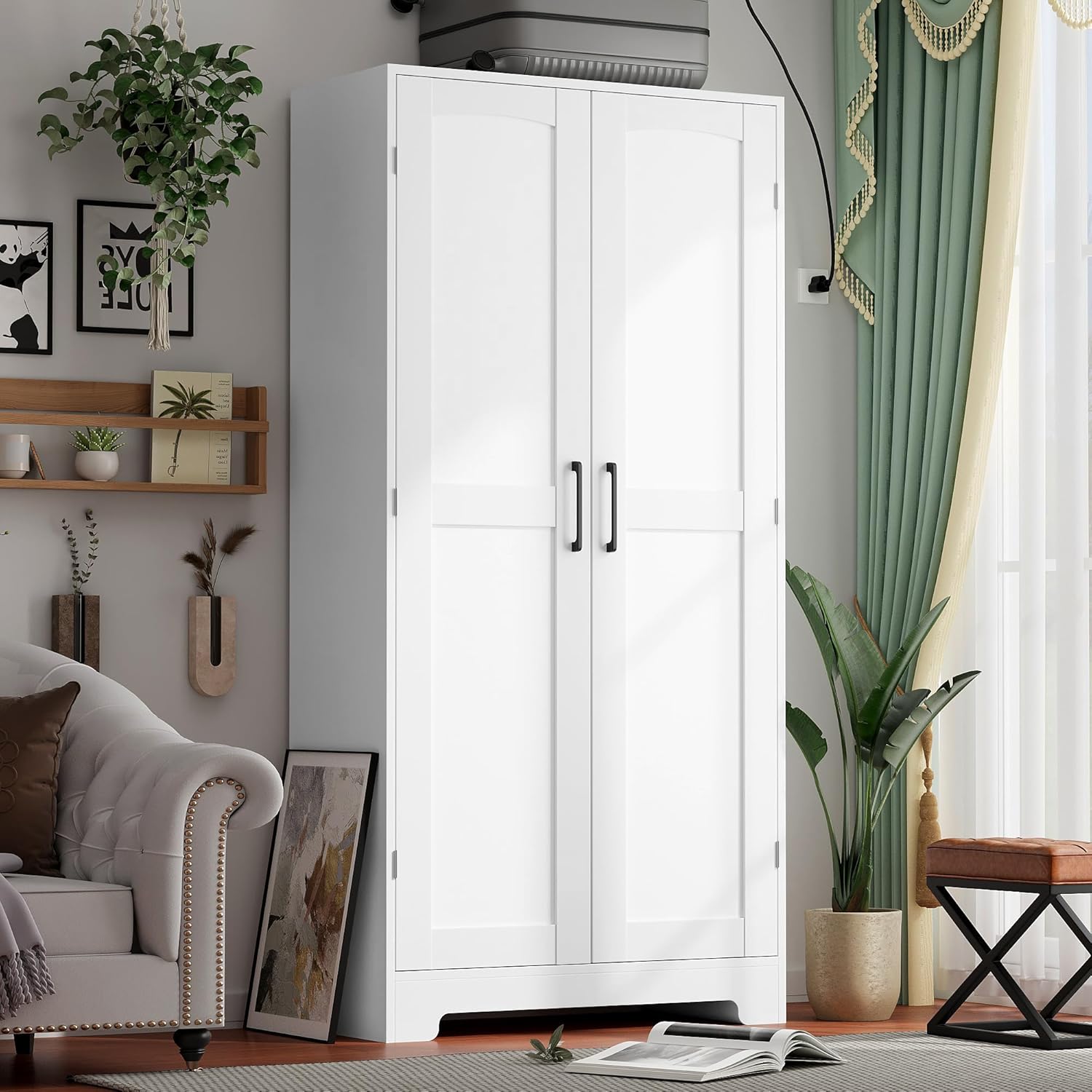
An armoire is a tall two-door cabinet, mostly hanging space, sometimes with a drawer or two in the base. A dresser is a low wide chest of drawers, no hanging space at all. Buy the armoire if the room has no closet — hanging space is the one thing a dresser cannot substitute for. Buy the dresser if you already have a closet, because then folded storage is what is missing. Footprints differ too: an armoire uses about 4 to 6 sq ft of floor and 6 ft of height; a dresser uses 7 to 9 sq ft and stays below eye level.
What each one actually holds
| Measure | Armoire | Dresser |
|---|---|---|
| Primary storage | Hanging rail | Drawers |
| Typical size | 40 to 60 in wide, 65 to 80 tall | 50 to 65 in wide, 30 to 36 tall |
| Floor area | About 4 to 6 sq ft | About 7 to 9 sq ft |
| Holds | Shirts, jackets, dresses, coats | Folded knitwear, underwear, jeans |
| Cannot hold | Anything that must stay folded flat | Anything that must stay hung |
| Surface on top | No, too tall | Yes, usually the point |
| Clear floor needed in front | 20 to 24 in for door swing | About 36 in for drawer travel |
The “surface on top” row matters more than people expect. A dresser top is a genuinely useful piece of furniture in its own right — a lamp, a mirror, a tray, a television. An armoire top is at or above eye level and does nothing.
Choose by what the room lacks
No closet in the room
Buy the armoire first, without hesitating. Folded clothes can live in almost anything — a chest, a trunk, a shelf, under the bed. Hanging clothes cannot. A shirt that spends a year folded is a shirt that needs ironing every time.
There is a closet, and it is full of hanging clothes
Buy the dresser. The closet is already doing the job an armoire would do, and duplicating it wastes a wall.
There is a closet, and it is half empty
Buy the dresser, and use the closet floor and shelf for the rest. This is the commonest case and the one where people buy an armoire they do not need.
Two people, one bedroom, one closet
An armoire is genuinely useful here, because 24 to 40 inches of extra rail resolves an argument that no amount of tidying will. Or consider the hybrid — hanging on one side, drawers on the other — in chifferobe against armoire.
The measurements that decide it
- Internal depth of the armoire. A hanger is about 22 inches across the shoulder, so you need at least 21 inches internally. Shallow armoires exist and they make clothes hang at an angle. This is the number to check first and the one most often skipped.
- Hanging drop. Shirts and jackets need about 40 inches; dresses and coats 60 to 66. An armoire with a shelf eating the top of the compartment may not take a long coat.
- Door swing. Two hinged doors need 20 to 24 inches of clear floor. A dresser needs more — about 36 inches, so a drawer can come fully out with somebody standing at it.
- Ceiling height. An 80-inch armoire in a room with a 7-foot ceiling leaves four inches. It will look and feel wedged in, and it has to be tilted upright during assembly, which needs the diagonal to clear.
Construction: different loads, different weak points
On an armoire the load is a hanging rail supported at two points, plus two doors on hinges. The rail supports and the case sides need to hold a screw indefinitely — solid timber or plywood. A back panel fixed all the way round is what stops a tall box racking.
On a dresser the load is drawers cantilevered out into the room. The drawer boxes need proper joints, the bottoms need to sit in a groove rather than be stapled underneath, and the case sides need to hold the runner screws. The full checklist is in wood dressers.
Both fail in the same material: particleboard where a fixing goes. Panel elsewhere is fine and often the better choice for wide flat doors, which move seasonally if solid — the terms are in what engineered wood actually is.
Both of them need anchoring
An armoire with a door open and clothes hanging on the inside of it, and a dresser with a loaded top drawer out, both put their centre of gravity in front of the base. Anchor each into a stud with the supplied strap on the day it goes together.
Tall narrow pieces are the worst case — the reasoning is set out in tall wood dressers.
If you can only fit one piece
Then the honest answer is usually neither of these, but the hybrid: a case with hanging on one side and drawers on the other. It gives up hanging width to get drawers, which is the right trade when the alternative is having no drawers at all.
That piece is a chifferobe, and the trade-offs are set out in chifferobe against armoire. For the naming confusion between armoire and wardrobe, see armoire or wardrobe.
Whichever you buy
- Furniture anti-tip kit Both tip forward when loaded and open; anchor into a stud
- Tape measure Armoire internal depth, or dresser drawer clearance in front
- Slimline hangers An armoire gains several shirts per foot of rail from thinner hangers
- Drawer liners Keeps clothing off a raw panel bottom in a dresser
What to buy



For the drawer side in detail, see wood dressers and tall wood dressers. For the hanging side, armoire or wardrobe, and for the one-piece compromise, chifferobe against armoire.
Questions we get asked
What is the difference between an armoire and a dresser?
An armoire is a tall cabinet for hanging clothes; a dresser is a low wide chest of drawers for folded ones. They do not substitute for each other.
Do I need both an armoire and a dresser?
Only if the room has no closet and you need folded storage too. With a closet, the dresser alone is usually the right buy.
Which takes up less space?
An armoire uses less floor — about 4 to 6 square feet against 7 to 9 — but it needs six feet of height and reads as a much larger object in a small room.
Can you put a TV on an armoire?
Not on top; it is too tall. Some armoires are built as TV cabinets with the set inside, which is a different product from a clothes armoire.
How deep does an armoire need to be?
At least 21 inches internally, because a hanger is about 22 inches across the shoulder.
Which one should I buy first for a room with no closet?
The armoire. Folded clothes can live almost anywhere; hanging clothes cannot.