How much weight can a nightstand hold? 50 to 200 lb
The Wooden Stars is a participant in the Amazon Services LLC Associates Program. We may earn a commission when you buy through links on our site, at no extra cost to you.
How much weight can a nightstand hold? 50 to 200 lb on the top — which sounds generous until you notice that the number people actually need is the drawer rating, and almost nobody publishes it.
Nightstands fail at the drawer and at the back panel, not at the top.
Top ratings run 50 to 80 lb on particleboard units, 100 to 150 on solid timber, and 150 to 200 on heavy solid-wood chests. Drawers are the weak point: 15 to 25 lb on stapled plywood boxes with ball-bearing slides, 35 to 50 on dovetailed solid sides. What actually breaks is the thin back panel when someone leans on the unit, and the drawer bottom when it is loaded with books. None of this matters for a lamp and a glass — it matters the moment someone sits on it, which children do, so anything in a child’s room should be strapped to the wall.
How much weight can a nightstand hold, by construction
- Particleboard with a laminate finish: top 50 to 80 lb, drawers 15 to 20.
- MDF with a veneer: top 70 to 100, drawers 20 to 25.
- Solid timber, stapled drawer boxes: top 100 to 150, drawers 20 to 30.
- Solid timber, dovetailed drawers: top 150 to 200, drawers 35 to 50.
The pattern: the top tracks the material, and the drawer tracks the joinery. A solid oak nightstand with stapled ply drawer boxes has a strong top and weak drawers, which is a very common combination and the reason drawers sag on furniture that otherwise looks fine.
The material distinction is worth understanding properly — engineered wood against hardwood and what “all wood” actually means.
| Part | Weak | Strong |
|---|---|---|
| Carcass | Particleboard, 0.6 in | Solid timber, 0.75 in or more |
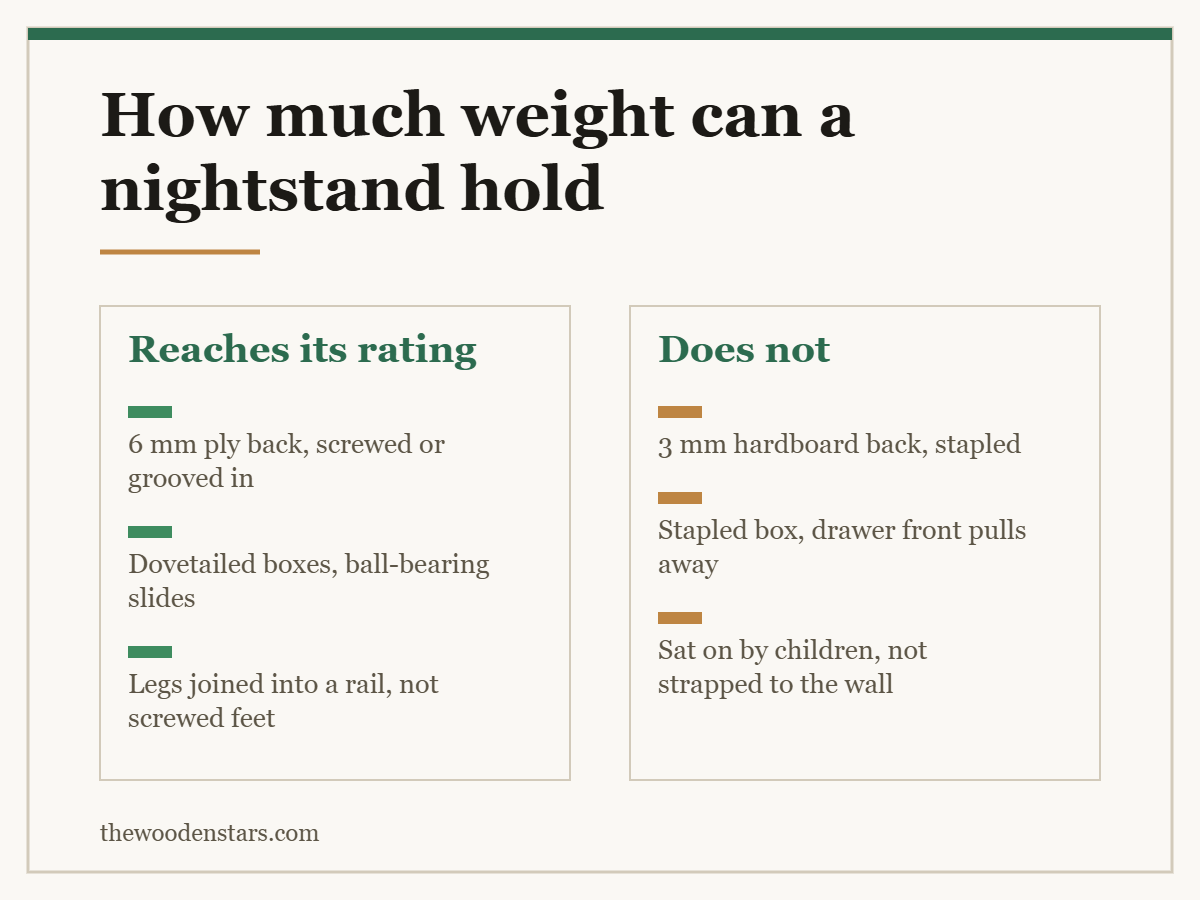
| Back panel | 3 mm hardboard, stapled | 6 mm ply, screwed or grooved in |
| Drawer box | Stapled plywood | Dovetailed solid sides |
| Drawer bottom | 3 mm hardboard, loose | 6 mm ply in a groove |
| Slides | Side rollers | Full-extension ball bearing |
| Legs | Screwed-in plastic feet | Turned timber into a rail |
The back panel is what actually fails
Ask what breaks on a nightstand and the answer is almost never the top. It is the back.
A 3 mm hardboard back stapled into a rebate is the only thing stopping the carcass racking into a parallelogram. Push the unit sideways to vacuum behind it, or lean on the top while getting out of bed, and the staples pull. Once the back is loose the drawers stop running square, and then the whole thing feels like it is failing — because it is.
What to look for: a back panel of 6 mm ply or better, screwed rather than stapled, or — best — housed in a groove in the carcass sides. You can often see which from the listing photographs.
The cheap fix on a unit you already own: run screws with washers through the existing back into the carcass every 6 inches, and add a diagonal batten if it has already racked.
Drawers, and what they are really for
A nightstand drawer is sized for a book, a charger, medication and a pair of glasses. Loaded like that, no rating matters.
The problems start when it holds a stack of hardbacks or a laptop. Then:
- The bottom bows. A 3 mm hardboard bottom sitting in a shallow groove drops out of its groove at one corner and jams.
- The slides bind. Side rollers are rated around 25 lb; full-extension ball-bearing slides are usually 65 to 100.
- The front separates. On a stapled box, the drawer front pulls away from the sides — the classic failure, and the reason dovetails cost more.
If you need real drawer capacity beside the bed, a narrow bedside chest is built for it where a nightstand is not — sizing in how wide a nightstand should be.
The case that is actually about safety
Everything above is about durability. One case is about safety.
Children climb on furniture with drawers. A nightstand with two open drawers and a child leaning on them has its centre of gravity outside its footprint, and narrow tall units — the ones recommended for small rooms — are the least stable shape there is.
Strap anything with drawers to the wall in a child’s room, and preferably everywhere. Anti-tip straps cost very little and take ten minutes. This is not a durability question and it does not depend on the unit’s rating.
The other honest habit: do not sit on a nightstand. Adults do it while putting on socks, and at 150 lb on a corner of a 100 lb-rated top it is exactly the load the unit was not designed for. A small bench or the bed itself is what that job wants — and the same reasoning about static ratings against real loads is in how much weight a bar stool can hold.
And check the feet. Screwed-in plastic feet are a common weak point on cheaper units, because the screw goes into particleboard end grain and works loose under any sideways load.
Making one last
- Anti-tip furniture straps The one item on this list that is about safety, not wear
- Wood glue for loose joints Restores a carcass that has started to rack
- Ball-bearing drawer slides Upgrades a nightstand whose side rollers bind
- Felt furniture pads Stops the unit being dragged, which is what loosens the back
What to buy


For sizing, see how wide a nightstand should be and nightstand height. For placement, how far it should sit from the bed and one nightstand against two.
Questions we get asked
How much weight can a nightstand hold?
Fifty to 200 lb on the top depending on material, and only 15 to 50 lb in a drawer depending on the joinery.
What fails first?
The back panel. A 3 mm stapled hardboard back is what stops the carcass racking, and leaning on the top pulls the staples.
Why do the drawers sag?
Thin bottoms in shallow grooves, and side-roller slides rated around 25 lb. Dovetailed boxes on ball-bearing slides hold 35 to 50.
Can I sit on a nightstand?
Better not. An adult on a corner exceeds what a 100 lb-rated top was designed for.
Do I need to strap it to the wall?
In a child’s room, yes, and preferably anywhere. Open drawers put the centre of gravity outside the footprint.
How do I strengthen one I already own?
Screw the back panel into the carcass every 6 inches with washers, and reglue any joint that has started to open.