Single vs double wardrobe — Rail length, not doors
The Wooden Stars is a participant in the Amazon Services LLC Associates Program. We may earn a commission when you buy through links on our site, at no extra cost to you.
Single vs double wardrobe sounds like a question about doors. It is really a question about rail length — and the two do not scale the way you would expect.
A double wardrobe does not give you twice the hanging space of a single. Usually it gives rather more than twice, and occasionally rather less.
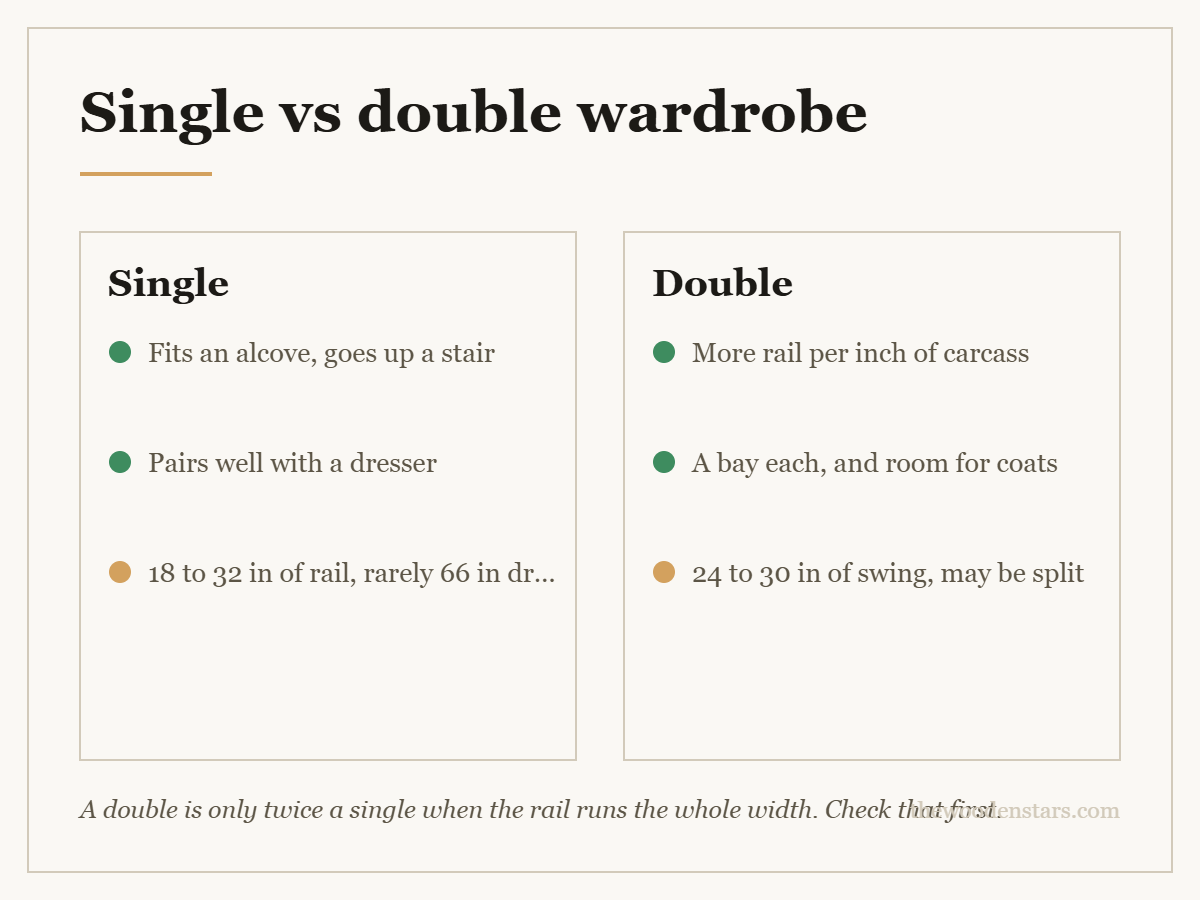
A single wardrobe is 20 to 36 inches wide with one door and one rail. A double is 36 to 60 inches with two doors. The useful comparison is rail: a single gives about 18 to 32 inches of rail, a double 32 to 56 — but a double is often split into a hanging bay and a shelved bay, which can leave less rail than a wide single. Check the internal layout, not the door count. On depth both need 21 to 24 inches. A double also needs its doors’ swing: allow the door width again in front, or buy sliding doors.
Single vs double wardrobe: count the rail, not the doors
Rail length is the capacity. Doors are how you reach it.
- Narrow single, 20 to 24 inches: about 18 to 22 inches of rail — around 20 shirts. A supplementary piece, not a main wardrobe.
- Wide single, 30 to 36 inches: 27 to 33 inches of rail — 30 shirts or 16 jackets. Genuinely useful for one person with a dresser alongside.
- Double, 36 to 48 inches: 33 to 45 inches of rail if it is one continuous rail.
- Double, 48 to 60 inches: up to 56 inches of rail, or two bays.
The trap is the split. Many doubles put a shelved or drawered column behind one door, which can leave a hanging bay of only 20 inches — less than a wide single, in twice the floor space. The maths for turning rail into garments is in how much hanging space in a wardrobe.
| Measure | Single | Double |
|---|---|---|
| External width | 20 to 36 in | 36 to 60 in |
| Rail, continuous | 18 to 32 in | 32 to 56 in |
| Rail, split layout | — | Can be as little as 20 in |
| Depth | 21 to 24 in | 21 to 24 in |
| Door swing needed | 20 to 36 in | Half the width, each side |
| Shelves and drawers | Above and below | Often a whole bay |
| Suits | One person, plus a dresser | A shared room, or one wardrobe only |
The door swing, which a double doubles
A hinged door needs its own width of clear floor to open. On a single that is 20 to 36 inches. On a double it is usually half the carcass width per door — so a 48-inch double needs about 24 inches in front of each side.
That sounds better than a single, and in practice it is worse, because you open both. Plan on 24 to 30 inches of clear floor across the whole front.
Where that floor does not exist — a wardrobe facing the end of a bed, or in a narrow room — the answers are:
- Sliding doors. No swing at all. The cost is that you can only ever see half the interior at once, and the running gear is the part that wears.
- Two singles side by side. Narrower doors, less swing each, and you can put them on different walls later.
- A bi-fold door. Halves the swing, at the price of a hinge that sags under a mirror.
The clearance arithmetic in a bedroom is in how much space around a bed.
Where the single is the right buy
Alongside a dresser. Most people’s clothes are more folded than hung. A 32-inch single plus a 60-inch dresser beats a 48-inch double on total capacity and costs less — see how deep a standard dresser is.
In an alcove. Singles fit chimney breast recesses, which are typically 24 to 36 inches.
Where the piece must move later. A single goes up a stair and round a landing. A 60-inch double frequently does not, and it is the carcass rather than the doors that will not turn.
For a child’s room. Children’s clothes are short, so a single with a double rail holds a surprising amount.
Where the double earns it
When it is the only storage. A bedroom with no dresser and no built-in needs the drop, the rail and the shelves in one box.
For two people. A bay each, which stops the daily negotiation.
For long garments. Doubles are more likely to offer a full-height single-hang bay at 66 inches of drop, which is what coats and gowns need. Wide singles usually put a shelf at the top and lose it.
Per inch of floor, if the rail is continuous. One 48-inch double carcass costs less and holds more than two 24-inch singles, because you only pay for two ends instead of four.
What to check on either, before buying
- The rail length and the drop, in inches, not the external width. If the listing does not state them, count the proportion of the door in the photographs.
- Depth of 21 to 24 inches. A hanger is 17 across and a jacket on it nearer 20; at 18 inches deep the door will not shut on a full rail.
- A back panel let into a groove, not pinned on. It is what stops a tall box racking, and a racked wardrobe has doors that stop closing.
- Adjustable feet. A wardrobe on an uneven floor throws its doors out of square immediately — levelling feet and glides.
- An anti-tip strap into a stud. Tall, top-heavy, and a door full of coats on one side is a lever — same logic as anti-tip kits for dressers.
Material terms are in what engineered wood actually is; a particleboard carcass at this height sags across the top rail within a few years.
For either size
- Furniture anti-tip strap A tall wardrobe with one door open is a tipping load
- Slim velvet hangers Recovers about a third of the rail you already own
- Levelling feet An out-of-square carcass has doors that stop closing
- Hanging rail extender Turns a tall single bay into two short ones
What to buy

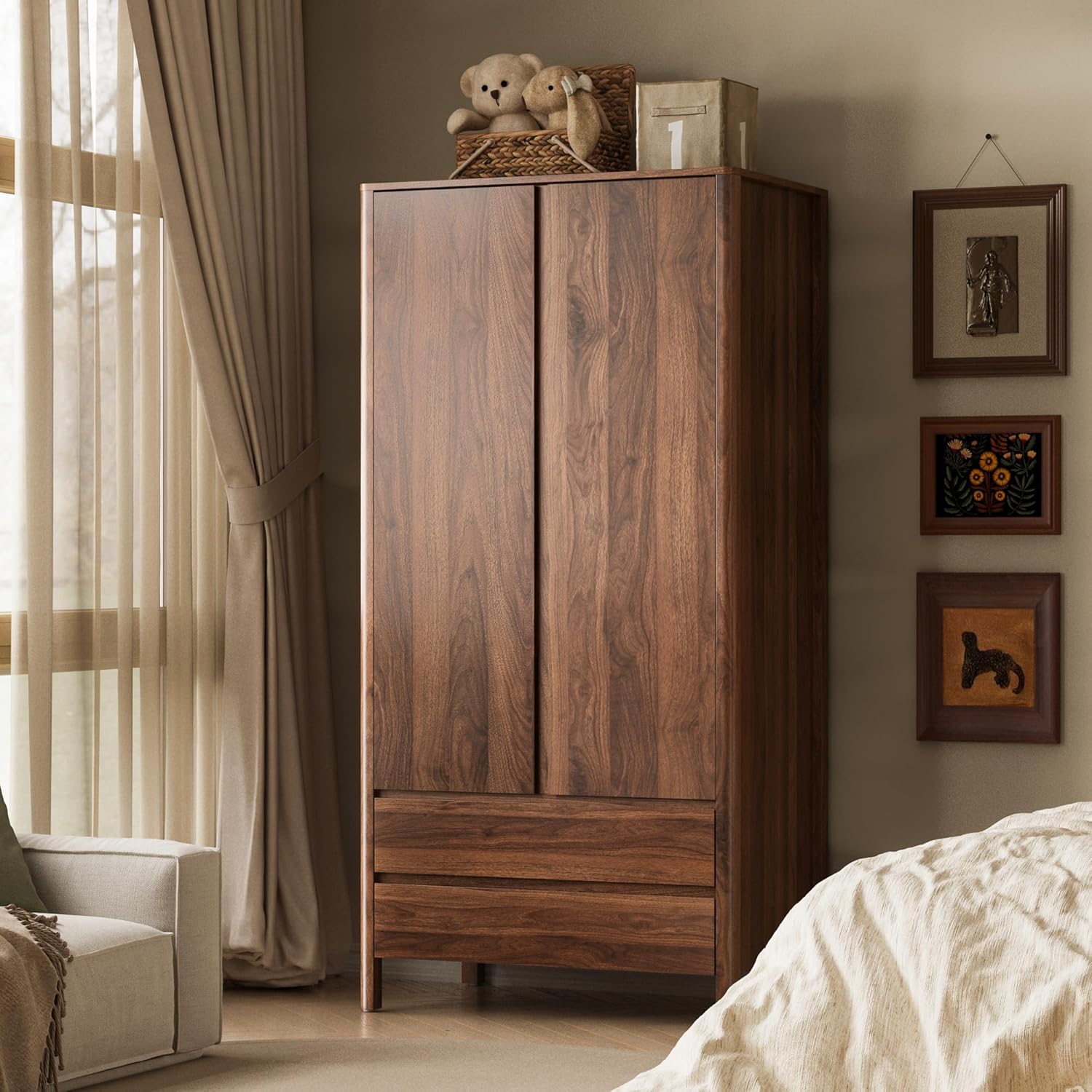

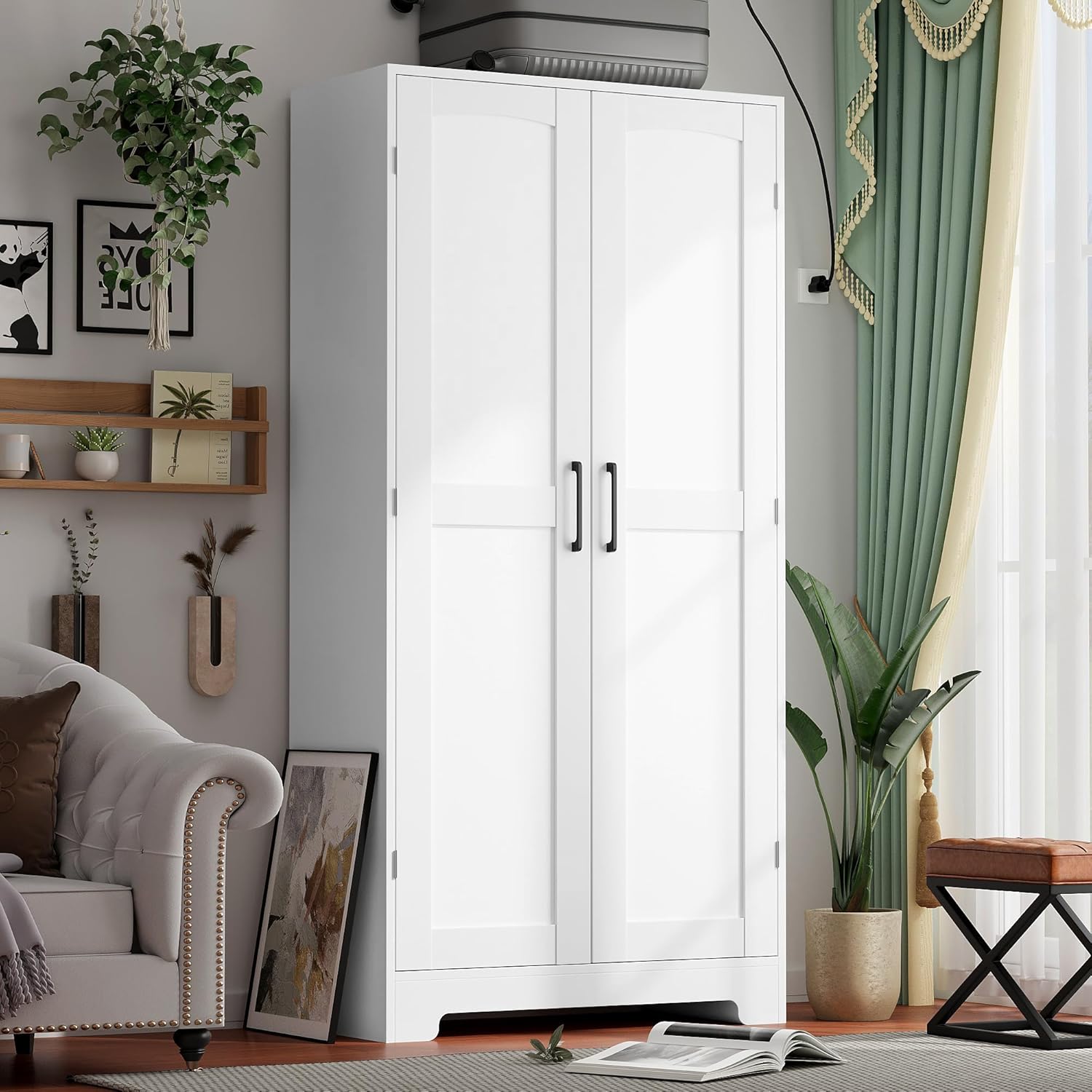
For the pieces, see armoires with drawers and armoire closets with drawers. For capacity planning, how much hanging space in a wardrobe. For the naming, armoire against wardrobe and chifferobe against armoire. For folded clothes, dresser depth.
Questions we get asked
What is the difference between a single and a double wardrobe?
Width and door count — 20 to 36 inches with one door against 36 to 60 with two. What matters is the rail inside.
Does a double wardrobe hold twice as much?
Only if the rail runs the full width. Many doubles put shelves behind one door, which can leave less rail than a wide single.
How much rail does each give?
About 18 to 32 inches on a single and 32 to 56 on a continuous-rail double. Allow 1 inch per garment on slim hangers.
How much clearance do the doors need?
Twenty-four to 30 inches across the front of a double, since you open both. Sliding doors remove the problem.
Is two singles better than one double?
For flexibility and stairs, yes. For capacity per pound and per inch, one double is better — you pay for two carcass ends instead of four.
Which suits a child’s room?
A single, usually with a double rail. Children’s clothes are short, so two rows fit in one bay.