Armoires with drawers — Hanging height is what you are buying
The Wooden Stars is a participant in the Amazon Services LLC Associates Program. We may earn a commission when you buy through links on our site, at no extra cost to you.
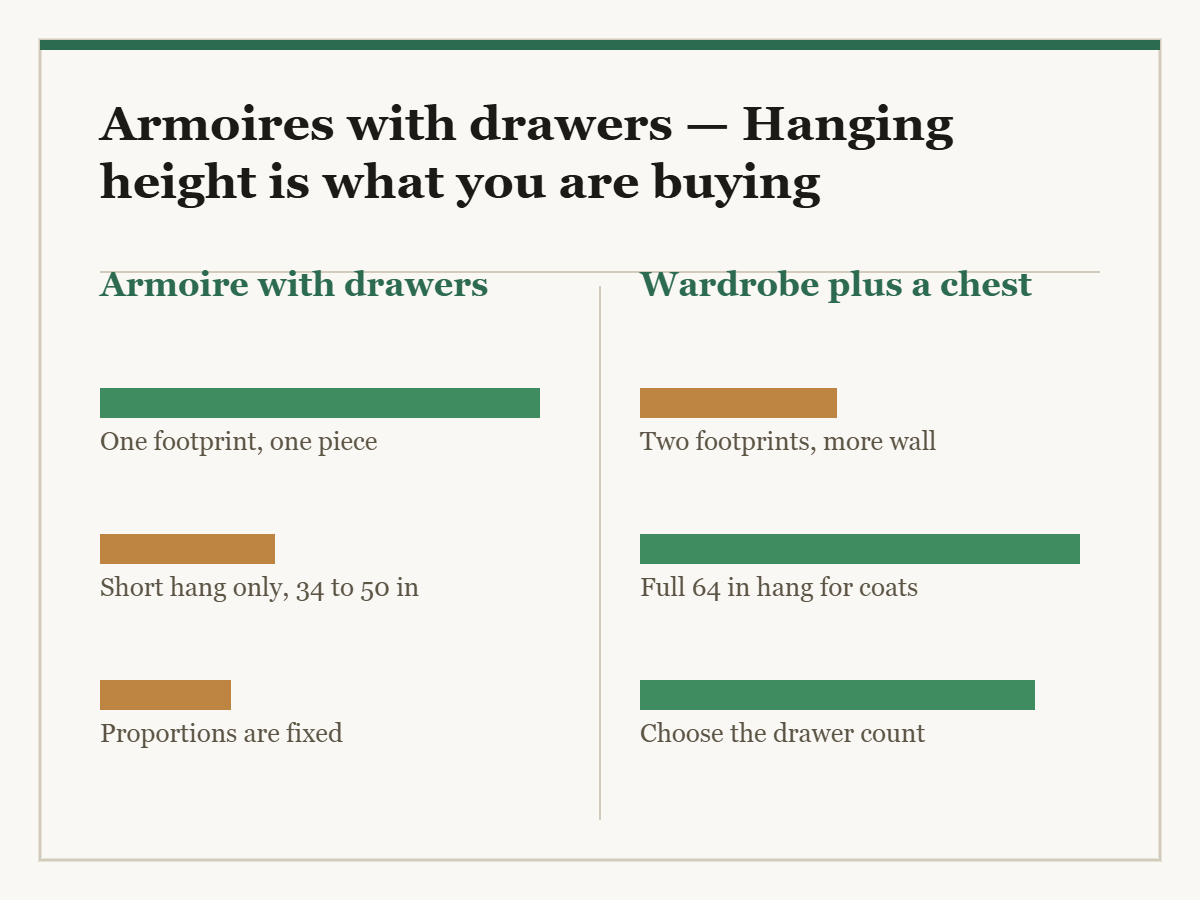
An armoire with drawers is trying to be two pieces of furniture in one carcase: a wardrobe for things on hangers and a chest for things folded. The photographs make it look like you get both at full size. You do not — the drawers eat the hanging space, and the only question that matters is how much is left.
Everything else about these cabinets is straightforward. This one measurement decides whether the piece works for your clothes or becomes an expensive cupboard full of jumpers.
A full-height armoire is 65 to 78 inches tall. Add a bank of drawers at the bottom and you lose 16 to 24 inches of that to the drawer box, so the hanging rail drops to somewhere between 34 and 50 inches of clear height. That is short-hang only: shirts, jackets and folded trousers. Anything long — dresses, coats, full-length trousers on a single hook — needs 60 inches and will not fit. Check the stated clear hanging height, not the cabinet height; check the internal depth is at least 21 inches or the doors will not shut on a hanger; and anchor it to the wall on day one.
The hanging height arithmetic
Work it from the top down. A 72-inch armoire has perhaps 3 inches of top rail and cornice, then the rail sits an inch or two below the roof of the compartment.
Then take off the drawers. Two deep drawers is 16 to 20 inches including the runners and the dividing rail; three is 24 or more. What is left — commonly 42 to 50 inches on a 72-inch cabinet with two drawers — is your clear hang.
The numbers that matter on the other side:
- Shirts and jackets: 36 to 40 inches. Fits comfortably.
- Trousers folded over the bar: 44 inches. Usually fits.
- Dresses and long coats: 60 to 68 inches. Does not fit in a drawer-base armoire, at any price.
Depth, and why doors stop closing
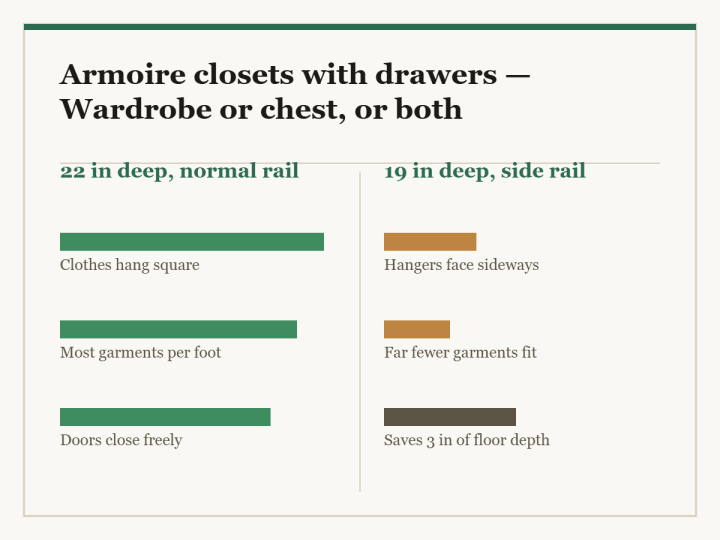
A coat hanger is about 17 inches wide and the shoulders of a jacket add more. Hung square to the back of the cabinet, clothes need 21 to 24 inches of internal depth before the doors will close without pressing on them.
Plenty of armoires are 19 or 20 inches deep externally, which leaves 17 or 18 inside. Those are built for a pull-out side rail — a short bar that runs front to back and holds hangers sideways — and that works, but it holds far fewer garments per foot of width.
If the listing does not state internal depth, the external depth minus about 2 inches is a fair estimate. Under 21 and you should expect the side-rail arrangement.
| Configuration | Clear hang | What it suits |
|---|---|---|
| No drawers, 72 in cabinet | 64 to 68 in | Coats and dresses |
| One drawer, 72 in | 54 to 58 in | Most things except long coats |
| Two drawers, 72 in | 42 to 50 in | Shirts, jackets, folded trousers |
| Three drawers, 72 in | 34 to 42 in | Shirts only, or double-hang |
| Two drawers, 65 in cabinet | 36 to 42 in | Shirts only |
The drawers themselves
Drawers in the base of an armoire carry more weight than drawers anywhere else in the house, because they are the easy place to put jumpers, jeans and bedding.
Runners. Side-mounted ball-bearing runners rated to 75 lb are what you want. Bottom-mounted roller runners are common and fine until the drawer is full, then they tilt and drag. Measuring and replacing them is covered in how to measure drawer slides.
The drawer box. Dovetailed or grooved solid sides last; stapled boxes with a bottom panel sitting in a rebate will loosen. If a drawer already sticks, the diagnosis order is in when a dresser drawer will not slide.
Full extension or not. A drawer that only pulls three-quarters out hides its back six inches, which on a deep armoire drawer is a lot of jumper.
Tipping, which is not optional here
This is a tall, narrow cabinet with heavy drawers at the bottom and doors that swing out. Open both doors and pull a loaded drawer and the centre of gravity moves forward, over a base perhaps 20 inches deep.
Anchor it to a stud on the day it is assembled. The reasoning and the kit are the same as for a chest of drawers — see anti-tip kits for dressers and tall chests of drawers.
Also level it before you load it. A cabinet this tall amplifies a dip in the floor into doors that swing open on their own, and the fix is a few minutes with levelling feet and glides.
When two pieces beat one
If you own long coats or dresses, a drawer-base armoire cannot hold them, and no amount of good construction changes that. A plain wardrobe plus a separate chest gives you the full 64 inch hang and lets you pick how many drawers you want.
The armoire wins on footprint and on looking like one deliberate piece rather than two. It also wins in a room where a second piece would block a door or a window.
The naming here is genuinely confusing, and the distinctions are worth knowing before you shop — see armoire against wardrobe, armoire against dresser and chifferobe against armoire, which is the hybrid closest to this piece.
What it is made of
The carcase sides carry the rail, the doors and everything hanging on them. That load lands on screws into panel edges at the top corners.
Solid timber or plywood holds those screws indefinitely. Particleboard holds them until someone hangs a winter coat collection on a 40-inch rail, then the top corner opens up. The material terms are decoded in what engineered wood actually is and what “all wood” actually means.
Before it is loaded
- Anti-tip strap Tall, front-loading, and heaviest at the bottom drawers
- Levelling feet Stops doors swinging open on their own
- Cedar blocks A closed cabinet holds moth risk more than an open rail
- Drawer runners Side-mounted ball bearing, rated 75 lb, for the base drawers
What to buy
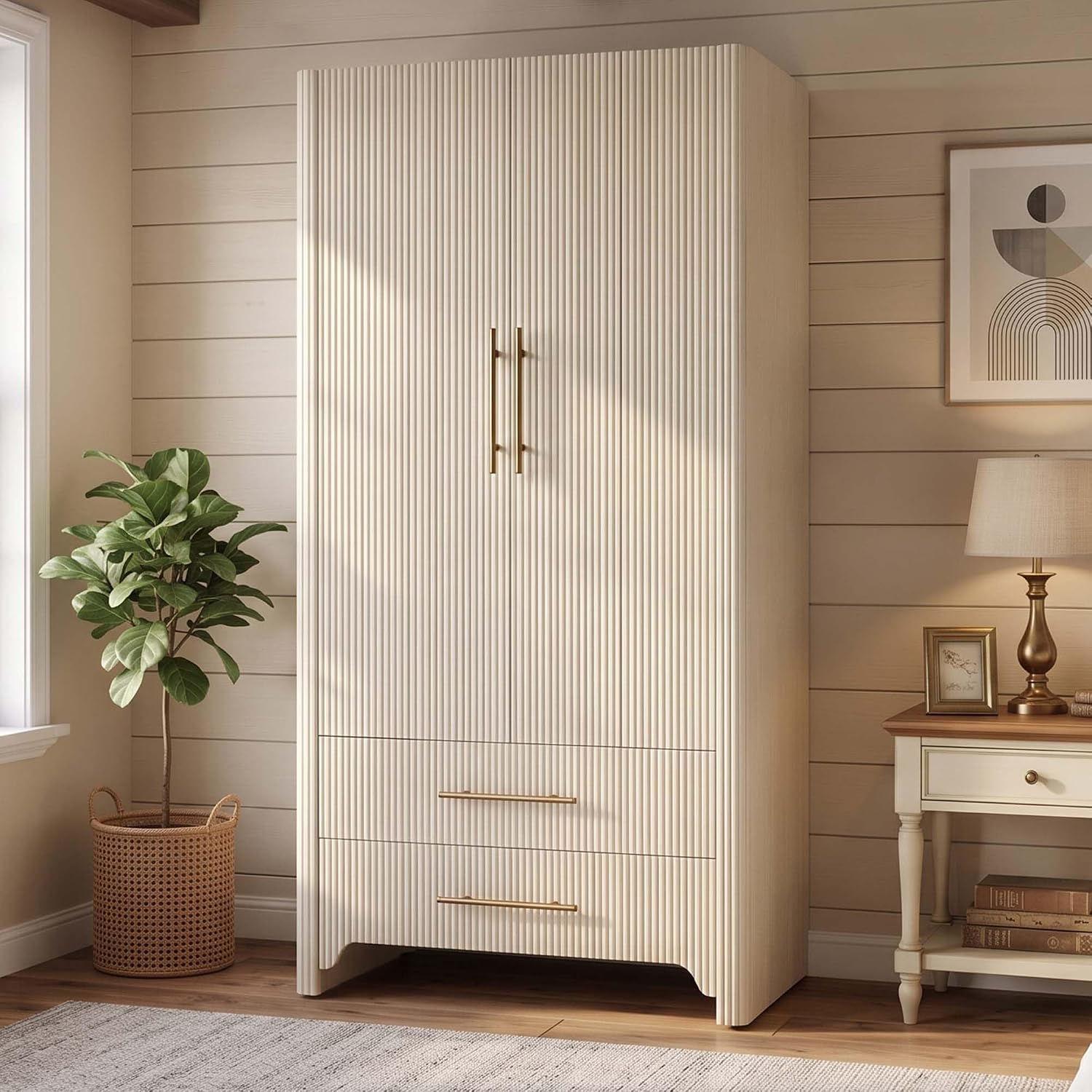


If you want the drawers without the cabinet, see tall chests of drawers and solid wood dressers. For the same job in a smaller room, armoire closets with drawers covers the compact versions. Hardware upgrades are in brass dresser hardware.
Questions we get asked
How much hanging space does an armoire with drawers give?
Usually 34 to 50 inches of clear rail, depending on how many drawers are in the base. That is short-hang only.
Will a long coat fit?
No. Coats and dresses need about 60 inches of clear hang, which a drawer-base armoire does not have at any height.
How deep does it need to be?
At least 21 inches inside, or the doors press on the shoulders of what is hanging. Shallower cabinets use a side rail that holds hangers sideways.
Do I have to anchor it to the wall?
Yes. It is tall and narrow, loads heaviest at the bottom, and both doors plus a full drawer move the weight forward over a shallow base.
Is one armoire better than a wardrobe plus a chest?
It is better on floor space and looks like one piece. Two pieces give you full hanging height and let you choose the drawer count.
What should the drawer runners be?
Side-mounted ball-bearing runners rated to about 75 lb. Base drawers end up holding jumpers and bedding, which is more weight than most drawers ever carry.