How far should a nightstand be from the bed? 2 to 6 in
The Wooden Stars is a participant in the Amazon Services LLC Associates Program. We may earn a commission when you buy through links on our site, at no extra cost to you.
How far should a nightstand be from the bed? 2 to 6 inches — close enough to reach a glass of water lying down, far enough that bedding does not drag across it.
Most people put it flush against the frame, which is the one position that causes problems.
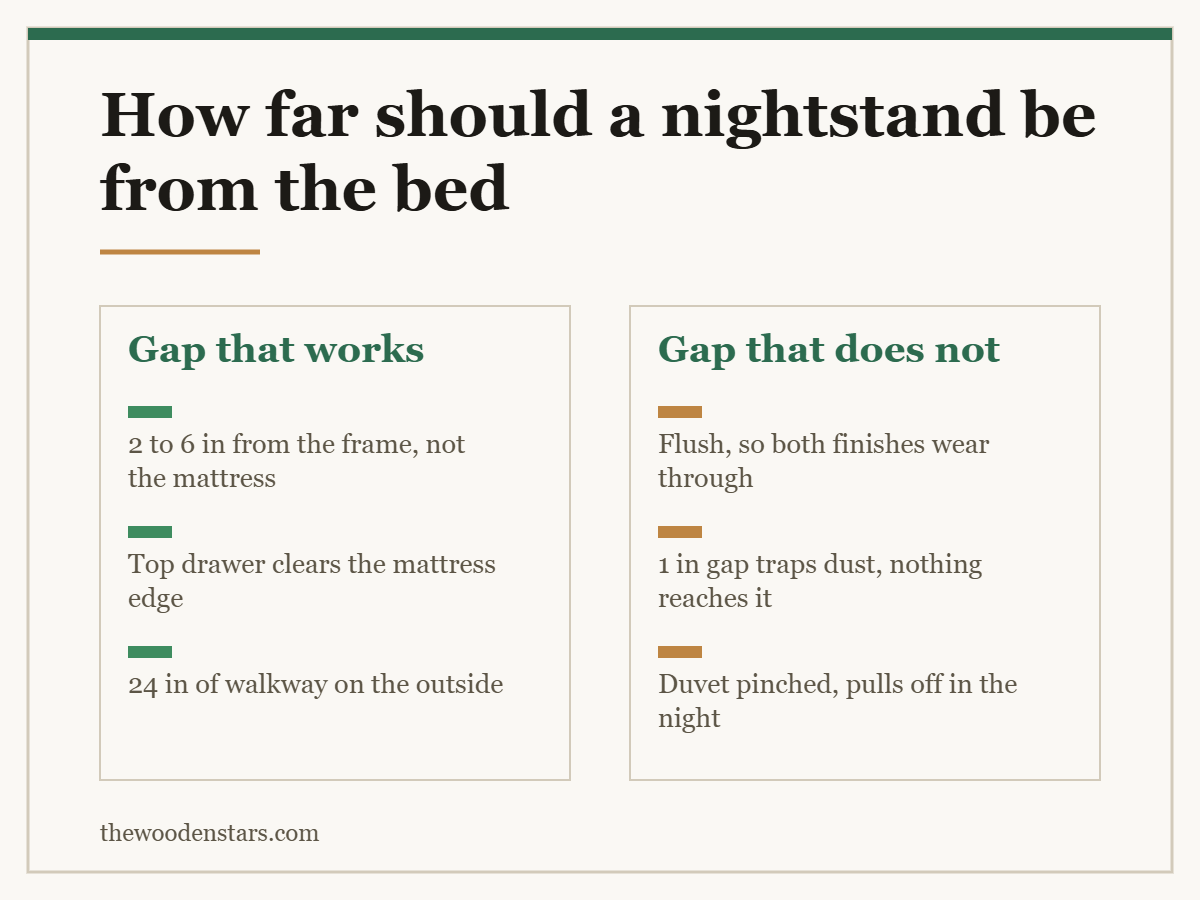
Leave a gap of 2 to 6 inches between the bed frame and the nightstand. Two to three inches suits a platform bed with a low, tight duvet; 4 to 6 suits a tall mattress with a deep overhanging quilt, because the bedding needs somewhere to fall. Flush against the frame traps dust, scuffs both finishes as the bed shifts, and stops drawers opening past the mattress. More than about 8 inches and you cannot reach the surface without sitting up. Check separately that the drawer clears the mattress and that there is 24 inches of walkway on the outside.
How far should a nightstand be from the bed: the working gap
Three things set the number.
- Reach. Lying on your side, an arm reaches comfortably about 24 to 28 inches from the mattress edge. The nightstand top has to be inside that.
- Bedding. A duvet with a 10-inch drop needs somewhere to hang. Pressed against a nightstand it rides up and pulls off you during the night.
- Movement. Beds shift a little every time someone gets in. A frame touching a nightstand grinds against it, and both finishes lose.
So: 2 to 3 inches for a platform bed with a fitted duvet and no overhang, 4 to 6 for a tall mattress with a deep quilt or a valance. The gap is measured from the outside of the bed frame, not the mattress, because the frame is usually wider.
| Bed | Gap | Why |
|---|---|---|
| Platform, fitted duvet | 2 to 3 in | No overhang to accommodate |
| Standard frame, normal duvet | 3 to 4 in | Bedding hangs clear |
| Tall mattress, deep quilt | 4 to 6 in | Quilt drop needs room to fall |
| Bed with a valance | 4 to 6 in | Valance must not catch drawers |
| Upholstered frame | 3 to 5 in | Fabric scuffs against timber |
What goes wrong when it is flush
Drawers stop opening. A nightstand hard against a tall mattress often has its top drawer fouled by the overhanging bedding or, on a wide frame, by the frame itself. You notice in week two.
Both finishes wear. Timber against timber with a few millimetres of nightly movement polishes through the finish within a couple of years, and on an upholstered frame it pills the fabric.
The gap becomes a dust trap you cannot reach. Counter-intuitively, a 1-inch gap is far worse than a 4-inch one, because nothing gets in to clean it and everything falls into it.
Bedding rides up. A duvet pinched between frame and nightstand pulls off the far side of the bed during the night, which is the version of this problem people never diagnose correctly.
The other two clearances to check
Drawer clear of the mattress. Measure from the floor to the top of the mattress, then check the nightstand’s top drawer sits below it — or that the gap is wide enough for the drawer to pass the mattress edge. This is the commonest reason a perfectly nice nightstand gets returned. The height rule itself is in nightstand height.
Walkway on the outside. Twenty-four inches minimum between the nightstand and the wall or wardrobe for someone to get past; 30 if a wardrobe door opens there. Below 24 the nightstand becomes something you edge round in the dark.
If the room cannot give both the gap and the walkway, a narrower nightstand is the fix rather than pushing it against the bed — sizing is in how wide a nightstand should be. A floating nightstand fixed to the wall also frees the floor entirely, and it lets you set the gap exactly.
Height and reach together
The gap only works if the height does. A nightstand whose top is level with the top of the mattress, give or take 2 inches, puts a glass where your hand naturally lands. Too low and you fumble; too high and you knock things off reaching over.
Tall mattresses have made this harder — a 14-inch mattress on a 14-inch frame puts the sleeping surface at 28 inches, while most nightstands are built at 24 to 26. A taller nightstand, or one with a low profile and a lamp that lifts the light instead, is the honest answer.
The full height reasoning is in nightstand height, and what a nightstand should hold in how much weight a nightstand can hold.
One thing that quietly forces the gap wider than you planned: the socket. A plug and its cable need 2 to 3 inches behind the nightstand, and a right-angled plug or an extension lead with a flat body saves most of that. Work it out before the bed goes in, because the alternative is a nightstand standing 4 inches off the wall with the gap to the bed shrinking to make up for it — which is the arrangement that traps dust and stops drawers opening.
Setting the gap
- Tape measure From the frame edge, not the mattress edge
- Felt furniture pads Stops a nightstand scuffing the bed frame if they do touch
- Furniture levellers A nightstand that rocks drifts into the bed over months
- Under-bed storage bags Frees the nightstand from holding what does not belong there
What to buy




For sizing, see how wide a nightstand should be and nightstand height. For how many, one nightstand against two. For the alternative, nightstand against side table.
Questions we get asked
How far should a nightstand be from the bed?
Two to 6 inches from the bed frame. Two to three for a platform bed, four to six if the bedding overhangs.
Can it touch the bed?
Better not. The bed moves slightly every night and both finishes wear through within a couple of years.
Why is a small gap worse than a bigger one?
Because a 1-inch gap collects dust and dropped items and nothing can reach in to clean it.
What if the drawer will not open?
The mattress is fouling it. Either widen the gap so the drawer passes the mattress edge, or choose a nightstand whose drawer sits lower.
How much room on the other side?
Twenty-four inches of walkway, or 30 if a wardrobe door opens into it.
Does the gap change with a tall mattress?
Yes. Deep quilts need 4 to 6 inches so the bedding has somewhere to fall.