Dresser Drawer Will Not Slide? Start With the Back Panel
The Wooden Stars is a participant in the Amazon Services LLC Associates Program. We may earn a commission when you buy through links on our site, at no extra cost to you.
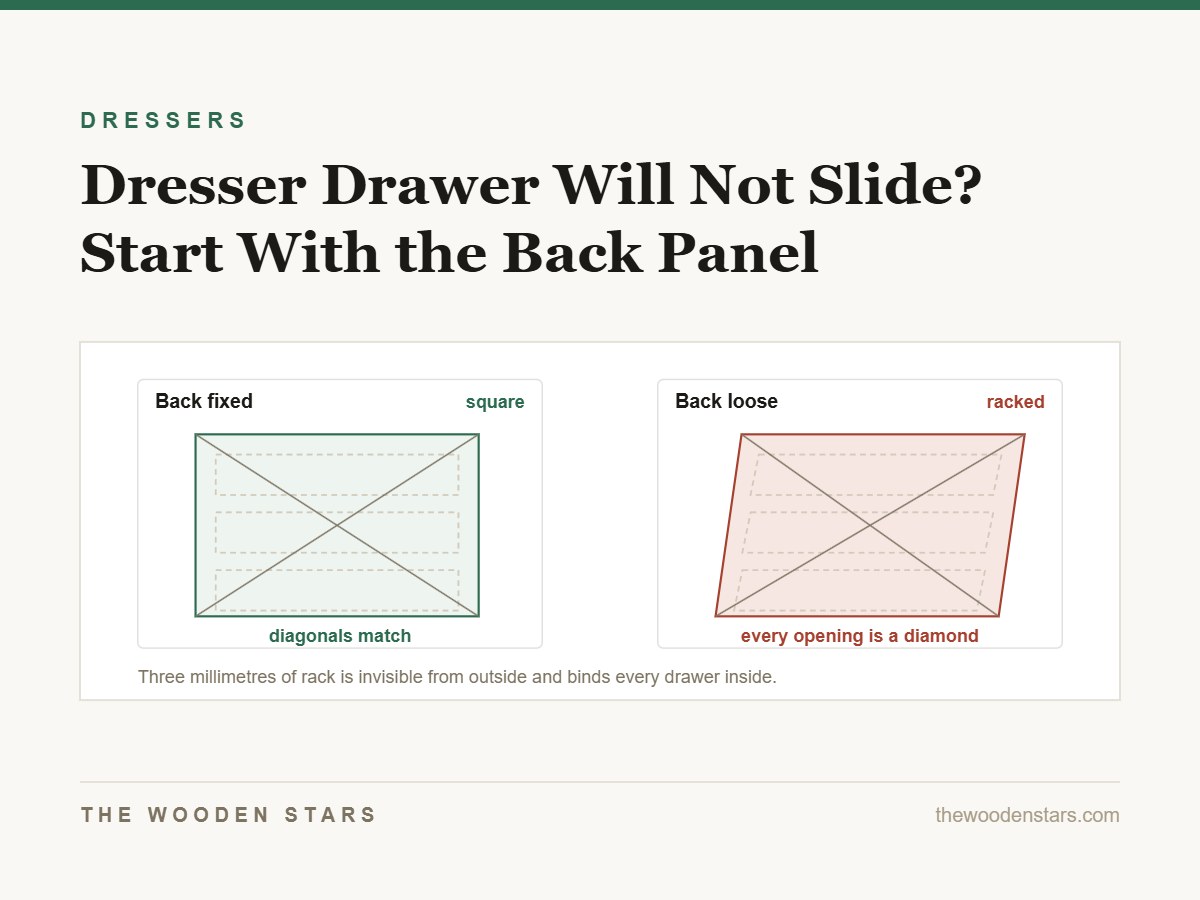
When one drawer in a dresser sticks, it is usually that drawer. When every drawer in the case starts binding at once, it is almost never the drawers — it is the back panel, and the reason is that the back panel is what holds the carcass square.
A dresser is a box. Take the back off a box and it becomes a parallelogram waiting to happen. Once the case racks by two or three millimetres, every opening in it goes out of square, and drawers that fit perfectly in a square opening bind in a diamond-shaped one.
If all the drawers bind, check the back panel: a loose, buckled or partly-detached back lets the case rack out of square. Re-fix it and the drawers usually free themselves. If one drawer binds, the cause is that drawer — worn slides, a swollen runner, a loose drawer box, or something wedged behind it. Wax before you replace anything: it fixes more sticking drawers than new hardware does.
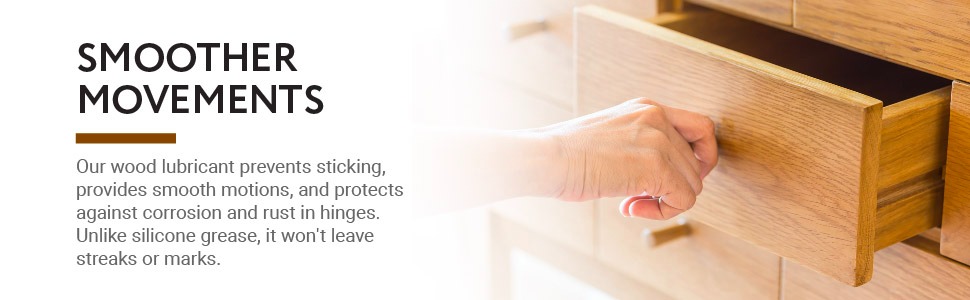
Start here: drawer wax is the five-minute fix, and it works on more sticking drawers than new hardware does.

Prime Impresa 6 Oz Wood Drawer Wax Paste - Friction-Free Sliding & Slide Wax - Squeak Elimination & Wood Lubricant for Smooth Movement - Corrosion Protection & Drawer Glide Lubricant














Diagnose by how many drawers are affected
| Pattern | Almost always | Fix |
|---|---|---|
| All drawers bind | Case racked — back panel loose | Re-fix or replace the back panel |
| All drawers bind after moving house | Case racked in transit | Square the case, then re-fix the back |
| Only the bottom drawers bind | Case sagging, or feet uneven | Level the piece, check the bottom rail |
| One drawer binds | That drawer or its slides | Wax, then inspect the runners |
| One drawer binds only in summer | Wood swelling | Wax and, if needed, plane 1 mm off the runner |
| Drawer drops at the front when open | Slides worn or wrong extension | Replace the slide pair |
| Drawer will not close fully | Something behind it, or a screw poking through | Empty and look before forcing |
The back panel: the real fix for a racked case
Turn the dresser round and look. Three things go wrong:
- Staples or brads have pulled out. Standard on flat-pack and common on older solid wood pieces too. The panel is still there but no longer holding anything.
- The panel has buckled — thin hardboard bowing outward in the middle. It has stopped being a structural diaphragm.
- Someone removed it to run a cable and never put it back.
The repair sequence:
- Empty the dresser and remove all the drawers. Non-negotiable — you cannot square a loaded case.
- Measure both diagonals of the back opening. Equal diagonals means square. On a racked case they will differ by 3 to 10 mm.
- Push the case square. Pressure on the long diagonal’s corner, gently, with the case on a flat floor. It moves more easily than you expect.
- Fix the back down while it is square. Screws, not staples: 16 mm screws every 100 mm around the perimeter and along any internal rails. This is the step that makes the repair permanent.
- Refit the drawers and check. They should slide freely again. If one still binds, that one has its own problem.
If the panel is beyond saving, replace it with 6 mm plywood rather than hardboard. Plywood is stiffer in shear, which is the property that actually matters here, and it is what keeps the case square for the next twenty years.
One drawer sticking: wax first
Before buying anything, do this. Pull the drawer right out and look at the wooden runners — both the strips on the drawer sides and the rails in the case. You will see shiny worn tracks where they rub.
Rub paste wax, or a dedicated drawer wax, along every shiny surface on both drawer and case. Not oil, not silicone spray: oil attracts dust and turns into a paste that binds worse than bare wood, and silicone makes future glue repairs impossible. Wax is the traditional answer because it is the right answer.
This alone fixes a large majority of sticking wooden drawers, and it takes five minutes per drawer.
When it is the runner, not the friction
- A worn groove in a wooden runner — the drawer has cut its own track and now drops into it. Glue a thin strip of hardwood over the worn area and re-wax.
- A swollen runner. Wood grows across the grain in humid weather. Wax first; if it still binds in August, take 0.5 to 1 mm off the runner’s side, not its bearing face, with a block plane. Take less than you think.
- A loose drawer box. If the drawer itself has racked — the joints at its corners loosened — it will bind no matter what the case does. Re-glue it square, as in our guide to re-gluing a loose joint.
- A screw or nail poking through from a repair someone made earlier. Very common, and instantly obvious once you look with a torch.
Upgrading to metal slides
If the wooden runners are worn out, fitting ball-bearing slides is a genuine upgrade: smoother, quieter, full extension, and they carry more weight. Two things to know before you buy:
- Side-mount slides need clearance — typically 12.7 mm (1/2 in) each side. If the drawer currently fills the opening, it must be narrowed, which usually means rebuilding the drawer box.
- Length is measured on the slide, not the drawer, and it must not exceed the internal depth of the case. A slide 25 mm too long will not let the drawer close.
The full measuring procedure, including which of the three mounting types your dresser can take, is in our guide to measuring drawer slides. Measure before ordering; slides are the single most commonly returned furniture part.
What this repair actually takes
- Drawer wax paste The five-minute fix, and the first thing to try On Amazon →
- Paste wax Works on runners, slats and anywhere wood rubs wood On Amazon →
- Ball-bearing drawer slides, full extension When the wooden runners are past saving On Amazon →
- 6 mm plywood and 16 mm screws For the back panel that racked the case
- Block plane Only if wax has failed and the runner is genuinely swollen
What to buy
Wax first, always. Only buy slides once you have waxed the runners and the drawer still binds.


Two habits that stop it coming back
- Wax the runners once a year. Same visit as retightening the bed bolts. It is a two-minute job per drawer that prevents most of what this article is about.
- Never lift or drag a dresser by the top. Dragging a case by its top is precisely the load that racks it — you are applying force at the top of a box whose only shear resistance is a thin panel at the back. Lift from the base, and empty the drawers first.
And while the drawers are out, this is the natural moment to fit an anti-tip fixing, because an empty dresser is the only time it is easy. Our guide to anti-tip kits covers doing it properly in solid wood.
Questions we get asked
Should I use soap, candle wax or a proper drawer wax?
All three work on the same principle and all three are better than oil. A dedicated drawer wax lasts longest because it contains harder waxes; a plain candle is the cheapest thing that works; bar soap works but attracts moisture. What matters most is that it is a wax and not a spray lubricant.
Why does only my bottom drawer stick?
Two usual reasons. The bottom of a case takes the most weight, so the bottom rail can sag — check with a straightedge. And an unlevel floor tilts the whole case, which shows up worst at the bottom because that is where the clearances are smallest. Level the piece before blaming the drawer.
Can I fit soft-close slides to an old wooden dresser?
Usually yes, and the constraint is space rather than age. Soft-close side-mount slides need the same 12.7 mm clearance plus a little depth for the mechanism at the back. Undermount soft-close slides need a specific drawer bottom construction that most old drawers do not have.
The drawer sticks only when it is full. Is that normal?
It is normal on wooden runners and it is a sign the slide system is at its limit. A loaded drawer flexes its own sides outward, which is what starts the bind. That is exactly the case where ball-bearing slides are worth fitting — they carry the load on the slide, not on the drawer’s own geometry.
My drawer fronts are no longer level with each other. Same problem?
Usually the same racked case, yes — if the openings have gone out of square, the fronts follow them. Square the case and re-fix the back first, and check the fronts again before adjusting anything on the drawers themselves.