Outdoor furniture is the only furniture you buy knowing the weather will attack it. Everything that matters follows from that: which timber you pick, whether the joints are bolted or stapled, how the piece drains, and whether you are honestly going to oil it once a year or leave it alone for a decade. The shape and the seat count are the easy part.
Buy on timber and joinery first, then size. Teak lasts decades untreated and costs the most; acacia and eucalyptus last five to fifteen years if you oil them, and a couple of seasons if you do not. Check the fixings: stainless or coated bolts survive, plain steel screws bleed rust stains down the timber within a year. Then size it — 24 inches of table edge per diner, 36 inches of clearance to walk behind a pulled-out chair, and a table height of 28 to 30 inches.
The timbers, and what each one actually asks of you
Teak — high natural oil content, which is what resists rot rather than hardness. Left alone it silvers to grey and keeps its structure for decades. Oiled, it stays honey-coloured and needs doing annually. The most expensive option by a wide margin, and the only one that genuinely tolerates neglect.
Acacia — dense, hard, widely available and a fraction of teak’s price. It has some natural oil but not teak’s. Oiled once or twice a year it lasts well; ignored on an exposed deck it checks and greys within two seasons. Most affordable “solid wood” patio sets are acacia.
Eucalyptus — similar position to acacia, often sold as a teak alternative. Same bargain: cheap, decent, needs the oil.
Cedar and redwood — light, naturally rot-resistant, soft. Excellent for benches and swings where weight matters and dents do not.
Pine, treated or not — the cheapest, and the one that will not last outside untreated. Pressure-treated pine is a structural material, not furniture timber.
The single most useful thing to understand is that oil content, not hardness, predicts outdoor life. A Janka rating tells you how well a timber resists dents from a dropped plate. It tells you almost nothing about how it will handle two winters of rain.
Joinery and fixings, which is where cheap sets fail
Outdoor furniture moves. Timber swells when it rains and shrinks when the sun comes out, and it does this every few days for years. A joint that is merely glued will open.
Bolts through the timber, with a nut or a barrel nut, survive that cycling and can be pulled up when they loosen. This is what you want on anything that carries weight.
Stainless steel or properly coated fixings. Plain steel screws rust, and the rust runs down the timber in black streaks that do not sand out. This is the single most common cosmetic failure on budget sets.
Mortise and tenon on chair frames, where there is room for it. Doweled joints on an outdoor chair have a shorter life than the timber does.
Folding hardware is a wear point. Folding chairs and tables are convenient and they are the first thing to develop play.
Water has to get out
Most outdoor furniture failures are drainage failures rather than material failures.
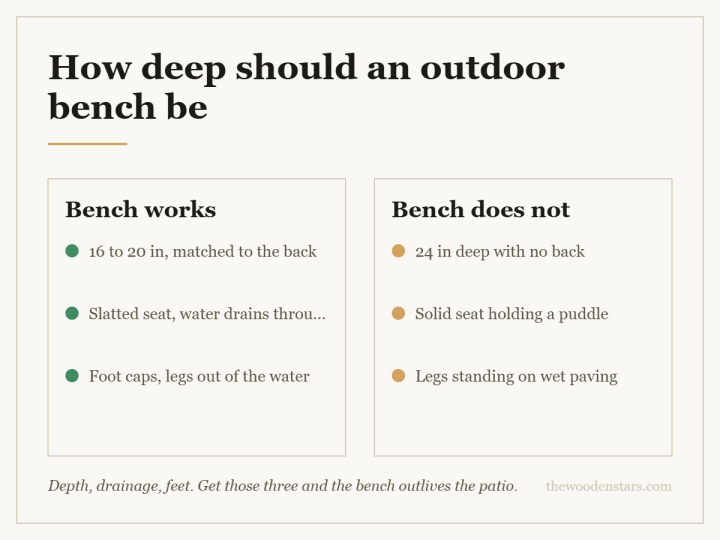
Slatted tops and seats let water through. A solid outdoor tabletop needs a slope, a gap, or somewhere for water to go; otherwise it sits in the joints and works on them. Feet matter too — timber legs standing in a puddle on a patio wick water upward, and the bottom two inches of the leg go first. Plastic or rubber foot caps are a genuinely worthwhile upgrade.
Cushion storage is the other half. Cushions left out absorb water, hold it against the timber and grow mildew. A deck box that costs a fraction of the set is what makes the set last.
Sizing a patio dining set
The arithmetic is the same as indoors, with two differences: the space is usually more constrained than it looks, and an umbrella eats a seat.
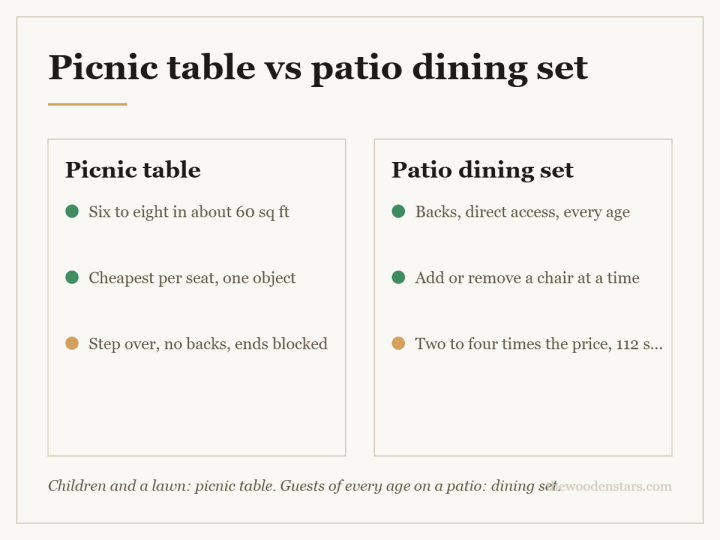
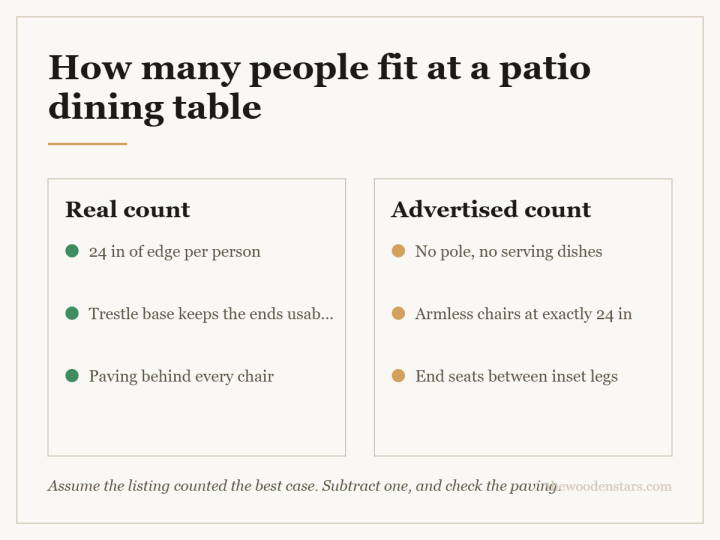
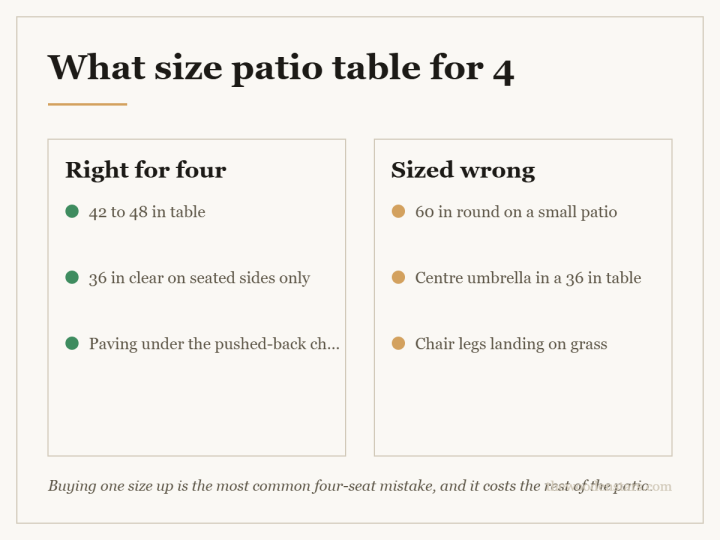
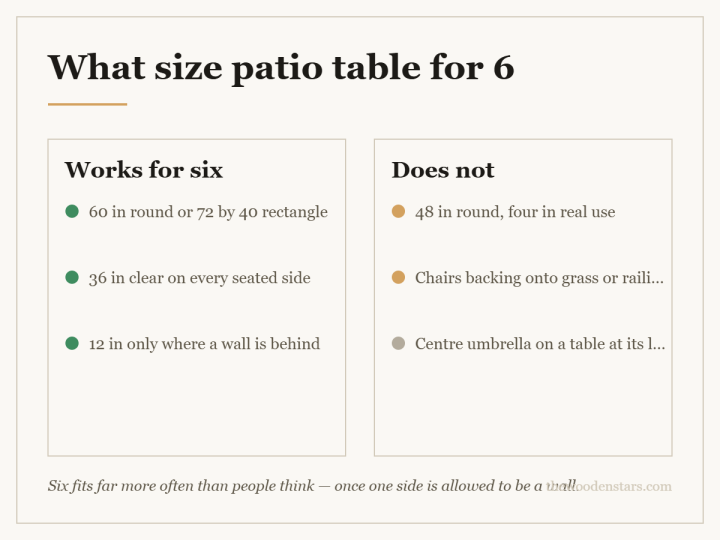
24 inches of table edge per diner. A 60-inch round seats six; a 72 × 40-inch rectangle seats six comfortably and eight at a squeeze.
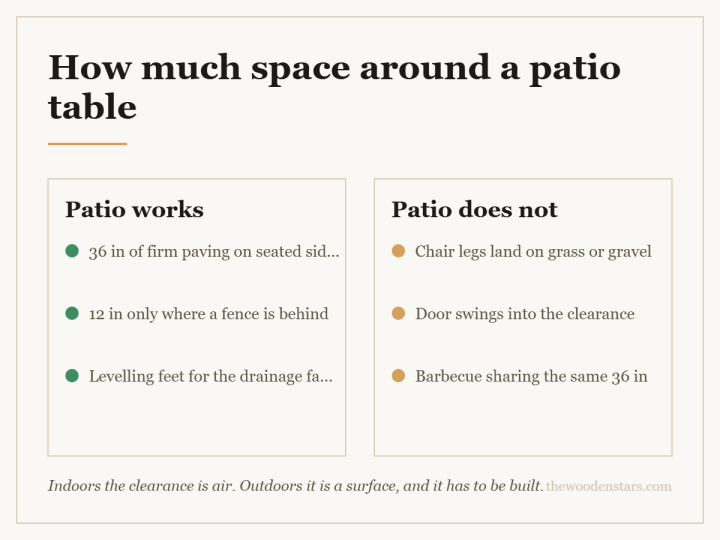
36 inches of clear floor behind every chair, so somebody can push back and stand. On a deck with a railing, measure to the railing and not to the edge of the boards.
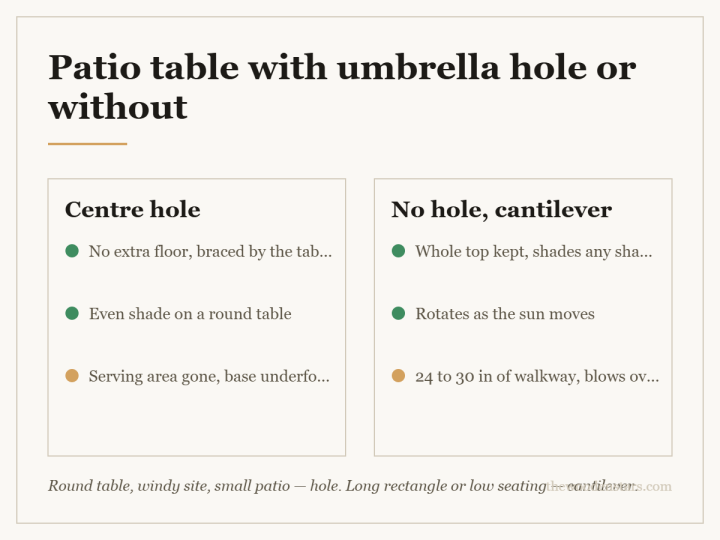
An umbrella through the middle takes the centre of the table out of use and often makes the two end seats awkward. Plan a cantilever umbrella instead if the seat count is tight.
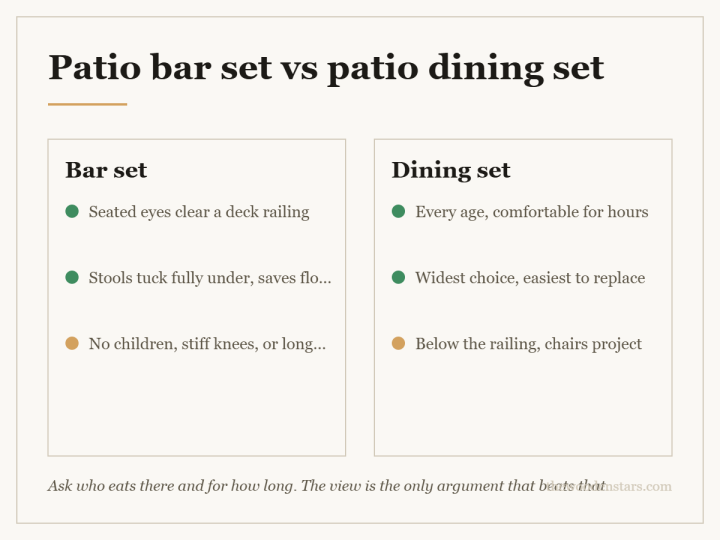
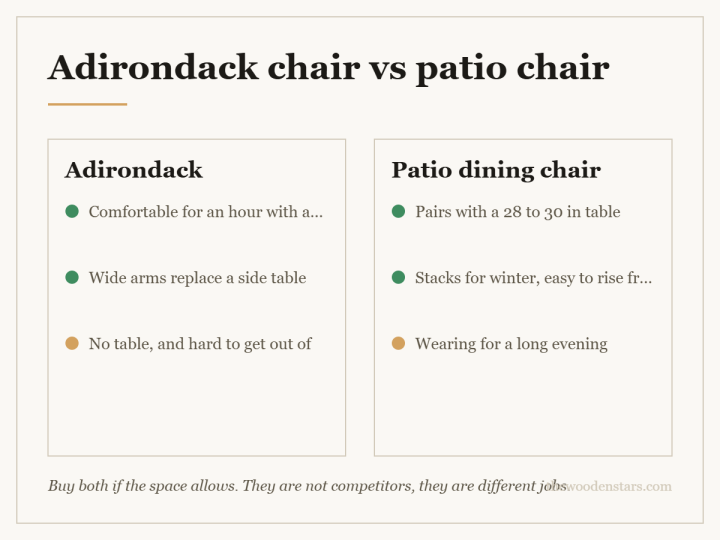
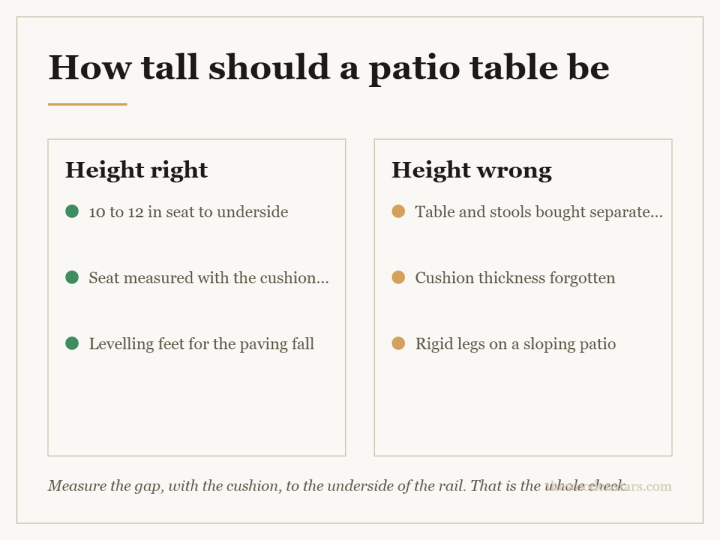
Table height 28 to 30 inches with 17 to 19-inch chairs, exactly as indoors. Bar-height patio sets run 40 to 42 with 29 to 30-inch stools.
Dining set, conversation set, or bistro set
These three words describe three different jobs, and the listings use them loosely.
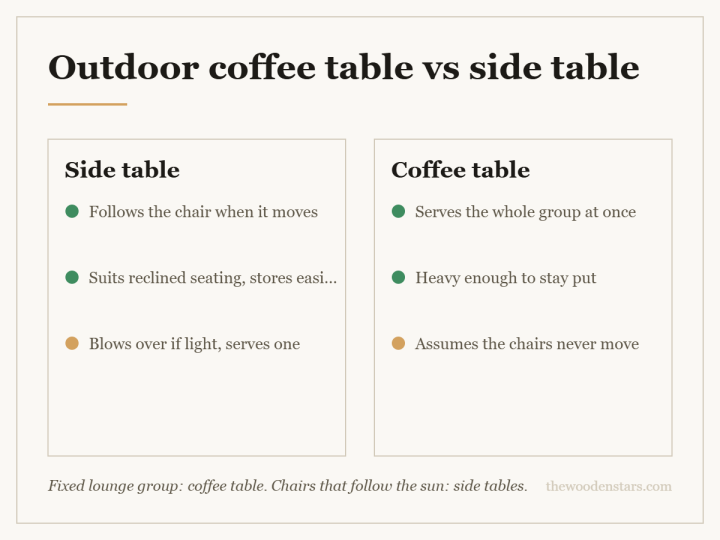
A dining set is a table at 28 to 30 inches with upright chairs — for eating. A conversation set is low seating around a coffee table at 16 to 20 inches — for sitting with a drink, not for a meal. A bistro set is a small table with two chairs, usually 24 to 30 inches across, for a balcony or a corner.
Most people who buy a conversation set for a patio they eat on regret it, and most people who buy a six-seat dining set for a balcony discover it does not fit. Work out which of the two things you actually do outside before looking at any photographs.
Benches, swings and loungers
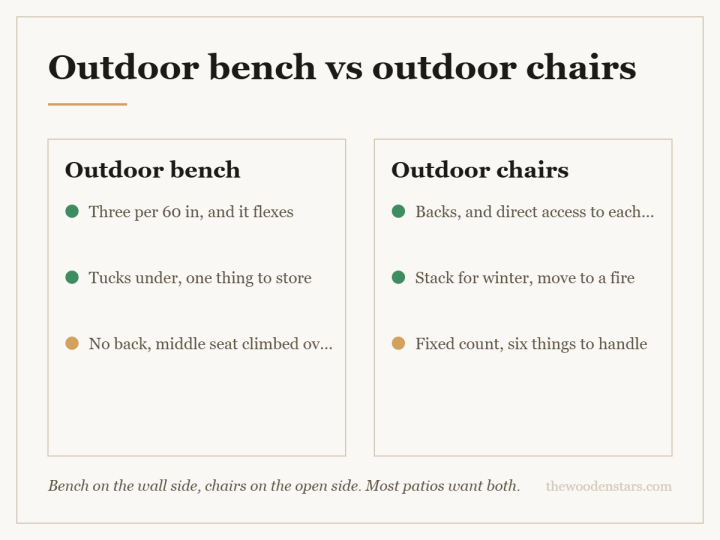
Benches give the most seats per foot and per pound — three adults on 60 inches, against two chairs in the same space. They have no back support unless you buy one that has it, and they do not move easily once they are in place.
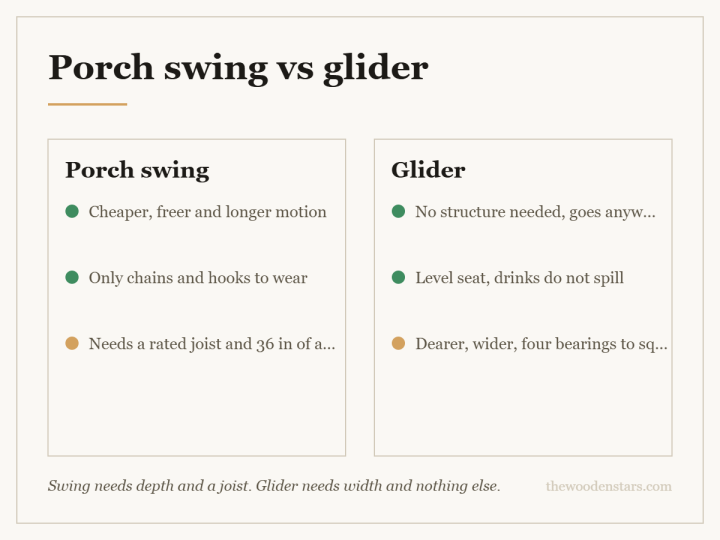
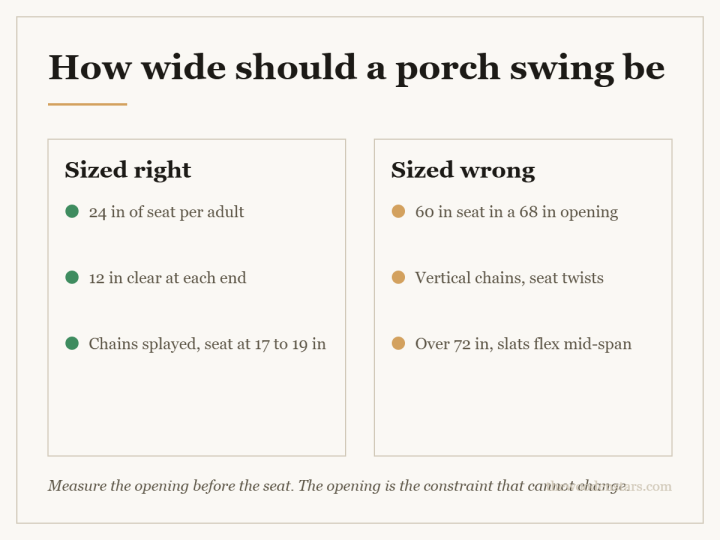
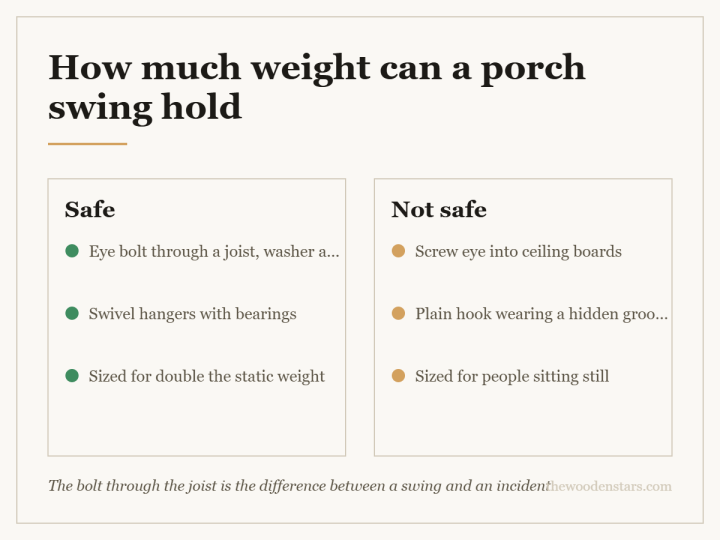
Porch swings and gliders are different products. A swing hangs from chains or ropes and needs a structure overhead rated for it; a glider stands on its own frame and needs nothing. If you are hanging a swing, the joist and the hardware matter more than the swing does.
Loungers and chaises are bought on the recline mechanism, which is the part that seizes. A timber lounger with a fixed back lasts longer than one with an adjustable back at the same price.
What to check on any listing
The timber, named. “Solid wood” and “hardwood” tell you nothing. Acacia, teak, eucalyptus, cedar — the species is the specification.
The fixings. If the listing does not say stainless, assume it is not.
Assembly. Most sets arrive flat. Read how many bolts; a six-chair set can be three hours of work.
Weight. Light furniture blows over. On an exposed roof terrace, mass is a feature.
Cushion fabric and whether cushions are included. Very often the photograph includes cushions the price does not.
What the warranty covers. Residential-only warranties are the norm and they generally exclude weathering, which is the thing that will happen.
The maintenance, stated honestly
If you oil an acacia or eucalyptus set once each spring — a couple of hours with a cloth — it will look good for a decade. If you do not, it will grey and check, which is a cosmetic failure rather than a structural one, and many people are perfectly happy with it. Teak is the only timber where doing nothing is genuinely the mainstream choice.
What you cannot skip: getting cushions under cover, keeping legs out of standing water, and pulling the bolts up once a year. Those three habits are worth more than any finish.