How wide is a patio chair? 22 to 28 inches
The Wooden Stars is a participant in the Amazon Services LLC Associates Program. We may earn a commission when you buy through links on our site, at no extra cost to you.
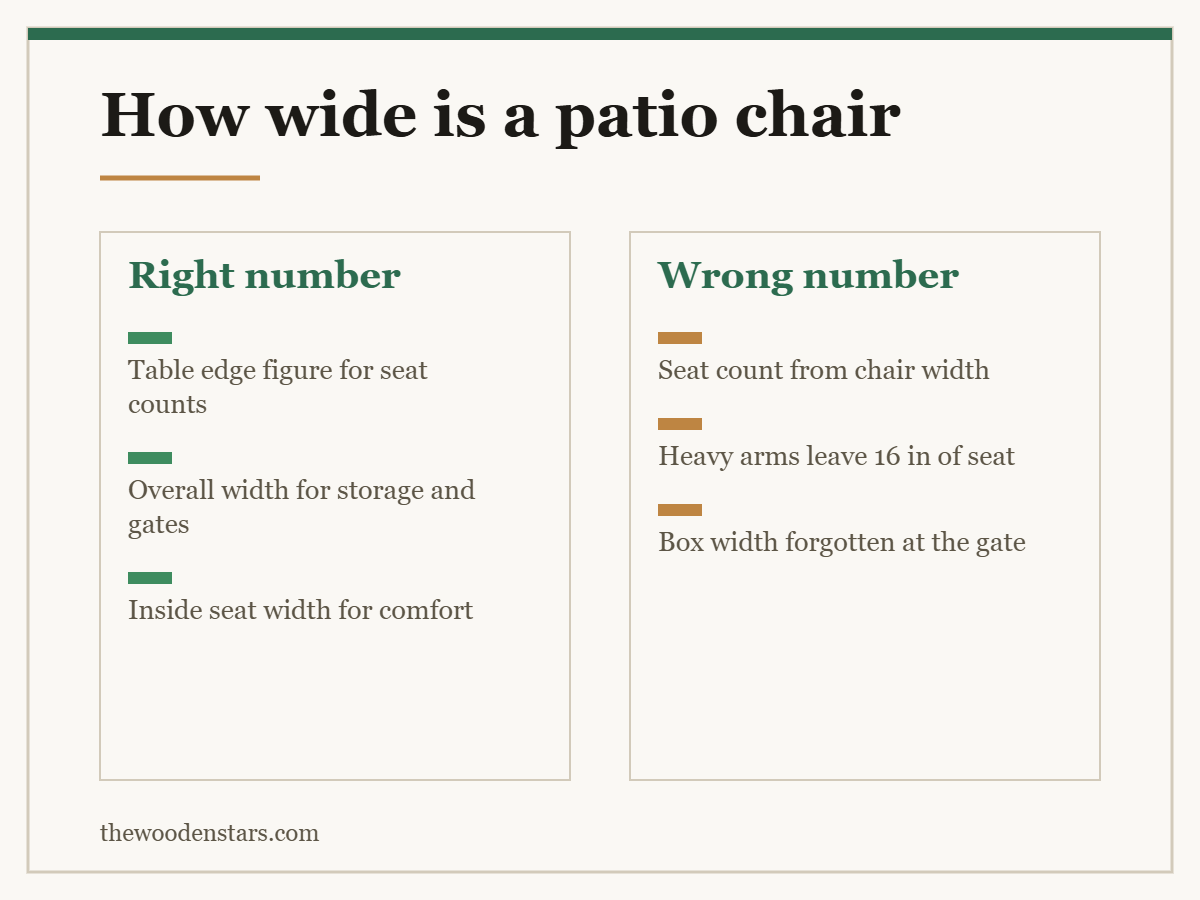
How wide is a patio chair? 22 to 28 inches overall — and the number that decides how many fit round your table is not that one, it is the 24 inches of table edge each person needs.
Those two figures get confused constantly, and the confusion is why six chairs arrive for a table that seats five.
An outdoor dining chair is 22 to 24 inches wide armless and 26 to 28 with arms. A lounge or club chair is 28 to 34. But chairs are not placed edge to edge — you plan on 24 inches of table edge per diner (26 to 28 with arms), which leaves a small gap between chairs. Seat width inside the frame is 17 to 20 inches, and that is the figure that decides comfort. For storage, add up the overall widths; for seat counts, use the table edge figure; for comfort, check the inside seat.
How wide is a patio chair: three different widths
Every chair has three, and listings usually give only the first.
- Overall width — the widest point, usually the arms or the back rail. 22 to 28 inches for dining, 28 to 34 for lounge. This is what you use for storage and for whether it fits through a gate.
- Table edge per diner — 24 inches armless, 26 to 28 with arms. Slightly more than the chair, because people need a gap. This is what decides seat counts.
- Inside seat width — between the arms or the back uprights, 17 to 20 inches. This is what decides whether the chair is comfortable.
The inside figure is the one almost never published and the one that matters most in use. A 28-inch armchair with 4-inch timber arms gives 20 inches of seat — generous. The same 28 inches with heavy 6-inch arms gives 16, which is tight for many adults.
| Chair | Overall | Table edge | Inside seat |
|---|---|---|---|
| Dining, armless | 22 to 24 in | 24 in | 18 to 20 in |
| Dining, with arms | 26 to 28 in | 26 to 28 in | 17 to 20 in |
| Folding | 20 to 23 in | 23 in | 16 to 18 in |
| Adirondack | 30 to 34 in | — | 20 to 24 in |
| Club or lounge | 28 to 34 in | — | 20 to 24 in |
| Bar stool | 16 to 20 in | 22 in | 15 to 18 in |
Using the right number for the right job
For seat counts, use the table edge figure. Divide the usable edge by 24 (or 26 to 28 with arms). A 60-inch round has 188 inches of circumference, so eight armless places or six to seven with arms. Full arithmetic in how many people fit at a patio dining table.
For storage, use overall width. Six stacking chairs is one chair’s footprint; six folding chairs standing against a wall is six times the thickness — folding against stacking patio chairs.
For getting them home, use overall width plus the box. Flat-packed chairs ship in boxes wider than the chair. Gates and side passages are the usual obstacle.
For comfort, ask for the inside seat. If the listing does not give it, subtract twice the arm thickness from the overall — and arm thickness is visible in the photographs even when the number is not.
Why the gap between chairs exists
People do not sit shoulder to shoulder at a table. A 24-inch allowance for a 23-inch chair leaves an inch; a 27-inch allowance for a 27-inch armchair leaves nothing, which is why armchairs feel tight at their nominal spacing.
The gap is for elbows and for getting out. Two chairs touching means the person in the middle of three has to move a chair to leave the table — which at an outdoor meal, where people get up constantly, is the difference between a relaxed lunch and a fidgety one.
Where the numbers are tight, the honest fixes are a bench on one side (no frames between people, so 20 to 22 inches each works) or armless chairs. Both are in outdoor bench against outdoor chairs and arms against armless.
The other chair dimensions worth knowing
- Seat height 17 to 19 inches, with a 10 to 12-inch gap to the table apron — how tall a patio table should be.
- Seat depth 16 to 20 inches on a dining chair. Deeper than 20 and shorter sitters lose the floor under their feet.
- Overall depth 22 to 26 inches, which plus the 36-inch push-back clearance is what the patio has to give — how much space around a patio table.
- Arm height 24 to 27 inches, which has to clear the table apron or the chair will not tuck in.
- Weight 11 to 26 lb. Under about 8 and it blows over; the load rating is in how much weight a patio chair can hold.
What to check before buying
Ask for the inside seat width if it is not stated. It is the difference between a chair you sit in and one you sit between.
Multiply properly. Six chairs at 27 inches of table edge is 162 inches of perimeter — a 72 × 40-inch rectangle has 224, so it works; a 48-inch round has 151, so it does not.
Measure the gate. Assembled chairs go through side passages; boxed ones often do not.
Timber and fixings apply as always — best wood to use outside, stainless bolts, and the annual routine in is acacia good for outdoor furniture.
Measuring and fitting
- Tape measure Inside seat width is the number listings leave out
- Seat pads for outdoor chairs An inch of pad makes a narrow seat noticeably kinder
- Felt furniture pads For stacking chairs without scuffing the arms
- Furniture foot caps Legs standing in water on paving rot from the bottom up
What to buy


For seat counts, see how many people fit at a patio dining table. For chair choices, arms against armless, sling against cushion and folding against stacking. For the table, what size patio table for 6.
Questions we get asked
How wide is a patio chair?
Twenty-two to 24 inches armless, 26 to 28 with arms, and 28 to 34 for a lounge or club chair.
Which width do I use for seat counts?
The table edge figure — 24 inches per diner armless, 26 to 28 with arms. Not the chair’s overall width.
What is the inside seat width?
Seventeen to 20 inches, between the arms or back uprights. It is rarely published and it is what decides comfort.
Why is the table edge allowance bigger than the chair?
Because people need a gap for elbows and for getting out without moving a neighbour’s chair.
How do I work out the inside width if it is not listed?
Subtract twice the arm thickness from the overall. Arm thickness is visible in the photographs.
What if the numbers do not fit?
Use armless chairs, or put a bench on one side — a bench needs only 20 to 22 inches per person.