How many people fit at a patio dining table?
The Wooden Stars is a participant in the Amazon Services LLC Associates Program. We may earn a commission when you buy through links on our site, at no extra cost to you.
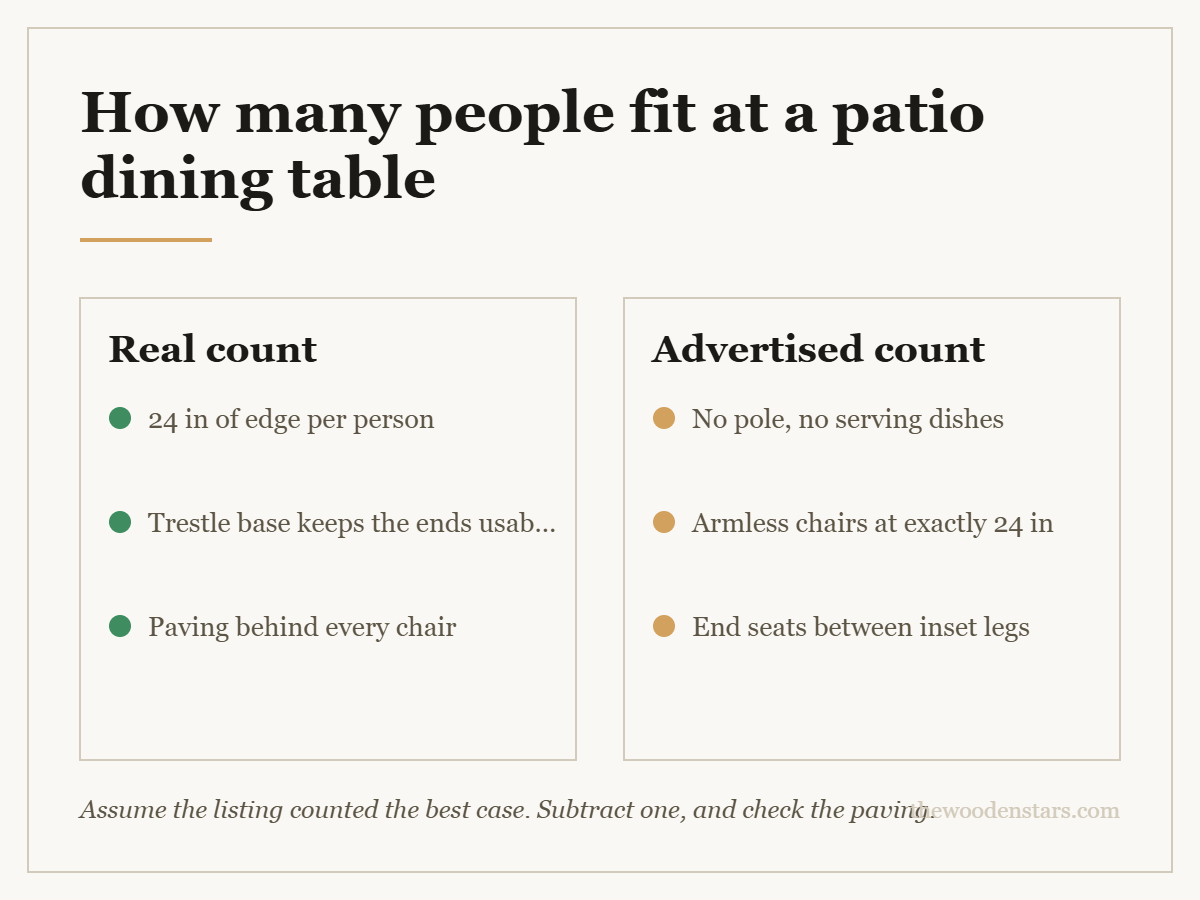
How many people fit at a patio dining table? Divide the usable edge by 24 inches — then subtract for the umbrella pole, the serving dishes and the corner legs, which outdoors take more than people expect.
The arithmetic is simple. What catches people out is that an outdoor table’s advertised seat count assumes none of those three things exist.
Allow 24 inches of table edge per person. On a round table that is the circumference: a 48-inch round gives 151 inches — six places on paper, four to five in real use. A 60-inch gives 188 — eight on paper, six in use. On a rectangle, count the long sides at 24 inches each and add the ends only if nothing blocks them: 72 × 40 seats six, 84 × 40 seats eight. Then check the room, not just the table — every seat needs 36 inches of firm paving behind it, and that is what usually caps the real number.
How many people fit at a patio dining table: round
A circle’s usable edge is its circumference — diameter × 3.14.
- 36 in: 113 inches ÷ 24 = 4 places. Realistically four, casually.
- 42 in: 132 inches = 5 places. Four comfortably, five at a push.
- 48 in: 151 inches = 6 places. Four to five in use.
- 54 in: 170 inches = 7. Six in use.
- 60 in: 188 inches = 7 to 8. Six comfortably.
- 72 in: 226 inches = 9. Eight in use.
The gap between the paper number and the real one grows with the table, and there is a reason: on a round table the middle is shared, so as the table gets bigger the centre becomes a place nobody can reach. Past about 60 inches you cannot pass a dish across, so serving moves to the edge and eats places.
| Table | Edge | On paper | In use |
|---|---|---|---|
| 36 in round | 113 in | 4 | 4 casual |
| 42 in round | 132 in | 5 | 4 |
| 48 in round | 151 in | 6 | 4 to 5 |
| 60 in round | 188 in | 7 to 8 | 6 |
| 72 in round | 226 in | 9 | 8 |
| 48 × 30 in | 156 in | 6 | 4 |
| 72 × 40 in | 224 in | 9 | 6 |
| 84 × 40 in | 248 in | 10 | 8 |
Rectangles, and the two seats that usually do not exist
On a rectangle, count each long side at 24 inches per person and treat the ends separately, because the ends are where the legs are.
A four-legged table has a leg at each corner. If the legs are at the extreme corners, an end seat straddles nothing and works. If the legs are inset — which looks lighter and is common — an end diner sits with a leg between their knees.
A trestle or pedestal base leaves the ends completely clear, which genuinely adds two seats to a 72-inch table. Outdoors this is rarer than indoors but worth looking for.
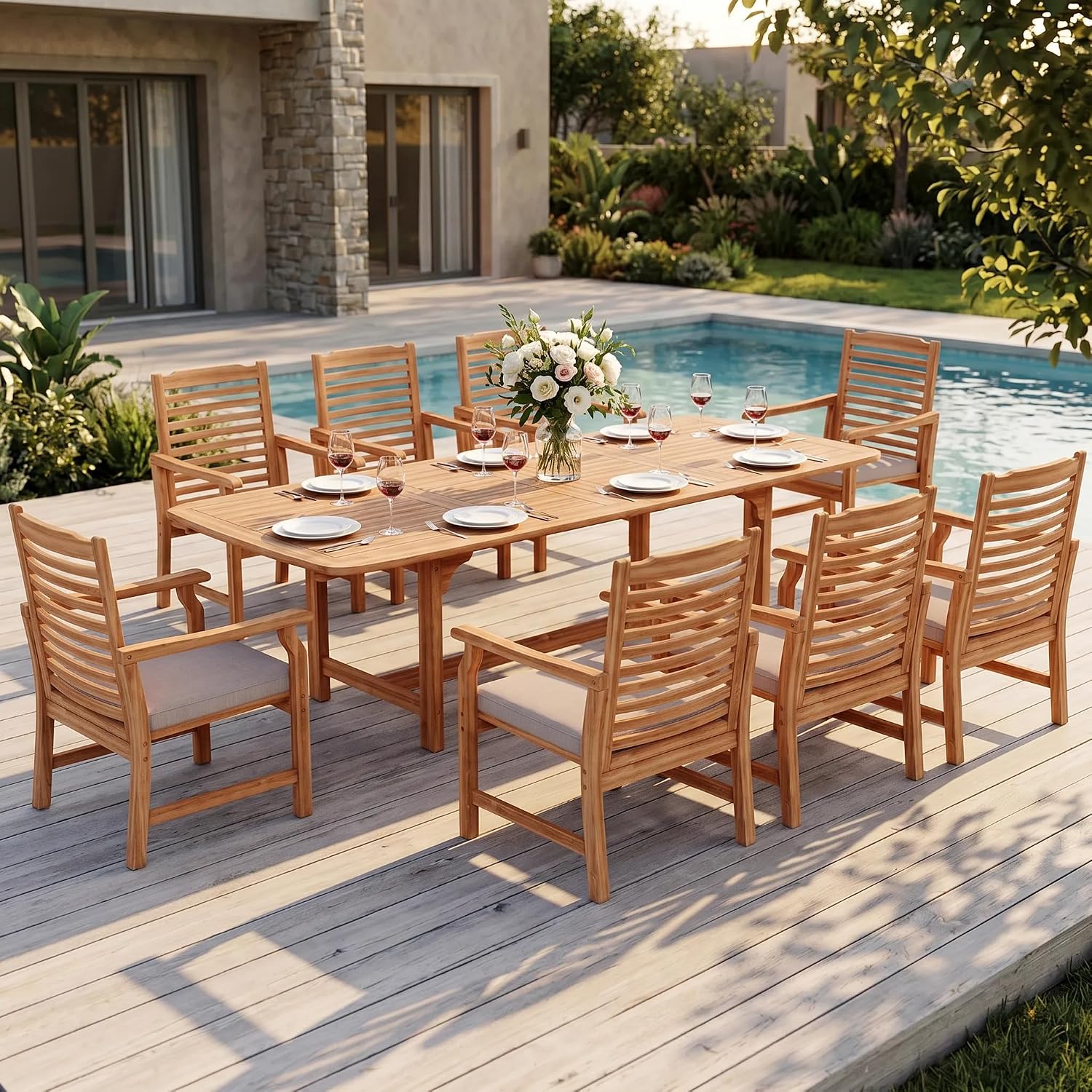
So: a 72 × 40 four-legged table seats six. The same size on a trestle seats eight. The listing calls both “seats 8”.
What subtracts seats outdoors
- The umbrella pole. It does not take a seat, it takes the serving area — so dishes move to the edge and effectively cost you one place. Worked through in patio table with umbrella hole or without.
- Serving outdoors is bulkier. Platters, a salad bowl, a bottle, a jug — more than a plated indoor meal, and it all sits on the table rather than being served from a sideboard.
- Chairs with arms. An armchair needs 26 to 28 inches rather than 24. Six armchairs need a table sized for seven.
- Cushions. They add width to each seat, and outdoor chairs are usually cushioned.
- The paving. The hard limit. Every seat needs 36 inches of firm surface behind it, and the patio often runs out before the table does.
The bench exception
A bench breaks the 24-inch rule in both directions.
It seats more, because nobody is bounded by a chair frame — a 60-inch bench takes three adults or four children, and the count flexes with who turns up. And it seats them in less floor, because a backless bench tucks fully under the table between meals.
It also seats them worse for a long meal: no back support, and the person in the middle climbs over. The trade is in outdoor bench against outdoor chairs, and the usual answer outdoors is a bench on the wall side and chairs on the open side.
The room, which sets the real ceiling
Work it the other way once you have a candidate table: add 72 inches to each dimension for clearance, subtract where a side is against a wall, and see whether it lands on the paving you actually have.
A 72 × 40-inch table needs 144 × 112 inches of firm surface. If the patio is 12 × 8 feet, the long sides fit and the ends do not — so it seats six, not eight, whatever the base looks like. Full method in how much space around a patio table, and the size-specific answers in what size patio table for 6 and what size patio table for 4.
Seating more people outside
- Folding outdoor chairs Two spares in the shed beat a permanently oversized table
- Levelling feet and glides More seats means more weight on a sloping patio
- Seat pads for outdoor chairs What makes a slatted timber seat last a long lunch
- Outdoor serving tray Keeps platters off the table edge, which is where seats are lost
What to buy


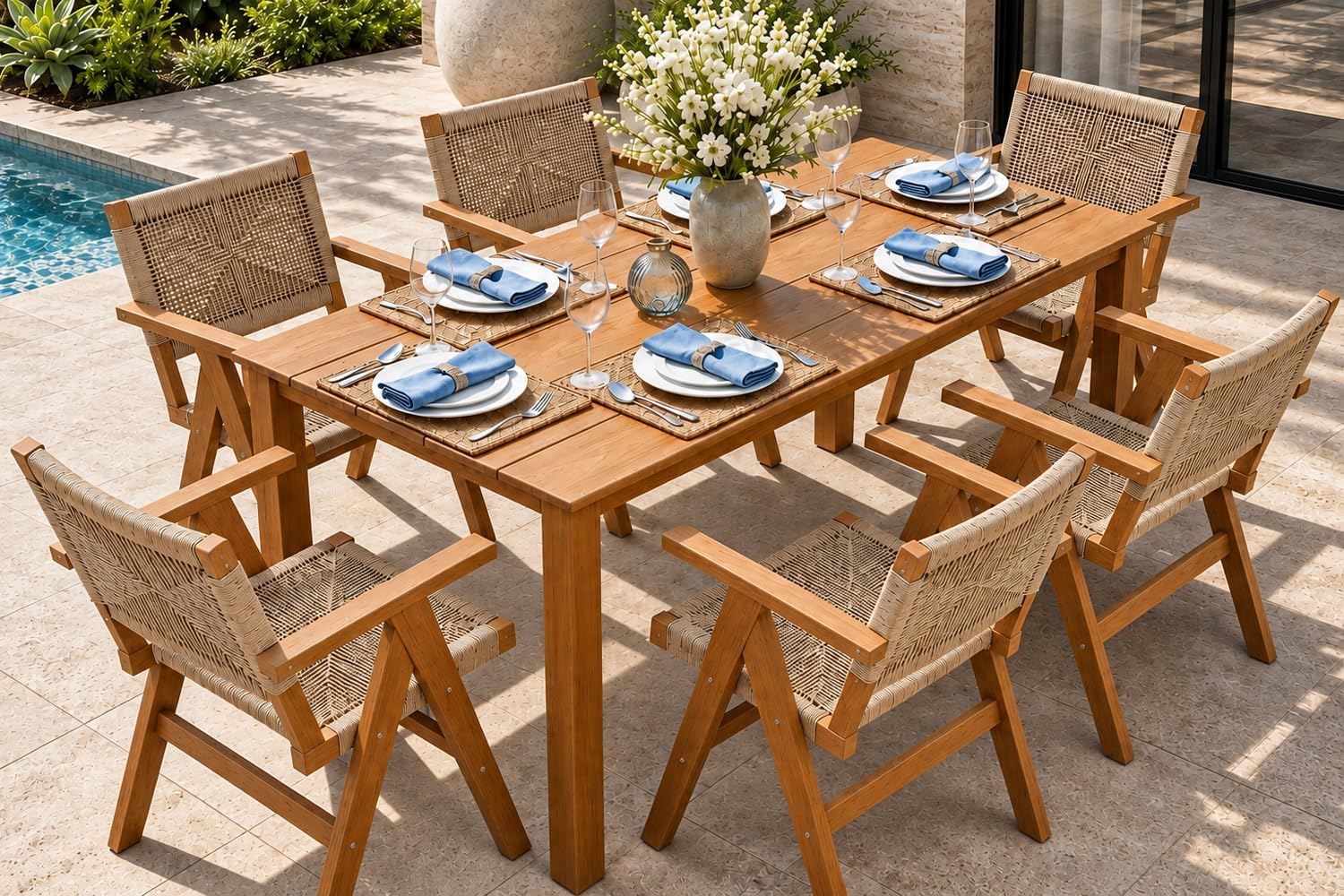
For specific sizes, see what size patio table for 6 and what size patio table for 4. For shape, round against rectangular. For clearance, how much space around a patio table. For bench seating, outdoor bench against outdoor chairs.
Questions we get asked
How many people fit at a patio dining table?
Divide the usable edge by 24 inches. A 60-inch round seats six in real use; a 72 × 40-inch rectangle also seats six.
Why is the real count lower than the listing?
Listings assume no umbrella pole, no serving dishes on the table, armless chairs and usable end seats. Subtract one from most claims.
Do the ends of a rectangle count?
Only if the legs allow it. Inset corner legs put a leg between an end diner’s knees; a trestle or pedestal base leaves the ends clear.
How much edge does each person need?
Twenty-four inches for an armless chair, 26 to 28 for one with arms.
Does a bench seat more?
Yes — a 60-inch bench takes three adults or four children, and it tucks fully under between meals.
What actually limits the number?
Usually the paving. Every seat needs 36 inches of firm surface behind it, and patios run out before tables do.