How deep should an outdoor bench be? 16 to 20 inches
The Wooden Stars is a participant in the Amazon Services LLC Associates Program. We may earn a commission when you buy through links on our site, at no extra cost to you.
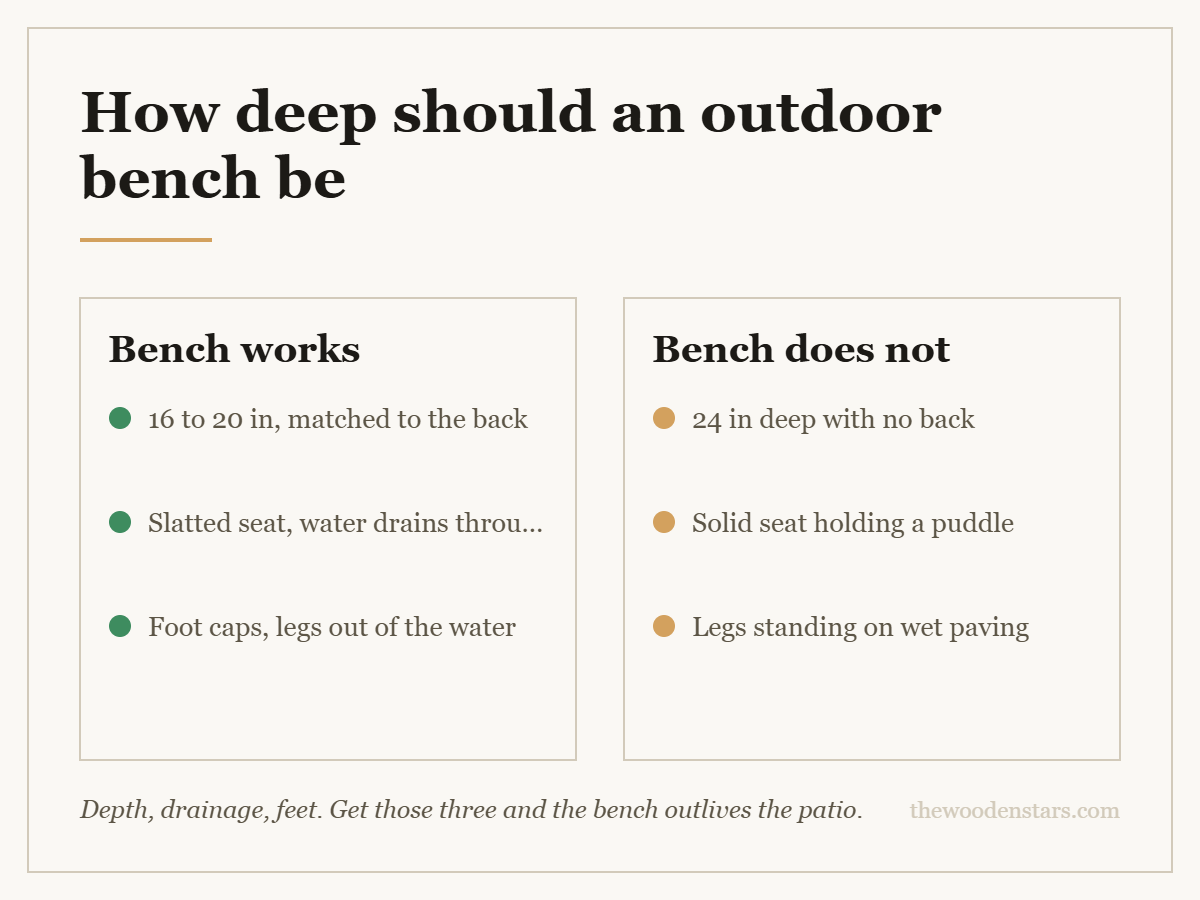
How deep should an outdoor bench be? 16 to 20 inches — and which end of that range depends on whether the bench has a back, because a backless bench needs less depth than people assume.
Outdoors there is one more constraint indoors never has: whatever depth you choose has to shed water, which rules out the solid seat that would otherwise be simplest.
A backless bench wants 16 to 18 inches deep — you sit forward on it, and extra depth is just more timber to weather. A bench with a back wants 18 to 20 inches, because you sit back into it and need thigh support. A lounging bench with a reclined back goes to 22 to 24. Deeper than that and short sitters’ feet leave the ground. Whatever the depth, the seat must be slatted with 3 to 8 mm gaps so water drains — a solid outdoor seat holds a puddle and rots at the joints. Seat height stays 17 to 19 inches regardless.
How deep should an outdoor bench be: by what it is for
- Dining bench at a table, backless: 16 to 18 inches. You sit forward with your feet under you. Anything deeper is timber you never sit on and that still needs oiling.
- Garden bench with a back: 18 to 20 inches. You lean back, so the seat must support the thigh to within a few inches of the knee.
- Lounging bench, reclined back: 22 to 24 inches. A deeper seat with a lower, raked back — comfortable, and hard to get out of.
- Storage bench with a lift lid: 18 to 20 inches. Set by the seat comfort, not by what you want to store; a deeper box is harder to reach into anyway.
The mistake is buying a deep bench because deep sounds comfortable. On a backless bench it is not — without a back to lean into, the extra depth does nothing, and it pushes the front edge further from the table.
| Bench | Depth | Seat height | Back |
|---|---|---|---|
| Dining, backless | 16 to 18 in | 17 to 19 in | None |
| Garden, upright back | 18 to 20 in | 17 to 19 in | 14 to 18 in tall |
| Lounging, raked back | 22 to 24 in | 15 to 17 in | 18 to 22 in tall |
| Storage, lift lid | 18 to 20 in | 17 to 19 in | Usually none |
| Under a window | 14 to 18 in | 17 to 19 in | Wall does the job |
Why a deep seat can be less comfortable
Seat depth has to suit the shortest person who uses it, not the tallest.
The measurement that matters is from the back of the knee to the back of the hip — about 17 inches on a short adult and 21 on a tall one. A seat deeper than someone’s thigh does one of two things: they perch on the front edge and lose the back entirely, or they slide back and their feet leave the ground.
So 18 to 20 inches suits nearly everyone on a bench with a back. Twenty-four inches suits tall adults reclining and is uncomfortable for anyone under about 5 ft 4 — fine on a lounging bench where that is the point, wrong on a garden bench by a path.
The same logic caps seat height at 17 to 19 inches: higher and short sitters dangle, lower and tall sitters have their knees up.
The outdoor constraint: water has to get out
This is the part that distinguishes an outdoor bench from an indoor one, and it is not negotiable.
- Slatted seat, gaps of 3 to 8 mm. Enough to drain, not enough to pinch. A solid outdoor seat holds a film of water across its whole area and pushes it into every joint.
- Slats running front to back on a bench with a back, so water runs off the front rather than pooling against the backrest.
- A slight fall if the seat is solid — some designs do this well, most do not.
- Feet off the ground. Foot caps or a plinth. Timber standing in a puddle on paving wicks water up the leg and rots from the bottom, which is where almost every old garden bench fails.
Deeper seats make all of this more important, simply because there is more surface holding more water.
Depth against the table, if it tucks under
A dining bench that tucks fully under the table is the whole reason to buy one — it gives the patio back between meals.
Two measurements decide whether it actually will:
Apron clearance. Measure from the ground to the underside of the table’s apron or frame, not to the tabletop. The bench seat plus a couple of inches has to pass under it. A deep outdoor table rail is what stops this, and it is common.
Bench length against the clear span between the table legs. An inch or two shorter, or it will not go in. Pedestal and trestle tables are far more forgiving here than four-legged ones.
Get both right and a 30-inch clearance on that side is enough instead of 36 — see how much space around a patio table.
Structure, because it is a long unsupported span
A bench carries concentrated loads in the middle of a span with nothing under it.
- Seat 1.25 inches thick or more in solid hardwood at 60 inches, or a stretcher underneath.
- A centre leg on anything over 72 inches.
- Bolted joints, because a bench racks along its length when people sit down at one end.
- Stainless fixings — a slatted seat has many fixings and plain steel streaks rust down all of them.
Timber choice is in best wood to use outside; if it is acacia, plan on the annual oil — is acacia good for outdoor furniture.
Making a bench last
- Furniture foot caps The bottom of the leg is where nearly every garden bench fails
- Bench cushion pad Depth and comfort are not the same thing on a backless bench
- Teak or hardwood oil A slatted seat is mostly edges, and edges drink oil
- Stainless replacement bolts Plain steel streaks rust down every slat fixing
What to buy


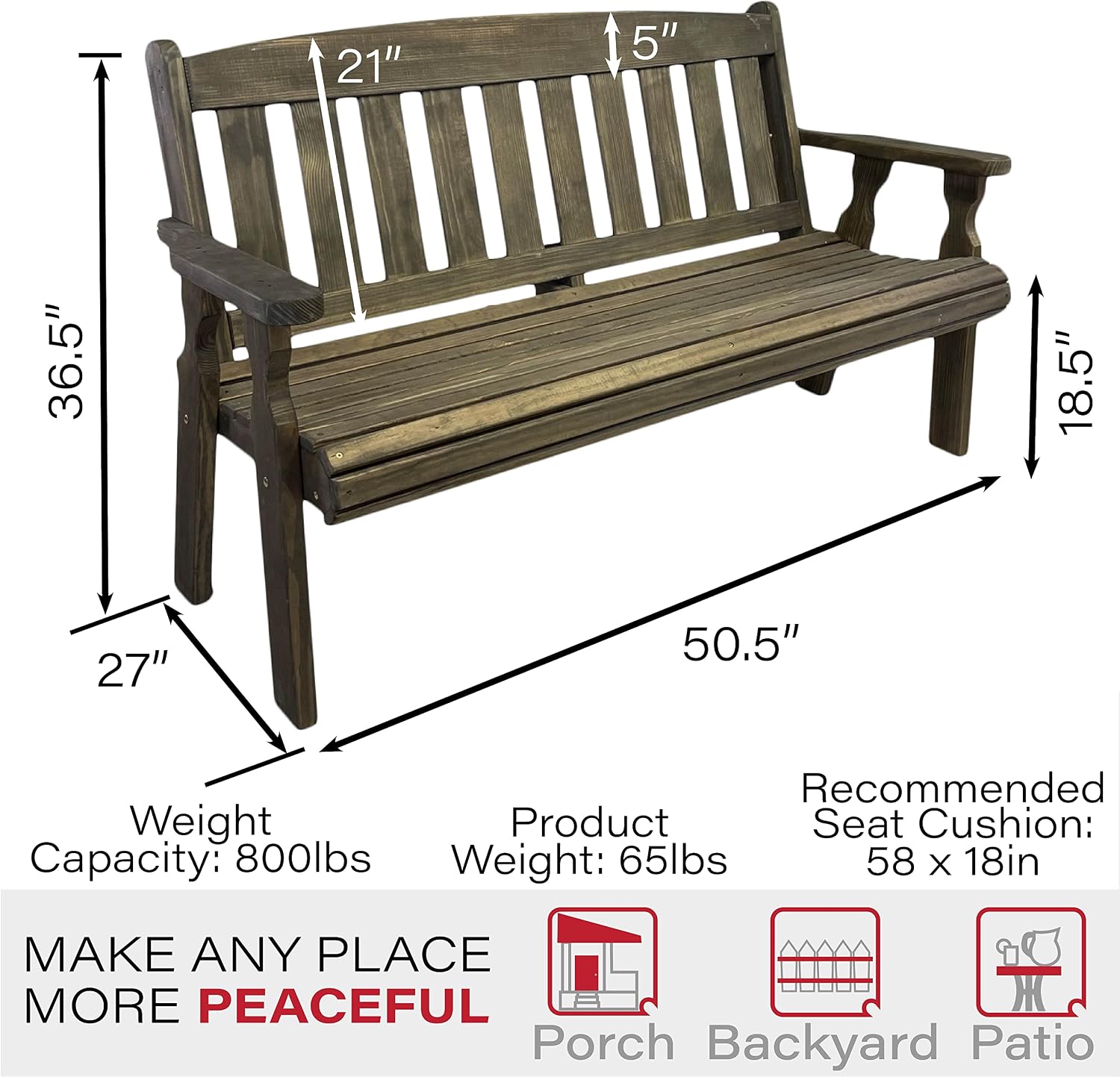
For the seating decision, see outdoor bench against outdoor chairs. For the table it serves, what size patio table for 6 and how tall a patio table should be. For the indoor version, under-window storage benches and dining bench against chairs.
Questions we get asked
How deep should an outdoor bench be?
Sixteen to 18 inches backless, 18 to 20 with a back, and 22 to 24 for a reclined lounging bench.
Why is a backless bench shallower?
Because you sit forward on it. Without a back to lean into, extra depth is timber nobody sits on.
Can a bench be too deep?
Yes. Past about 20 inches, shorter sitters either perch on the front edge or slide back and lose the floor under their feet.
Does the seat have to be slatted?
Outdoors, effectively yes. A solid seat holds water across its whole area and pushes it into the joints.
What seat height goes with it?
Seventeen to 19 inches, the same as a dining chair, whatever the depth.
Will it tuck under my table?
Measure to the underside of the table apron, not the tabletop, and check the clear span between the legs.