Round vs rectangular patio table — Deck shape decides
The Wooden Stars is a participant in the Amazon Services LLC Associates Program. We may earn a commission when you buy through links on our site, at no extra cost to you.
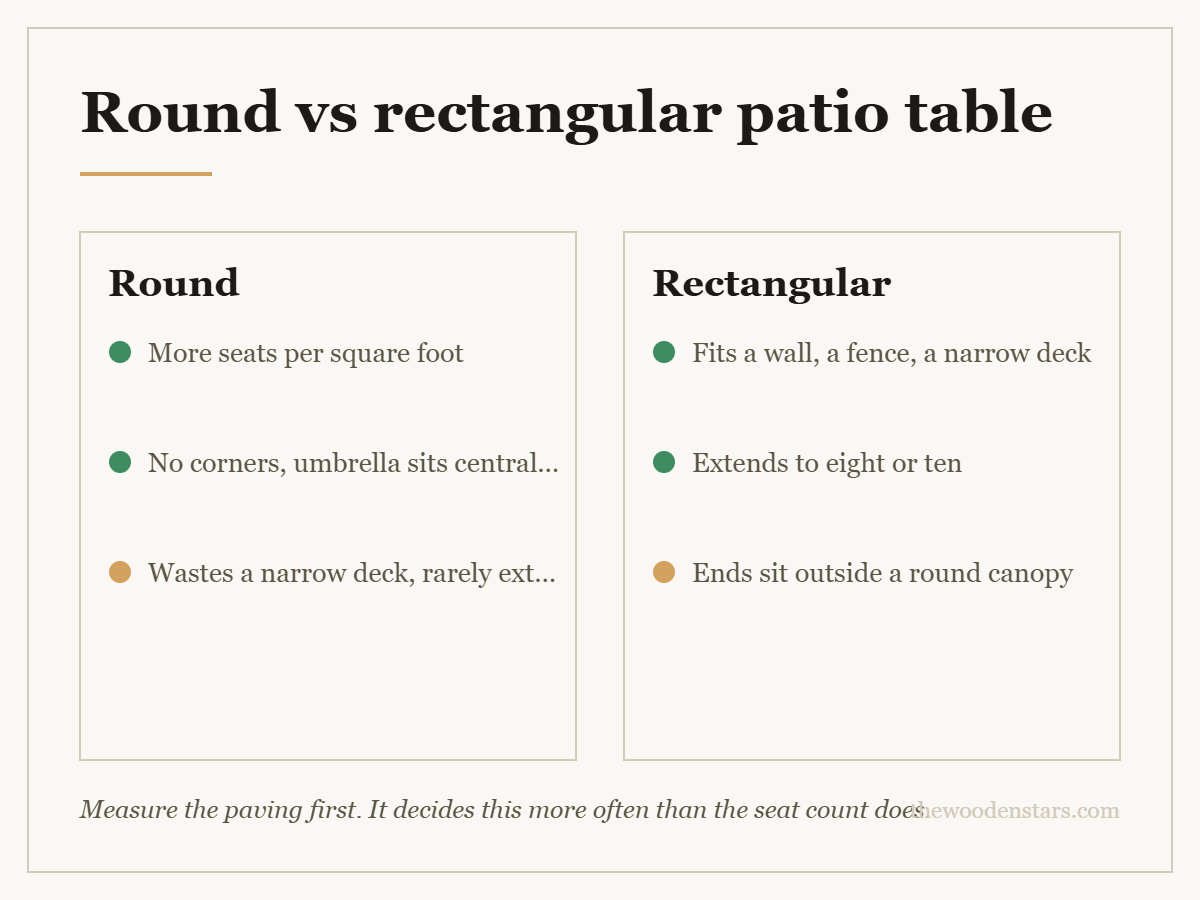
Round vs rectangular patio table is usually settled by the shape of the paving, not by the shape of the table — and by whether an umbrella is going through the middle.
Outdoors the two shapes behave differently from how they do indoors, because a patio is rarely a neat rectangle and the wind has an opinion.
A round table seats more people per square foot — a 60-inch round seats six in a 60-inch square footprint, where a rectangle needs 72 × 40 for the same six. It has no corners to catch a shin on a busy patio, everyone can see everyone, and a centre umbrella sits naturally in it. A rectangular table fits along a wall, a fence or a narrow deck where a round one wastes the corners, extends to eight or ten far more easily, and gives more usable surface for serving. Both want a table height of 28 to 30 inches and 36 inches of clearance behind every chair.
Round vs rectangular patio table: seats per square foot
Round wins this, and it is the strongest argument for it.
Allow 24 inches of table edge per diner. A circle’s edge is its circumference, so:
- 48-inch round: 151 inches of edge — six places, comfortably four to five with serving dishes.
- 60-inch round: 188 inches — seven or eight, realistically six.
- 72 × 40-inch rectangle: three per long side plus one per end — six, using a footprint 20% larger.
A round table also has no “bad seat”. On a long rectangle, the two people at the far ends conduct separate conversations, which on a patio — where the point is usually the company — matters more than it does at a formal dinner.
| Measure | Round | Rectangular |
|---|---|---|
| Seats six | 60 in diameter | 72 × 40 in |
| Footprint for six | 25 sq ft | 20 sq ft, but long |
| Seats per sq ft | Higher | Lower |
| Fits along a wall or fence | Wastes the corners | Yes |
| Centre umbrella | Sits naturally | Works, splits the surface |
| Extends to 8 or 10 | Rarely | Commonly |
| Conversation | Everyone to everyone | Splits at the ends |
| Corners at shin height | None | Four |
The shape of the paving usually decides it
Indoors a room is a rectangle and the furniture follows. Outdoors the space is whatever the paving, the decking or the lawn edge gives you.
A narrow deck or a side return — rectangular, every time. A round table in a 10-foot-wide deck leaves two unusable crescents.
A square or roughly square patio — round, usually. It uses the middle and leaves the corners for a planter, a bench or a barbecue.
A corner with two walls — round again, because you can push a circle closer into a corner than a rectangle and still walk round it.
An open lawn — either. Here the umbrella and the seat count decide instead.
Measure the paving before the table, then apply 36 inches of clearance on every side people sit — the full method is in how much space around a patio table.
The umbrella, which is an outdoor-only problem
A centre umbrella changes the comparison, and it is the thing most likely to catch you out.
On a round table the pole sits at the centre, equidistant from everyone, and the canopy covers the table evenly. It costs the middle of the table — where serving dishes go — but nothing else.
On a rectangle the pole is still at the centre, which on a 72-inch table means it lands between the two middle diners, and the round canopy over a rectangular table leaves the ends in the sun. Rectangles longer than about 72 inches want either a rectangular canopy or a cantilever umbrella that stands off the table entirely.
Either way the hole steals a seat’s worth of usable surface. Worked through in patio table with umbrella hole or without.
Wind, weight and the base
An outdoor table gets loaded sideways in a way an indoor one never does.
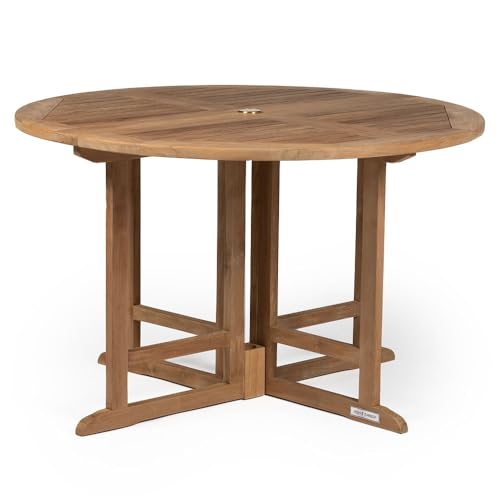
Round tables are usually pedestal-based, which is right for a circle — you approach from any angle and four legs would put one where a foot goes. But a pedestal on an exposed terrace has a smaller footprint to resist wind, so look for a base spread of at least half the top’s diameter.
Rectangles are usually four-legged, which resists wind better and sits more stably on uneven paving — provided the legs are not inset. A leg set in from the corner is the one you catch your toe on, and it reduces the stability advantage.
On any paving, levelling feet earn their keep: patios are laid with a fall for drainage, so an outdoor table is almost never on level ground. See levelling feet and glides and, if it already rocks, how to fix a wobbly table.
What to check on either, outdoors specifically
- A slatted top, or a top with a fall. Water must get off and out of the joints. A flat solid outdoor top is a slow failure.
- Named timber. Teak, acacia, eucalyptus — see best wood to use outside and acacia against teak.
- Stainless or coated fixings. Plain steel bleeds rust streaks within a year and they do not sand out.
- Foot caps. Timber legs standing in a puddle wick water upward and rot from the bottom.
- Weight. On a roof terrace or an exposed garden, a heavy table is a safer table.
For an outdoor table of either shape
- Levelling feet and glides Patios are laid with a fall, so the table is never level
- Furniture foot caps Stops legs standing in the water that collects on paving
- Teak or hardwood oil One afternoon each spring on acacia or eucalyptus
- Table cover Cheaper than replacing a top that sat under leaf litter all winter
What to buy


For sizing, see what size patio table for 6, what size patio table for 4 and how many people fit at a patio dining table. For height, how tall a patio table should be. For the set type, dining set against conversation set.
Questions we get asked
Is a round or rectangular patio table better?
Round if the paving is square or you want the most seats per square foot; rectangular if the space is narrow or runs along a wall or fence.
Which seats more people?
Round, per square foot. A 60-inch round seats six in a 60-inch square; a rectangle needs 72 × 40 for the same six.
How does an umbrella change it?
A centre umbrella suits a round table evenly. On a rectangle over about 72 inches, a round canopy leaves the ends in the sun.
Which is more stable in wind?
A four-legged rectangle, usually. Round tables are pedestal-based, so look for a base spread of at least half the top’s diameter.
How much clearance do I need?
Thirty-six inches behind every chair on every side people sit, measured to the railing or the edge of the paving.
Do outdoor tables need levelling feet?
Nearly always. Patios and decks are laid with a fall for drainage, so the table is sitting on a slope.