What size patio umbrella do I need? Table plus 4 feet
The Wooden Stars is a participant in the Amazon Services LLC Associates Program. We may earn a commission when you buy through links on our site, at no extra cost to you.
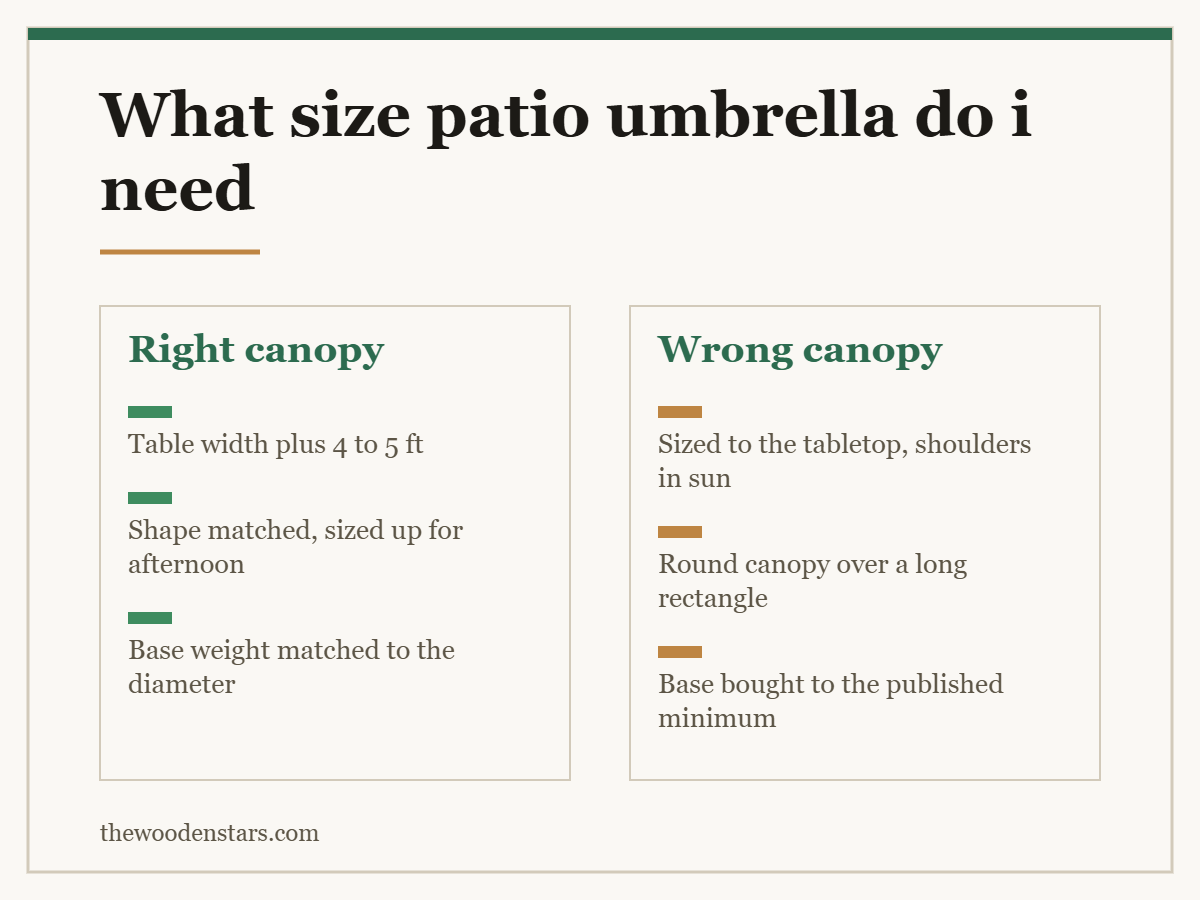
What size patio umbrella do I need? Take the table’s width and add 4 to 5 feet — the canopy has to shade the people, not the tabletop.
That one adjustment is what separates an umbrella that works from one that leaves everybody’s shoulders in the sun by two in the afternoon.
Canopy diameter = table width + 4 to 5 feet, because diners sit 2 feet beyond the table edge on each side. So a 36-inch bistro table wants a 7 to 7.5-foot canopy, a 48-inch round wants 9 feet, a 60-inch round wants 11, and a 72 × 40-inch rectangle wants a 10 × 6.5-foot rectangular canopy rather than a circle. Then add for the sun moving: a canopy sized exactly right at noon leaves the edges exposed by 3pm, so size up one step if the terrace has no other shade. Bigger canopies need heavier bases — 50 lb at 9 feet, 75 to 90 at 11.
What size patio umbrella do I need: the table-plus-4-feet rule
People size umbrellas to the table. The table is not what needs shading.
A diner’s head and shoulders sit roughly 24 inches beyond the table edge. Two sides, so the canopy has to be 4 feet wider than the table just to cover the people sitting at it — and 5 feet is better because nobody sits perfectly upright against the table.
- 30 to 36-inch bistro table: 7 to 7.5-foot canopy.
- 42 to 48-inch round: 9-foot canopy.
- 54 to 60-inch round: 10 to 11-foot canopy.
- 72-inch round: 13-foot canopy, which is a large and expensive object.
- 72 × 40-inch rectangle: a rectangular canopy about 10 × 6.5 feet.
Table sizing itself is in what size patio table for 6 and what size patio table for 4.
| Table | Canopy | Base weight | Pole |
|---|---|---|---|
| 30 to 36 in bistro | 7 to 7.5 ft | 30 to 40 lb | 1.5 in |
| 42 to 48 in round | 9 ft | 50 lb | 1.5 to 1.9 in |
| 54 to 60 in round | 10 to 11 ft | 75 to 90 lb | 1.9 in |
| 72 in round | 13 ft | 100 lb plus | 1.9 in |
| 72 × 40 in rectangle | 10 × 6.5 ft rectangular | 75 lb | 1.9 in |
| Cantilever, any table | 10 to 13 ft | 100 to 200 lb | Offset |
The sun moves, and the canopy does not
A canopy sized exactly to the seated diners works at noon, when the sun is overhead and the shadow falls straight down.
By three in the afternoon the sun is at 45 degrees and the shadow has slid sideways by roughly the height of the canopy — 7 to 8 feet. Half the table is in sun.
Three ways to handle it:
Size up one step. An 11-foot canopy over a 48-inch table looks oversized at noon and is correct at four o’clock. On a terrace with no other shade this is the simple answer.
Buy a tilting umbrella. A crank-and-tilt centre pole angles the canopy into the sun. It recovers most of the afternoon and costs nothing in floor.
Buy a cantilever. It rotates around its base as well as tilting, so it tracks the sun properly. It also needs a 100 lb-plus base standing in the walkway — the trade is in patio table with umbrella hole or without.
Shape has to match the table
An umbrella canopy is usually a circle, and a circle over a long rectangle leaves the ends in the sun.
Round table: round canopy, concentric, even shade for everyone. Simple.
Square table: either works. A square canopy covers the corners a circle misses.
Rectangle up to about 60 inches: a round canopy is acceptable.
Rectangle over 72 inches: you need a rectangular canopy or a cantilever. A 9-foot round over an 84-inch table shades the middle four seats and leaves the ends out. Rectangular canopies exist but the choice is much narrower — worth checking availability before committing to a long table plus centre umbrella.
Shape generally is in round against rectangular patio tables.
Centre pole or cantilever, at the same size
The same canopy diameter behaves very differently depending on where the pole is.
A centre-pole market umbrella puts the mast through the middle of the table, which costs you nothing in seating because nobody sits in the middle anyway. It is cheaper, lighter, more stable in wind, and the pole is braced at two heights by the table. Its limit is that the shade circle is locked concentric with the table.
A cantilever hangs the canopy from an offset arm, so the ground under it is clear and the shade can be swung over a lounger, a sandpit or a sofa without moving anything. That freedom costs three things: roughly twice the price at the same diameter, a base of 100 to 150 lb because the arm is a permanent lever, and a footprint for the post that eats about 2 square feet of patio somewhere it is in the way.
For a dining table, the centre pole is almost always the better buy. For shading seating that moves, the cantilever is the only thing that works.
The base, and the two other numbers
Base weight rises fast with diameter, because the canopy is a sail: 30 to 40 lb at 7 feet, 50 at 9, 75 to 90 at 11, and 100 lb plus for a cantilever. Those figures assume the pole also passes through a table, which braces it — free-standing, add half again.
Pole diameter is 1.5 or 1.9 inches. Table umbrella holes come in both and they are not interchangeable without a shim. Check the hole before buying the umbrella.
Height is 7.5 to 9 feet overall. Under the canopy edge you want 6 ft 8 of clearance so nobody ducks walking round the table — which means a low-slung 7-foot umbrella over a tall bar table does not work.
And the honest rule that no base fixes: close it when you leave. Most umbrella failures are an open canopy in an unexpected gust.
Getting the shade right
- Umbrella base, sized to the canopy 50 lb at 9 ft, 75 to 90 at 11, more free-standing
- Umbrella hole plug For when the umbrella is away, so water stays out of the top
- Protective umbrella cover What stops a canopy fading on the side that faces south
- Rubber base mat Keeps a heavy base from trapping water against timber decking
What to buy


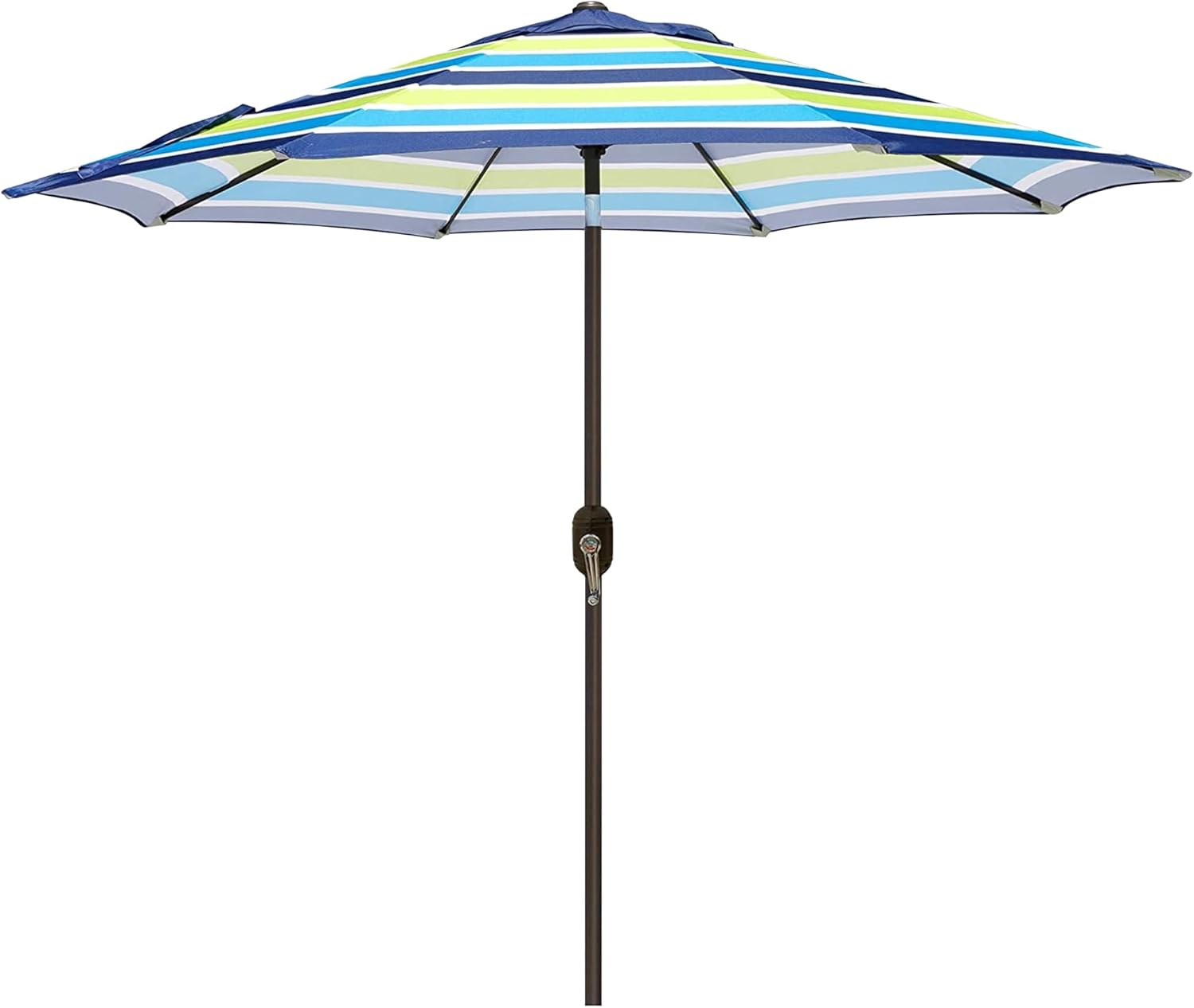
For the hole-or-not decision, see patio table with umbrella hole or without. For table sizing, what size patio table for 6 and what size patio table for 4. For shape, round against rectangular patio tables. For clearance, how much space around a patio table.
Questions we get asked
What size patio umbrella do I need?
Table width plus 4 to 5 feet. A 48-inch round wants a 9-foot canopy; a 60-inch round wants 11.
Why add so much?
Because diners sit about 24 inches beyond the table edge. The canopy has to shade the people, not the tabletop.
Should I size up?
On a terrace with no other shade, yes. A canopy sized exactly right at noon leaves the edges exposed by three o’clock.
Will a round umbrella shade a rectangular table?
Up to about 60 inches, yes. Past 72 you need a rectangular canopy or a cantilever.
How heavy a base do I need?
Fifty pounds at 9 feet, 75 to 90 at 11, and 100 or more for a cantilever. Add half again if the pole does not pass through a table.
What pole diameter?
One and a half or 1.9 inches. Check your table’s hole first — they are not interchangeable without a shim.