Outdoor coffee table vs side table — Reach and height
The Wooden Stars is a participant in the Amazon Services LLC Associates Program. We may earn a commission when you buy through links on our site, at no extra cost to you.
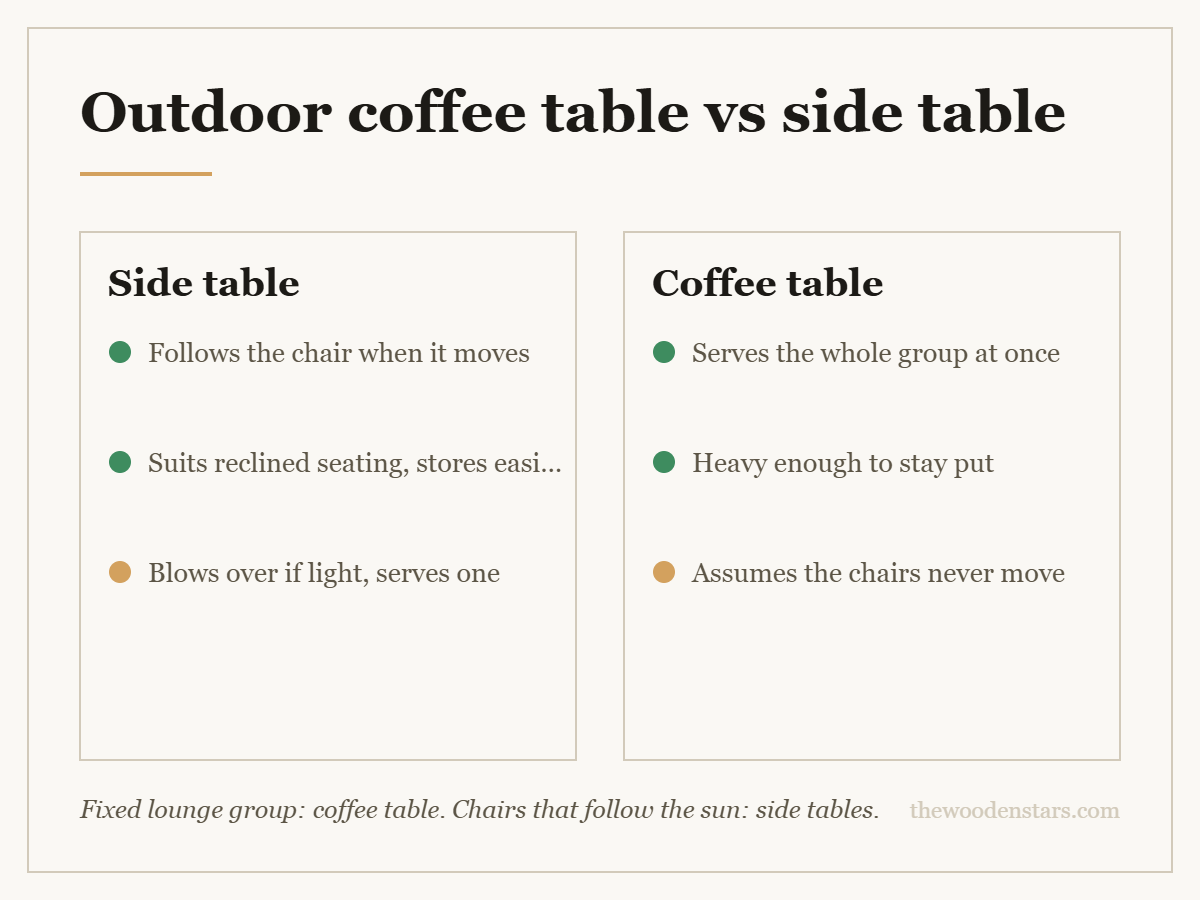
Outdoor coffee table vs side table is the same distinction as indoors — one serves the whole group, one serves a single chair — with one outdoor twist: the side table usually wins, because outdoor seating is rarely arranged around a centre.
Patios put chairs in a loose ring facing a view or a fire. That arrangement wants a table beside each chair far more than it wants one in the middle.
An outdoor coffee table is 16 to 20 inches tall and 36 to 48 long, sitting in the middle of a seating group with 14 to 18 inches to each seat. An outdoor side table is 18 to 24 inches tall — level with or just below the chair arm — and 16 to 20 inches across, standing beside one chair. Outdoors the side table is usually the better buy: chairs get moved to follow the sun or face a fire, and a centre table stops working the moment they do. Both must drain and both need weight, because a light side table is the first thing to blow over.
Outdoor coffee table vs side table: measured from different things
A coffee table is measured from the seat. Within an inch or two of the seat height of the chairs it serves — so 16 to 20 inches for typical outdoor lounge seating at 15 to 18. Too high and it blocks the view across the group; too low and you lean off the chair to reach it.
A side table is measured from the arm. Level with the chair arm, or up to 2 inches below. Outdoor chair arms run 18 to 24 inches, which is where the range comes from. That way you put a glass down without looking.
The indoor arithmetic is identical and worked through in coffee table dimensions and nightstand against side table. What changes outdoors is the seating arrangement, not the numbers.
| Measure | Coffee table | Side table |
|---|---|---|
| Height | 16 to 20 in | 18 to 24 in |
| Measured from | Seat height | Chair arm |
| Size | 36 to 48 in long | 16 to 20 in across |
| Serves | The whole group | One chair |
| Gap to the seat | 14 to 18 in | Touching, or a few inches |
| Survives rearranging | No | Yes |
| Blows over | Rarely, it is heavy | Easily, if light |
| Doubles as a stool | Sometimes | No |
Why the side table usually wins outside
Chairs move outdoors, constantly. People follow the sun in the morning and the shade in the afternoon, then pull chairs round a fire pit in the evening. A coffee table assumes a fixed arrangement; the moment two chairs move, it is a table in the middle of nowhere.
Adirondacks and loungers have no use for a centre table. They are low, reclined and face outward. A reclined sitter cannot reach a table 16 inches away at knee height without sitting up — which is the opposite of the point. See adirondack chair against patio chair.
One per chair is the natural unit. Two chairs and two small tables cost less and work better than four chairs and one coffee table, in most gardens.
Storage. Small tables stack or go in a shed. A 48-inch coffee table is another large object to cover.
The coffee table earns its place in exactly one arrangement: a fixed conversation set with a sofa and two chairs around it, which is the layout in patio dining set against conversation set.
Weight, and the thing that blows away
A light side table is the single most commonly blown-over piece of outdoor furniture. It has a small footprint, a high centre of gravity relative to that footprint, and nobody is sitting on it to hold it down.
What helps:
- A wide base relative to the top. A pedestal side table with a small foot is the worst case.
- Solid timber rather than a hollow frame. Mass is the only real answer.
- A lower shelf, which lowers the centre of gravity and gives somewhere to put a book.
Coffee tables rarely have this problem — they are long, low and heavy — but the same weight logic applies to whether the whole set stays put in a gust, and it is part of the wider argument in wood against metal patio furniture.
Drainage, on both
A low table collects everything — rain, leaves, spilled drinks — and a solid top holds all of it.
- Slatted tops with small gaps, or a top with a slight fall.
- No rim or lip that traps water at the edges. Decorative edge mouldings are where outdoor tables rot first.
- A lower shelf that also drains — a solid lower shelf is a tray that collects leaf litter all autumn.
- Feet off the ground. Caps or a plinth; a low table’s legs sit in exactly the water that runs across paving.
The trade-off is that a slatted top will not hold a glass steadily. A small hard tray solves it, and it is the accessory that makes a slatted outdoor table usable.
What to check
Height against the actual chairs you own or are buying — arm height for a side table, seat height for a coffee table. Measure the chairs first.
Named timber and stainless fixings — best wood to use outside, and if it is acacia, the annual oil in is acacia good for outdoor furniture.
Weight, stated. Under about 12 lb for a side table and it will move in wind.
Whether it doubles as a stool. Some outdoor cube tables are rated to sit on, which is a genuine bonus when numbers are unpredictable.
For either table
- Serving tray with handles What makes a slatted top hold a glass steadily
- Furniture foot caps Low tables sit in the water that runs across paving
- Teak or hardwood oil Low tables get the most rain and the most sun
- Outdoor furniture cover A small table blows away long before a coffee table does
What to buy


For the seating these serve, see dining set against conversation set and adirondack chair against patio chair. For the indoor arithmetic, coffee table dimensions and round against rectangular coffee tables. For materials, wood against resin.
Questions we get asked
What is the difference between an outdoor coffee table and a side table?
A coffee table is 16 to 20 inches tall and serves a whole group from the middle; a side table is 18 to 24 inches and serves one chair from beside it.
Which is better outdoors?
Usually the side table, because outdoor chairs get moved to follow the sun or face a fire and a centre table stops working when they do.
How tall should an outdoor side table be?
Level with the chair arm or up to 2 inches below — 18 to 24 inches for most outdoor chairs.
How far should a coffee table sit from the seats?
Fourteen to 18 inches, the same as indoors. Closer and you cannot get past; further and you lean off the chair.
Why do outdoor side tables blow over?
Small footprint, high centre of gravity and nobody sitting on them. Look for a wide base, solid timber and a lower shelf.
Do slatted tops matter?
Yes — a solid low table holds rain and leaf litter. A small hard tray gives you a steady surface on the slats.