How long is a chaise lounge? 72 to 80 inches
The Wooden Stars is a participant in the Amazon Services LLC Associates Program. We may earn a commission when you buy through links on our site, at no extra cost to you.
How long is a chaise lounge? 72 to 80 inches — and which end of that range you need depends on your height, not on the size of the terrace.
It is the one piece of outdoor furniture where buying too small is felt immediately and cannot be fixed with a cushion.
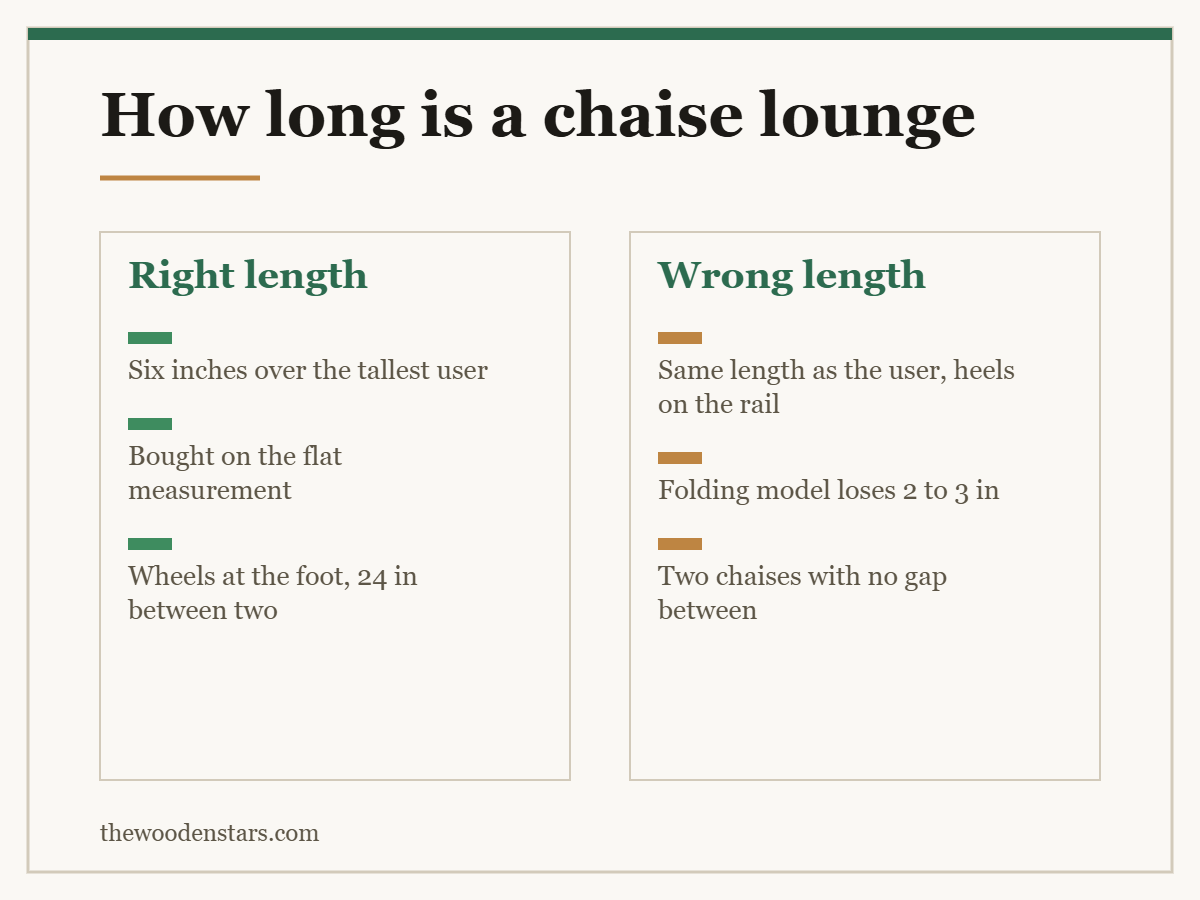
Outdoor chaise lounges run 72 to 80 inches long, with 75 inches the most common. The rule: the chaise should be at least 6 inches longer than the tallest regular user, so 72 inches suits up to about 5 ft 10 and 78 to 80 is what anyone over 6 feet needs. Width is 24 to 30 inches and matters less. Allow 15 square feet of floor per chaise including room to get on and off, and 24 inches between two of them for a side table. A folding chaise loses 2 to 3 inches of usable length to the hinge.
How long is a chaise lounge: by your height
Work from the person, not the patio.
- Up to 5 ft 6: 72 inches is generous.
- 5 ft 6 to 5 ft 10: 72 to 75 inches.
- 5 ft 10 to 6 ft 1: 76 to 78 inches.
- Over 6 ft 1: 80 inches, and they are not common — check before buying.
The 6-inch margin matters because you do not lie rigidly straight. Feet point, knees bend, people shift. A chaise exactly your height means your heels are on the end rail within ten minutes, and that rail is usually where the frame is hardest.
There is one more subtraction: with the back raised, the usable flat length shortens. A 75-inch chaise at a 45-degree back setting gives about 66 inches of horizontal surface. That is fine for sitting up to read, and it is why the flat measurement is the one to buy on.
| Measure | Range | Note |
|---|---|---|
| Length, flat | 72 to 80 in | 75 in is most common |
| Length usable, back at 45° | About 88% of flat | A 75 in gives 66 |
| Width | 24 to 30 in | 26 to 28 is comfortable |
| Seat height | 13 to 16 in | Low, by design |
| Back positions | 4 to 6 | Flat to near-upright |
| Floor per chaise | About 15 sq ft | Includes getting on and off |
| Gap between two | 24 in | Enough for a side table |
Width, which matters less but not zero
Twenty-four inches is the narrow end and feels like a camp bed. Twenty-six to 28 is the comfortable norm. Thirty and above is generous and starts to eat the space between two chaises.
Measure the inside width if the chaise has arms. Many do not — armless is the common design precisely because arms get in the way of lying down — but where they exist, 6-inch outdoor arms turn a 30-inch overall into a 22-inch bed.
If two chaises sit side by side, allow 24 inches between them: enough for a small side table and enough to get out of one without climbing over the other. Table sizing is in outdoor coffee table against side table.
The floor a chaise actually takes
The footprint is not the frame. You have to get on and off it, and the back reclines beyond the frame at some settings.
- Frame: 75 × 28 inches, about 15 square feet.
- Plus 24 inches on one long side to sit down and swing your legs up.
- Plus a foot at the head end, because the back tilts back past the frame on most designs.
Working figure: about 20 square feet per chaise in use. Two chaises and a table between them is a 9-foot run and roughly 45 square feet — on many terraces that is the entire seating plan, which is the real reason to decide between chaises and a conversation group rather than trying to have both. See chaise lounge against adirondack chair.
What else the length affects
Weight. A 75-inch hardwood chaise is 45 to 70 lb; an 80-inch one can be 90. That decides whether you can follow the sun with it, and whether it comes in for winter.
Wheels. Two small wheels at the foot end turn a lift into a tilt-and-roll. On anything over about 55 lb they are the difference between a chaise that gets moved and one that does not.
Storage. A 75-inch frame does not fit most sheds upright. Folding models exist and lose 2 to 3 inches of usable length to the hinge — check the folded dimensions against the shed door, not just the floor area.
The cushion. A chaise cushion is the largest outdoor cushion there is, and the slowest to dry. Removable covers, and somewhere dry to put it: how big a deck box should be.
What to check before buying
- Flat length, stated, against your height plus 6 inches.
- The back mechanism. A notched timber ratchet lasts; a sprung metal hinge is smoother and is what seizes. Work it before buying.
- Slatted deck so water drains rather than pooling under the cushion.
- Stainless fixings — a chaise frame has many, and plain steel streaks rust down the slats.
- Foot caps, because a low frame sits in the water that runs across paving.
Timber choice is in best wood to use outside and acacia against teak; the annual routine in is acacia good for outdoor furniture.
Living with a chaise
- Chaise lounge cushion The biggest outdoor cushion you own, so removable covers matter
- Furniture wheels or casters Turns a sixty pound lift into a tilt-and-roll
- Deck box for cushions A chaise cushion is the slowest one to dry out
- Teak or hardwood oil A slatted deck is mostly edges, and edges drink oil
What to buy


For the comparison, see chaise lounge against adirondack chair and outdoor daybed against chaise lounge. For lounge seating generally, patio sectional against separate chairs. For clearance, how much space around a patio table.
Questions we get asked
How long is a chaise lounge?
Seventy-two to 80 inches, with 75 the most common. Buy at least 6 inches longer than the tallest regular user.
What length do I need if I am over six feet?
Seventy-eight to 80 inches. They are less common, so check the stated flat length rather than assuming.
Does raising the back shorten it?
Yes — a 75-inch chaise at 45 degrees gives about 66 inches of horizontal surface. Buy on the flat measurement.
How wide should it be?
Twenty-six to 28 inches. Twenty-four feels like a camp bed, and arms turn a 30-inch overall into a 22-inch bed.
How much floor does one take?
About 20 square feet in use — the frame plus room to sit down and swing your legs up.
Are folding chaises a good idea?
For storage, yes, and they lose 2 to 3 inches of usable length to the hinge. Check the folded size against the shed door.