Patio table with umbrella hole or without? Shade first
The Wooden Stars is a participant in the Amazon Services LLC Associates Program. We may earn a commission when you buy through links on our site, at no extra cost to you.
Patio table with umbrella hole or without? Decide the shade first, because the hole is not a feature you can add later and it is not one you can easily ignore either.
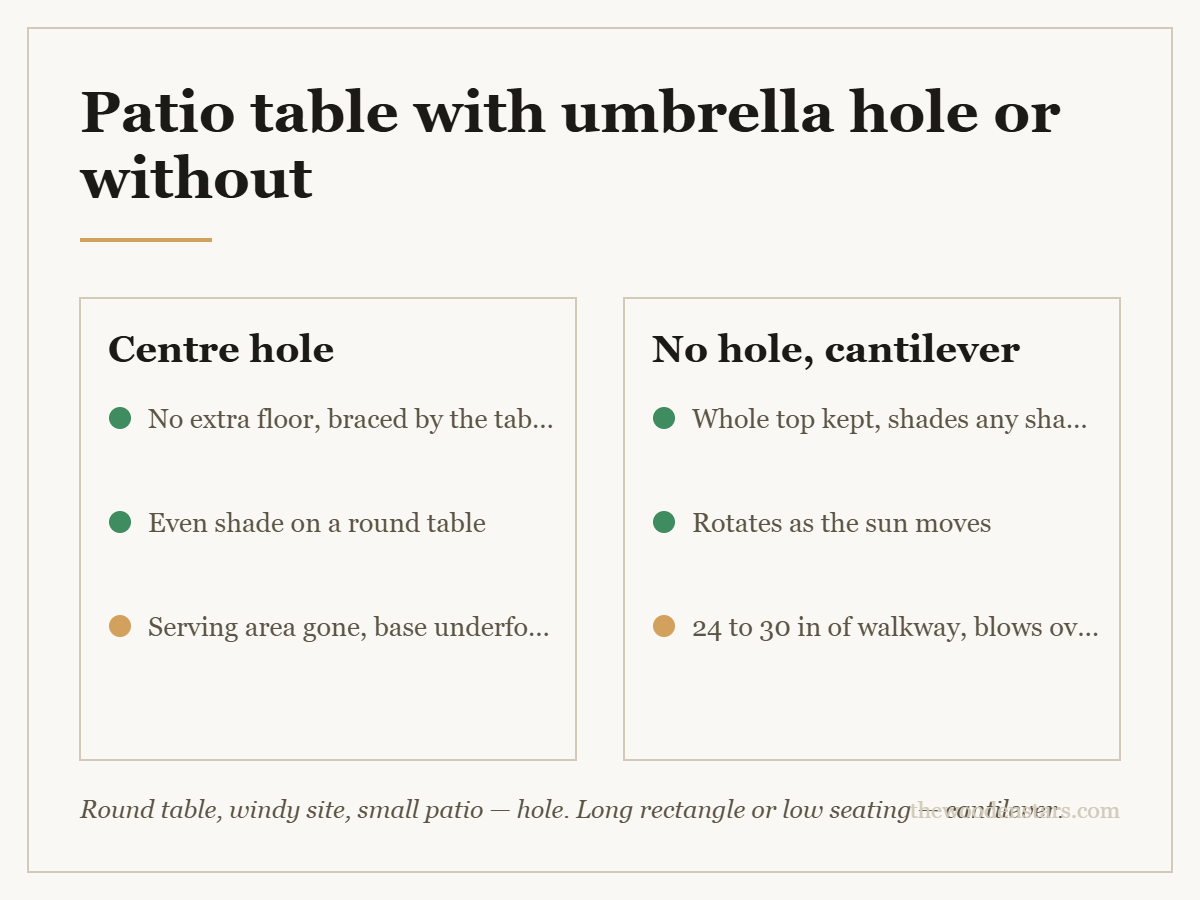
A centre hole commits you to one kind of umbrella, costs you the middle of the table, and needs a base that lives under your feet. Going without commits you to a cantilever, a wall parasol or the sun.
A centre hole takes a 1.5 to 2-inch pole, needs a 50 to 90 lb base sitting between the chairs, and removes roughly a 10-inch circle from the middle of the table — the serving area, not a seat. It shades a round table evenly and a long rectangle badly. Without a hole you keep the whole top and use a cantilever umbrella standing to one side, which shades any shape, needs a 24 to 30-inch base weighing 100 lb or more, and takes floor out of the walkway. A hole you never use also lets water into the tabletop unless it is plugged.
Patio table with umbrella hole or without: what the hole costs
Three things, and only one of them is obvious.
The serving area. The pole and its collar occupy a circle about 10 inches across at the centre — exactly where a platter, a salad bowl and a bottle would go. It does not remove a seat; it removes the middle. On a 60-inch round that is noticeable; on a 36-inch bistro table there is essentially nothing left.
The base, underfoot. A centre-pole umbrella needs a base of 50 to 90 lb sitting on the paving directly under the table, between everybody’s feet. People kick it. In a set where the table has its own pedestal this is designed in; with a four-legged table it is an obstacle.
The hole itself, when empty. An unplugged hole in a timber top lets water straight into the end grain of the boards around it, which is the worst place for it. Most tables ship with a plastic cap; if yours has lost it, that is a ten-minute fix worth doing.
| Measure | Centre hole | Cantilever |
|---|---|---|
| Pole diameter | 1.5 to 2 in | Not through the table |
| Base weight | 50 to 90 lb | 100 to 200 lb |
| Base position | Under the table, underfoot | Beside the table, in the walkway |
| Base footprint | 18 to 24 in | 24 to 30 in |
| Serving area lost | About a 10 in circle | None |
| Shades a round table | Evenly | Evenly |
| Shades a long rectangle | Ends stay sunny | Fully |
| Adjustable through the day | Tilt only | Rotates and tilts |
Shape decides more than you would think
An umbrella canopy is a circle — 9 to 11 feet across on most domestic models.
Over a round table that geometry works perfectly. The canopy is concentric with the table, everyone gets the same shade, and the pole is equidistant from every seat.
Over a rectangle longer than about 72 inches, a round canopy leaves the two end seats in the sun for most of the day. The fixes are a rectangular canopy, which exists but is a much smaller market, or a cantilever standing off the long side.
And because the sun moves, a canopy that covers the table at one o’clock does not at four. A centre umbrella can only tilt; a cantilever rotates around its base as well, which over a long lunch is a real difference.
The shape decision generally is in round against rectangular patio tables.
When a hole is clearly right
A round table of 48 inches or more. Enough top left after the pole, and the geometry suits it.
A pedestal table. The base tucks around the pedestal rather than sitting where feet go, which removes the main objection.
A windy site. A centre pole passing through the table is braced by the table itself. A cantilever is a large sail on a single upright and is the one that goes over — and takes the table with it if it is tied.
A tight patio. The centre base takes no extra floor; a cantilever base takes 24 to 30 inches out of the walkway, which on a small patio is the walkway.
When to go without
Any table under 42 inches. There is not enough middle to give up. Bistro sets almost never have holes for this reason — patio dining set against bistro set.
A rectangle over 72 inches. The round canopy will not cover it.
A conversation set. Low seating has no table to pass a pole through, and a cantilever is the only sensible option — dining set against conversation set.
If the shade could come from the building. A wall-mounted parasol or an awning costs no floor at all and is the neatest answer where there is a suitable wall.
The base is the part people under-buy
An umbrella is a sail. The base is the only thing stopping it, and the published minimums are minimums.
- Through-table centre pole: 50 lb for a 9-foot canopy, 70 to 90 for an 11-foot. The table adds bracing, which is why these are lighter than free-standing.
- Free-standing centre pole, no table: add 50%.
- Cantilever: 100 lb minimum, and 150 to 200 on an exposed site. Cross-bases that take four paving slabs are the honest solution.
- Close it when you leave. Most umbrella failures are an open umbrella in an unexpected gust, and no base fixes that.
On timber, also check the base does not sit directly on the tabletop or the deck without a pad — a heavy metal base traps water underneath and marks the timber. A rubber mat under it solves both.
What to check on the table itself
Hole diameter, usually 1.5 or 2 inches. Umbrella poles come in both, and they are not interchangeable without a shim.
A plug for when it is empty. Water into end grain around the hole is the fastest way to open the joints on a timber top.
A reinforced collar. The boards around the hole are cut short and lose strength; better tables add a metal or thicker timber ring.
For the timber itself, best wood to use outside, and if it is acacia, is acacia good for outdoor furniture.
Shade, either way
- Umbrella base, 50 lb or more Published minimums are minimums, not targets
- Umbrella hole plug Stops water entering the end grain around the hole
- Rubber base mat Keeps a heavy metal base from trapping water on timber
- Teak or hardwood oil The annual coat, and the area round the hole needs it most
What to buy


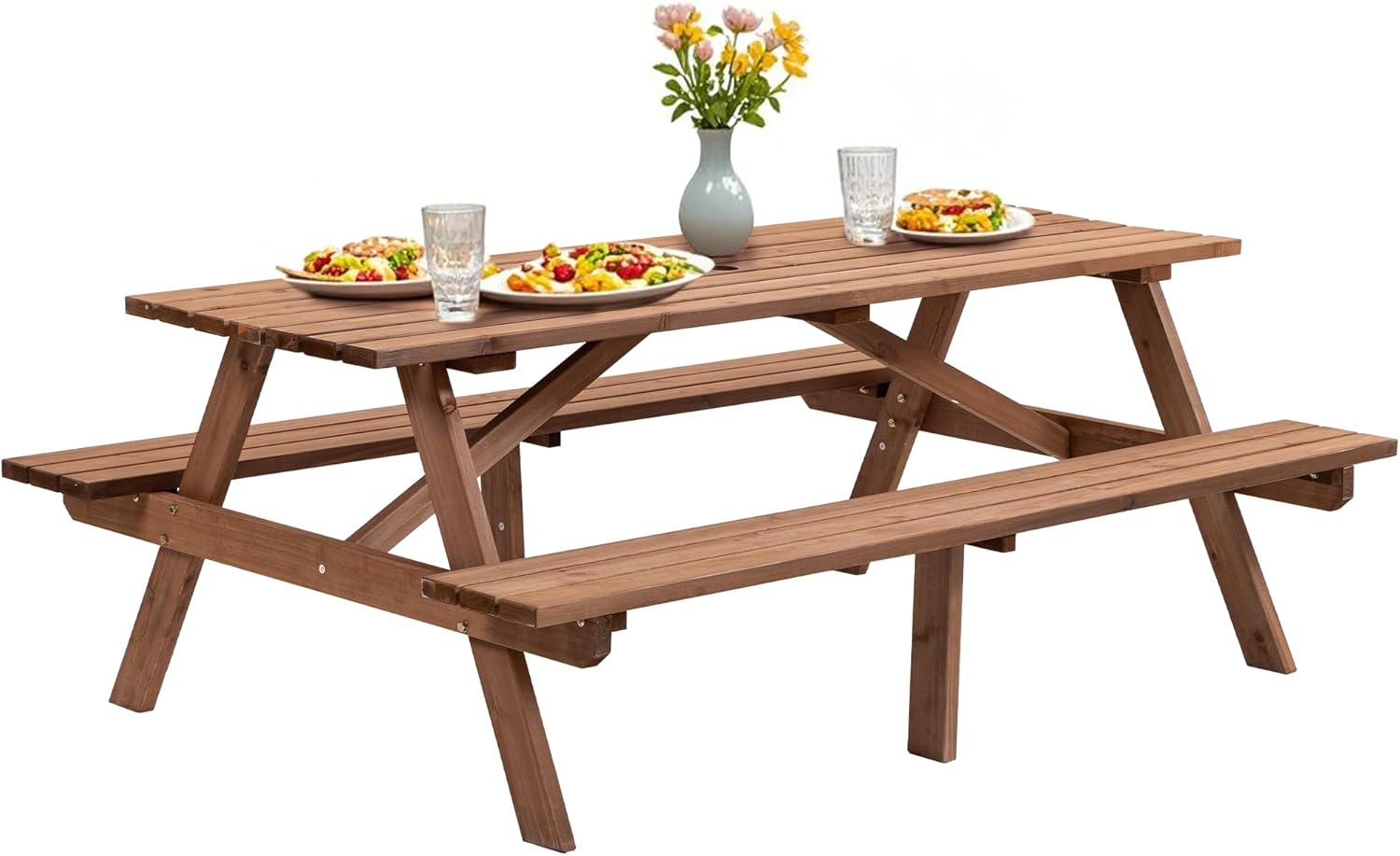
For shape, see round against rectangular patio tables. For sizing, what size patio table for 6 and what size patio table for 4. For clearance around the base, how much space around a patio table.
Questions we get asked
Should a patio table have an umbrella hole or not?
A hole suits a round table of 48 inches or more, especially on a windy or tight site. Go without for small tables, long rectangles and low seating.
Does the hole cost me a seat?
No — it costs the middle of the table, about a 10-inch circle, which is where serving dishes go.
How heavy does the base need to be?
Fifty pounds for a 9-foot canopy through a table, 70 to 90 for an 11-foot, and 100 or more for a cantilever.
Will a round umbrella shade a rectangular table?
Not past about 72 inches — the end seats stay in the sun. Use a rectangular canopy or a cantilever.
What if I never use the hole?
Plug it. An open hole lets water into the end grain of the boards around it, which opens the joints.
Is a cantilever umbrella better?
It shades any shape and rotates as the sun moves, but it needs a 100 lb-plus base in the walkway and it is the type that blows over.