Patio chair with arms vs armless — Four inches each
The Wooden Stars is a participant in the Amazon Services LLC Associates Program. We may earn a commission when you buy through links on our site, at no extra cost to you.
Patio chair with arms vs armless costs you four inches per chair — and around a six-seat table that is a whole extra place setting you no longer have.
Arms are worth those inches for some people and nobody else. The useful thing is knowing which group you are buying for.
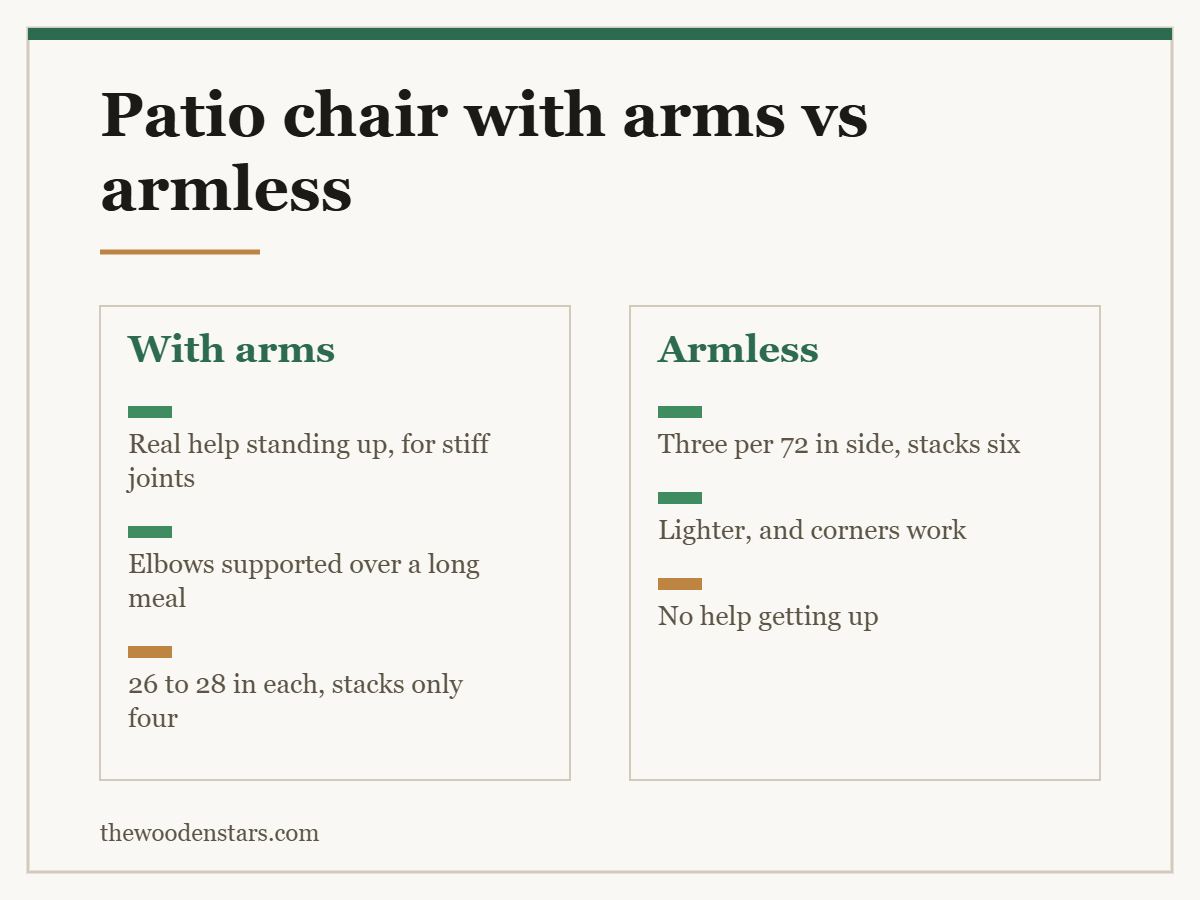
An armchair needs 26 to 28 inches of table edge; an armless chair needs 22 to 24. Over six seats that is 18 to 24 inches of table length — one more diner, or a table one size smaller. Arms matter most for older people and anyone with knee or hip trouble, because you push up on them to stand; they also decide whether a chair tucks under a table with an apron. Armless chairs stack deeper (six against four), weigh less, and let people sit at the corners of a rectangular table. The usual answer: arms at the ends, armless down the sides.
Patio chair with arms vs armless: the four inches
An outdoor arm is chunkier than an indoor one — 3 to 4 inches of timber each side, because the section has to survive weather.
So the table edge each chair needs:
- Armless: 22 to 24 inches.
- With arms: 26 to 28 inches.
On a 72-inch rectangle that is three armless chairs per long side comfortably, or two armchairs plus a squeeze. On a 60-inch round — 188 inches of circumference — it is eight armless places against six or seven with arms.
The seat-count arithmetic is in how many people fit at a patio dining table, and the chair’s own width in how wide a patio chair is.
| Measure | With arms | Armless |
|---|---|---|
| Table edge needed | 26 to 28 in | 22 to 24 in |
| Seats on a 72 in side | 2 | 3 |
| Seats at a 60 in round | 6 to 7 | 8 |
| Helps you stand up | Yes, significantly | No |
| Tucks under a low apron | Often not | Yes |
| Stack depth | 4 | 6 |
| Weight each | 16 to 26 lb | 11 to 18 lb |
| Corner seating | No | Yes |
Who actually needs arms
This is the part worth being plain about, because it is a real accessibility question rather than a style preference.
Anyone who pushes up to stand. With a stiff knee or hip, rising from a 17-inch seat without arms means using the table edge or someone’s hand. Arms turn that into an ordinary movement. For an older guest this is the difference between joining a meal outside and staying indoors.
Anyone sitting for hours. Arms give you somewhere to put your elbows between courses, and they change how long a hard timber chair stays tolerable.
Anyone who reclines. An armless chair only supports you while you sit upright.
Against that, arms help nobody who simply sits down and eats. For a family with children, six armless chairs is straightforwardly the better buy.
What arms do to storage and fit
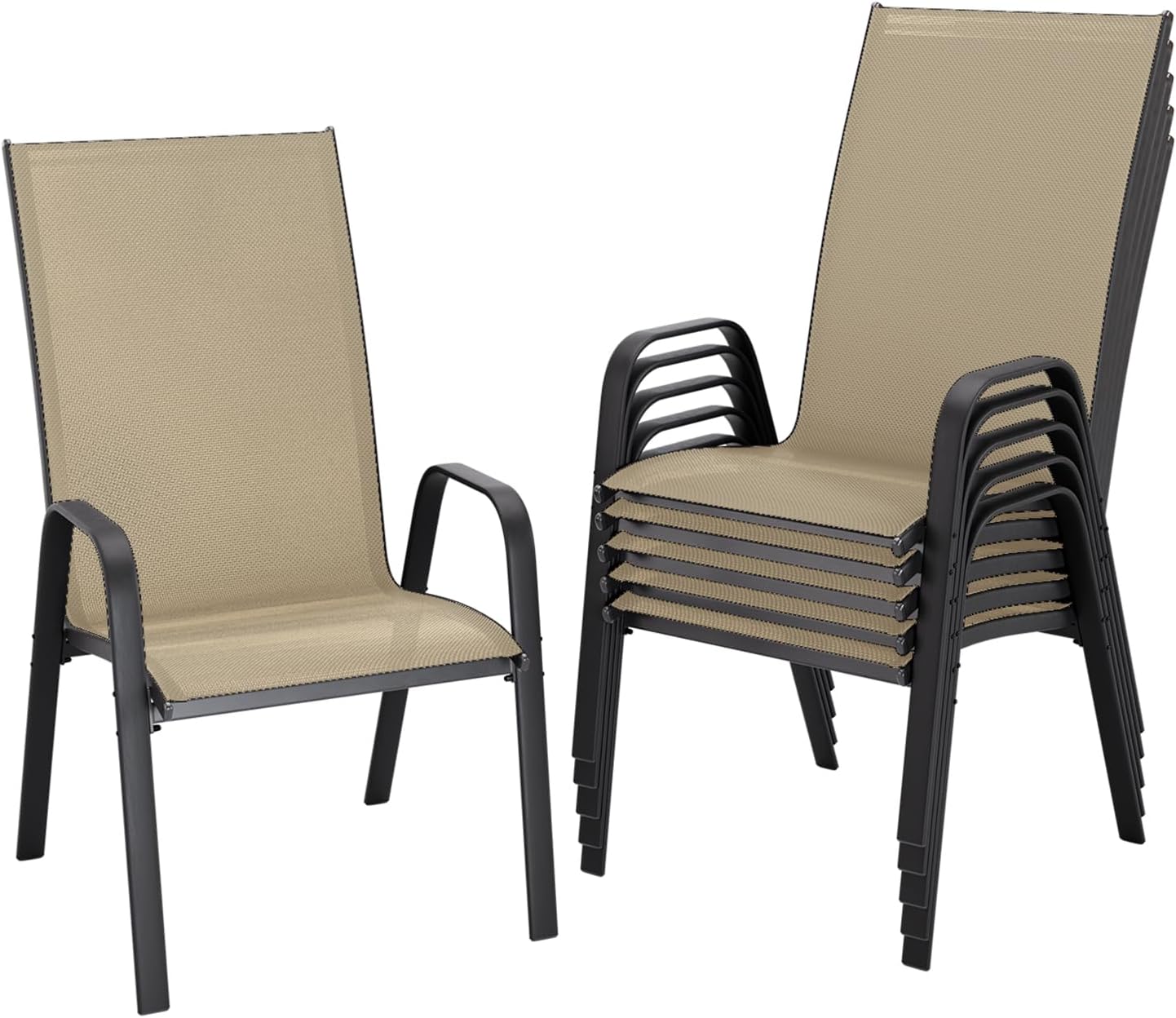
Stacking. Armchairs stack about four high before the arms bottom out; armless chairs stack six. Over a winter that is a real difference in shed floor — folding against stacking patio chairs.
Tucking under the table. Measure from the ground to the underside of the table’s apron, and compare it to the arm height, usually 24 to 27 inches. Outdoor tables often have a deep stiffening rail, and an armchair that will not tuck in sits permanently 8 inches proud — which eats the walkway you measured so carefully in how much space around a patio table.
Corners. On a rectangular table, a diner at the corner needs the two chairs either side to not have arms. Armchairs cannot corner.
Weight. Sixteen to 26 lb against 11 to 18. Heavier is steadier in wind and more tiring to rearrange.
The mix that suits most tables
Armchairs at the two ends, armless down the sides.
It is the traditional arrangement and it is traditional because it works. The ends are where you can afford the width — a 40-inch table end takes one chair whatever its arms do — and the sides are where every inch costs a seat.
It also solves the guest problem quietly: the person who needs arms takes an end, without anyone having to arrange it.
Two things to match if you buy them separately: seat height at 17 to 19 inches, and the timber, which weathers differently between ranges. Buying both from one range solves both.
The bench variant of the same idea — bench on the wall side, chairs on the open side — is in outdoor bench against outdoor chairs.
What to check on either
- Arm height against the table apron, measured to the underside of the rail rather than the tabletop.
- Seat 17 to 19 inches, with 10 to 12 to the tabletop — how tall a patio table should be.
- The arm-to-frame joint. On an outdoor chair this joint takes the full load every time someone pushes up on it. Bolted, not screwed into end grain.
- Weight rating, which is usually higher on armchairs because the arms brace the frame — how much weight a patio chair can hold.
- Stainless fixings and foot caps, as on any outdoor timber.
Timber and finish notes are in best wood to use outside and is acacia good for outdoor furniture.
For either chair
- Seat pad for outdoor chairs What makes a hard timber seat last a long meal
- Felt furniture pads For stacking without scuffing the arms
- Wood glue for loose joints The arm-to-frame joint is the one that loosens first
- Furniture foot caps Legs standing in water on paving rot from the bottom
What to buy


For seat counts, see how many people fit at a patio dining table and how wide a patio chair is. For other chair decisions, sling against cushion, folding against stacking and swivel against stationary.
Questions we get asked
Should patio chairs have arms?
Arms help anyone who pushes up to stand and anyone sitting for hours. They cost 4 inches of table edge per chair.
How much table edge does each need?
Twenty-six to 28 inches with arms, 22 to 24 without. Over six seats that is 18 to 24 inches of table.
How many fit at a 60-inch round table?
Eight armless places, or six to seven with arms.
Do armchairs tuck under the table?
Only if the arm height clears the apron. Measure to the underside of the rail, not the tabletop.
Do arms affect stacking?
Yes — about four high against six for armless, because the arms bottom out.
What is the best arrangement?
Armchairs at the two ends, armless down the sides. The ends can afford the width; the sides cannot.