Porch swing vs glider — Hanging or standing
The Wooden Stars is a participant in the Amazon Services LLC Associates Program. We may earn a commission when you buy through links on our site, at no extra cost to you.
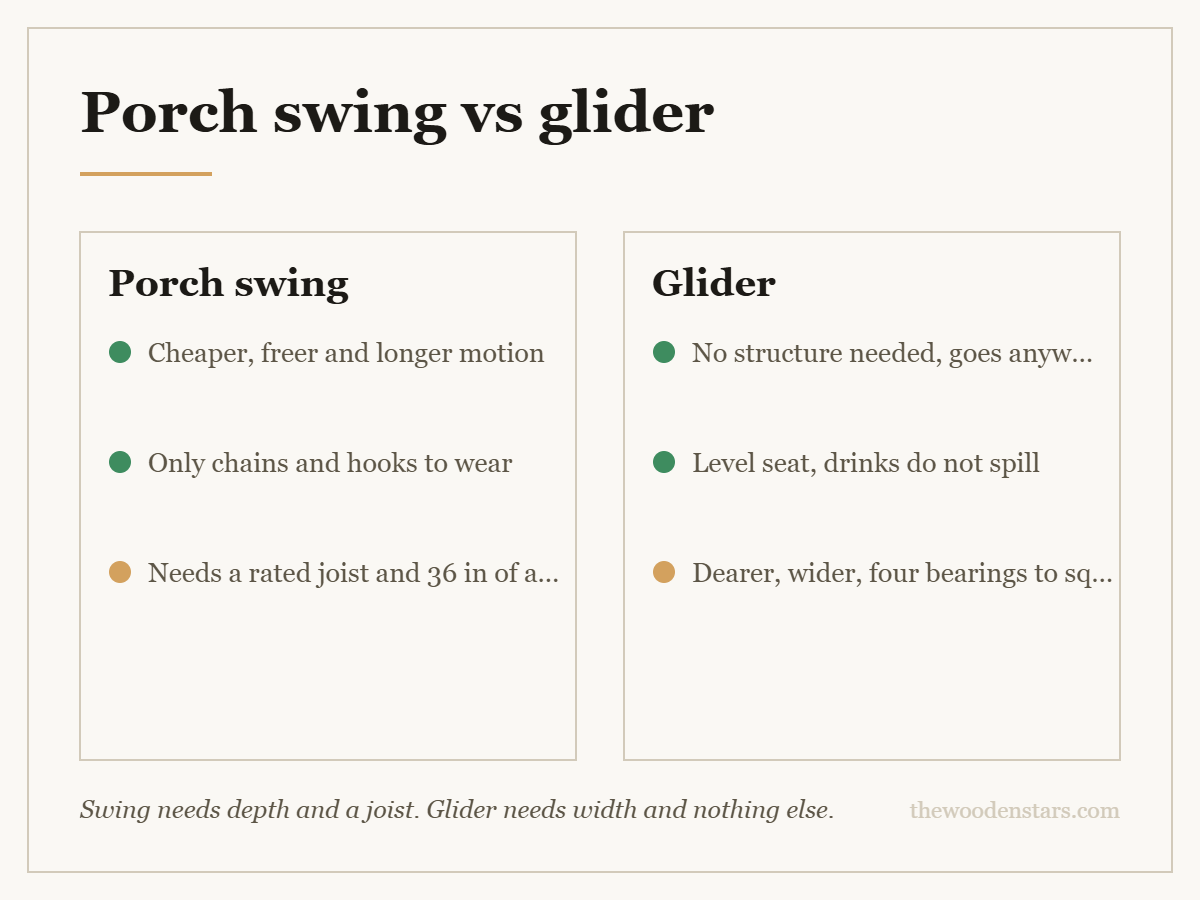
Porch swing vs glider is decided before you look at a single product: does the structure overhead exist, and will it carry the load?
A swing hangs from something. A glider stands on its own legs. Everything else — the motion, the space needed, the price — follows from that one difference.
A porch swing hangs from chains or rope and needs a ceiling joist or beam rated for at least 500 lb, ideally more. It swings in an arc, so it needs 36 inches clear behind and in front and about 18 inches from the back of the seat to the wall. A glider stands on a frame and moves the seat forward and back on a level path, so it needs almost no clearance, can go anywhere on a deck or lawn, and needs no structure at all. Swings are cheaper and feel better; gliders are installable anywhere and are the only option without a porch roof.
Porch swing vs glider: the structure question comes first
Before anything else, look up.
A hanging swing puts a dynamic load into whatever it is fixed to — not just the weight of two people, but that weight accelerating and decelerating through an arc. The rule of thumb is to size the fixing for at least 500 lb, and 800 is a safer number for a three-seat swing.
What that means in practice:
- Fix into a joist or a beam, not into the boards of a ceiling lining. Locate it properly; a stud finder on a porch ceiling is the same tool as one on a wall.
- Screw eyes or eye bolts through the joist with a washer and nut on top are better than a screw eye into the underside alone.
- Hang across the joists where possible, or into a beam that spans them.
- If the porch roof is a lightweight canopy, it will not do. That is the common case and it is what sends people to a glider.
A glider asks nothing of the building. On a deck, a lawn or a paved terrace, it simply stands there.
| Measure | Porch swing | Glider |
|---|---|---|
| Needs overhead structure | Yes, 500 to 800 lb rated | No |
| Motion | Arc, swings up at each end | Level, seat stays flat |
| Clearance front and back | 36 in each way | 6 to 12 in |
| Seat back to wall | 16 to 20 in | Can touch |
| Goes on a lawn | No | Yes |
| Typical price | Lower | Higher, it includes a frame |
| Moving parts | Chains and hooks | Four pivot bearings |
| Feel | Freer, longer motion | Contained, quieter |
The motion is genuinely different
A swing travels through an arc: as it moves forward it also rises, and it comes back under gravity. The motion is long, free and slightly unpredictable, which is most of the appeal.
A glider travels on a parallelogram linkage: the seat stays level and moves forward and back on a shallow path. It is a shorter, more controlled motion, and it stops as soon as you stop pushing.
Which is better is a matter of taste, with two practical notes. The glider’s level seat means a drink on the arm does not spill, and the glider is easier for a nervous child or an older person because there is no rise.
And the swing is quieter if hung well — chains through rubber-lined hooks make almost no noise, while a glider’s four pivot bearings develop a squeak that needs occasional grease.
Space, which the swing needs more of
- The arc. A swing travels 18 to 24 inches each way in normal use, and further if someone is enthusiastic. Allow 36 inches clear in front and behind.
- The wall gap. Hang it so the back of the seat is 16 to 20 inches from the wall at rest. Closer and it hits the wall; further and it hangs oddly into the space.
- Hanging height. The seat should sit 17 to 19 inches off the floor, the same as any chair. Measure from the joist down and buy chain to suit.
- Glider clearance is almost nothing at the back — its own frame contains the motion — but it is wider than a swing of the same seat length because the A-frames splay outward.
So a swing needs depth; a glider needs width. On a narrow porch that alone often decides it.
The third option: a swing on its own A-frame
A free-standing swing frame gets you the arc motion without needing a porch roof. It is the honest middle ground and it is worth knowing about because many people assume a swing is off the table once they see their canopy.
What it costs: a large footprint — typically 7 to 8 feet wide and 4 to 5 feet deep — and the frame has to be heavy or staked, because a swinging load tries to walk a light frame across the lawn.
What it gains: it goes on grass, it moves, and it takes the same swing seat you would have hung.
The hardware, on both
On a swing: stainless or hot-dip galvanised chain and hooks, and swivel hangers with a bearing rather than a plain screw eye. A plain eye wears through in a few seasons, and it wears where you cannot see it. Check the chain and the eye each spring — this is the one outdoor maintenance job that is a safety job.
On a glider: the four pivots are the wear point. Sealed bearings last; plain bushings wear oval and the glider starts to rock sideways as well as fore and aft. Grease them annually.
On both: stainless fixings throughout, because a swing seat has a lot of joints and plain steel streaks rust down every one — and see best wood to use outside for the timber, plus how much weight a porch swing can hold for the load arithmetic.
Hanging and maintaining
- Swing hanger kit with bearings A plain screw eye wears through where you cannot see it
- Stud finder The fixing must reach a joist, not the ceiling lining
- Marine-grade chain Hot-dip galvanised or stainless, sized for 500 lb and up
- White lithium grease The annual job on a glider’s four pivots
What to buy


For load and fixings, see how much weight a porch swing can hold. For sizing, how wide a porch swing should be. For other seating, outdoor bench against outdoor chairs and adirondack chair against patio chair.
Questions we get asked
What is the difference between a porch swing and a glider?
A swing hangs from a joist and moves through an arc; a glider stands on its own frame and moves the seat on a level path.
What does a porch swing need to hang from?
A joist or beam rated for at least 500 lb, and 800 for a three-seater. A lightweight canopy roof will not do.
How much clearance does a swing need?
Thirty-six inches clear in front and behind, with the seat back 16 to 20 inches from the wall at rest.
Can a glider go on grass?
Yes — it needs no structure and no fixing, though a soft lawn will let the feet sink over time.
Which is more comfortable?
A matter of taste. The swing’s motion is longer and freer; the glider keeps the seat level so a drink on the arm does not spill.
Can I have a swing without a porch?
Yes, on a free-standing A-frame — about 7 to 8 feet wide and 4 to 5 deep, and it needs weight or stakes.