How much weight can a porch swing hold? 400 to 800 lb
The Wooden Stars is a participant in the Amazon Services LLC Associates Program. We may earn a commission when you buy through links on our site, at no extra cost to you.
How much weight can a porch swing hold? The seat itself is usually rated 400 to 800 lb — but the number that matters is what the joist and the hardware can take, and that is where swings actually fail.
A swing is the one piece of outdoor furniture where getting the specification wrong drops people on the floor. It is worth the ten minutes.
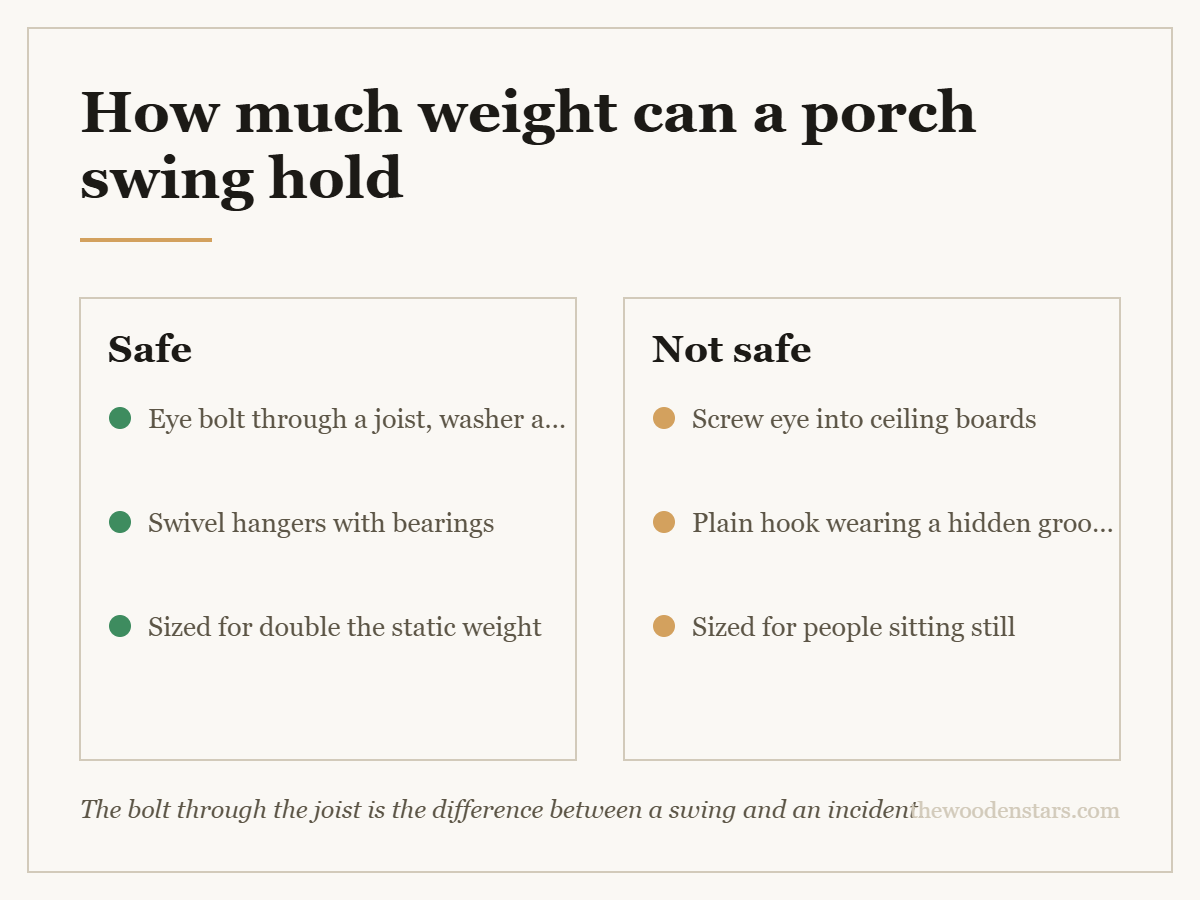
Most two-seat swings are rated 400 to 600 lb and three-seaters 600 to 800. Size the fixing for far more than the people, because a swing applies a dynamic load — swinging roughly doubles the static weight at the top of the arc. So two adults at 400 lb means designing the hanging point for 800 lb or more. Fix into a joist or beam, never into ceiling boards, using eye bolts through the timber with a washer and nut rather than screw eyes. Use hardware rated individually — chain, hooks, hangers — and inspect the eye each spring, because it wears where you cannot see it.
How much weight can a porch swing hold: three separate limits
People read one number. There are three, and the chain is only as strong as its weakest.
- The seat. The timber frame and its joints — 400 to 800 lb, and this is the number on the listing.
- The hardware. Chain, hooks, quick links, swivel hangers. Each is rated separately and the smallest one governs. A 1,000 lb chain with a 300 lb hook is a 300 lb system.
- The structure. The joist, the beam, and how the fixing engages it. Almost always the real limit, and almost never stated anywhere.
The failures that hurt are nearly all in the third category — and specifically a screw eye driven into the underside of a board rather than through a joist.
| Item | Typical rating | Design for |
|---|---|---|
| Two-seat swing frame | 400 to 600 lb | Its stated figure |
| Three-seat swing frame | 600 to 800 lb | Its stated figure |
| Chain, 3/16 in galvanised | About 750 lb | Per leg |
| Screw eye into a joist | Highly variable | Avoid, use an eye bolt |
| Eye bolt through a joist | 1,000 lb and up | The right answer |
| Hanging point, two adults | — | 800 lb or more |
Why the dynamic load doubles it
Sitting still, two adults at 400 lb apply 400 lb.
Swinging, the seat decelerates at the bottom of each arc and accelerates upward — and that acceleration adds force. In normal use the peak is roughly 1.5 to 2 times the static weight. Somebody pushing hard, or a group of teenagers, goes higher.
So the working rule is simple: design the hanging point for at least double the people you expect, and treat the seat’s own rating as a static figure that assumes gentle use.
This is the same reasoning that applies to any furniture rating — published numbers are static and people are not. The bed version of the same arithmetic is in how much weight a bed frame can hold.
Fixing into the structure properly
- Find a joist or a beam. A stud finder works on a porch ceiling. Tapping does too — a joist sounds solid.
- Drill through it and use an eye bolt with a large washer and a nut on the upper side. This puts the joist in compression between washer and bolt head, which is far stronger than any thread biting into the underside.
- If you must use screw eyes, they need to penetrate at least 2 inches into solid timber, and they are still the weaker option.
- Hang across the joists — a swing hung parallel to a single joist loads that one joist alone. A beam that spans several is better.
- Space the hangers 2 to 4 inches wider than the seat, so the chains splay slightly. Vertical chains let the seat twist.
- Use swivel hangers with a bearing. A chain link rubbing directly in a screw eye wears a groove, and the groove is on the hidden upper surface.
If the porch roof is a lightweight canopy rather than a framed structure, none of this applies and the answer is a free-standing frame or a glider — porch swing against glider.
What makes the seat itself strong
The frame’s rating comes from the same things as any timber furniture:
Bolted joints rather than screws. A swing seat racks fore and aft on every cycle, and screws into end grain work loose. Bolts through with nuts can be pulled up annually.
The hanging points. Look at where the chain attaches — it should be through the frame with a bolt and a plate, not a screw eye into the arm. This is the commonest weak point on cheap swings.
Slat thickness and support. A 60-inch seat slat under 0.75 inches flexes. Look for a mid-span rail.
Species. Cedar is traditional and light; acacia and teak are denser and heavier. Heavier is fine here — the structure carries it, and mass makes the motion smoother. See best wood to use outside.
The annual check, which is a safety check
Once each spring, ten minutes:
- Unhook one chain and look at the eye. Wear happens on the top inner surface, invisible while hanging.
- Check the bolt is still tight and the washer has not crushed into the timber.
- Look for rust in the chain links, particularly where two links bear on each other.
- Pull up the seat frame bolts. Ten minutes with a spanner.
Everything else about outdoor timber — oiling, foot caps, drainage — applies as usual: is acacia good for outdoor furniture.
Hanging a swing safely
- Swing hanger kit with bearings Eye bolts, washers and bearings, rated and matched
- Stud finder The fixing has to reach a joist, not the ceiling lining
- Marine-grade chain Galvanised or stainless, with the rating printed per leg
- Spanner set The annual ten minutes that keeps the rating real
What to buy


For the free-standing alternative, see porch swing against glider. For sizing, how wide a porch swing should be. For timber, best wood to use outside. For other seating, outdoor bench against outdoor chairs.
Questions we get asked
How much weight can a porch swing hold?
The seat is usually rated 400 to 600 lb for two seats and 600 to 800 for three. The hanging point should be designed for far more.
Why design the fixing for double?
Because swinging roughly doubles the static load at the top of the arc. Four hundred pounds of people is about 800 lb of force.
What should I fix into?
A joist or beam, using an eye bolt drilled through with a washer and nut on top. Never into ceiling boards.
Are screw eyes good enough?
They are the weaker option. If you use them they need at least 2 inches into solid timber, and an eye bolt is better.
How far apart should the hangers be?
Two to 4 inches wider than the seat, so the chains splay slightly. Vertical chains let the seat twist.
What should I check each year?
Unhook a chain and look at the eye — wear happens on the hidden upper surface. Then check the bolt, the chain links and the frame bolts.