Wood vs metal patio furniture — Heat, weight, repair
The Wooden Stars is a participant in the Amazon Services LLC Associates Program. We may earn a commission when you buy through links on our site, at no extra cost to you.
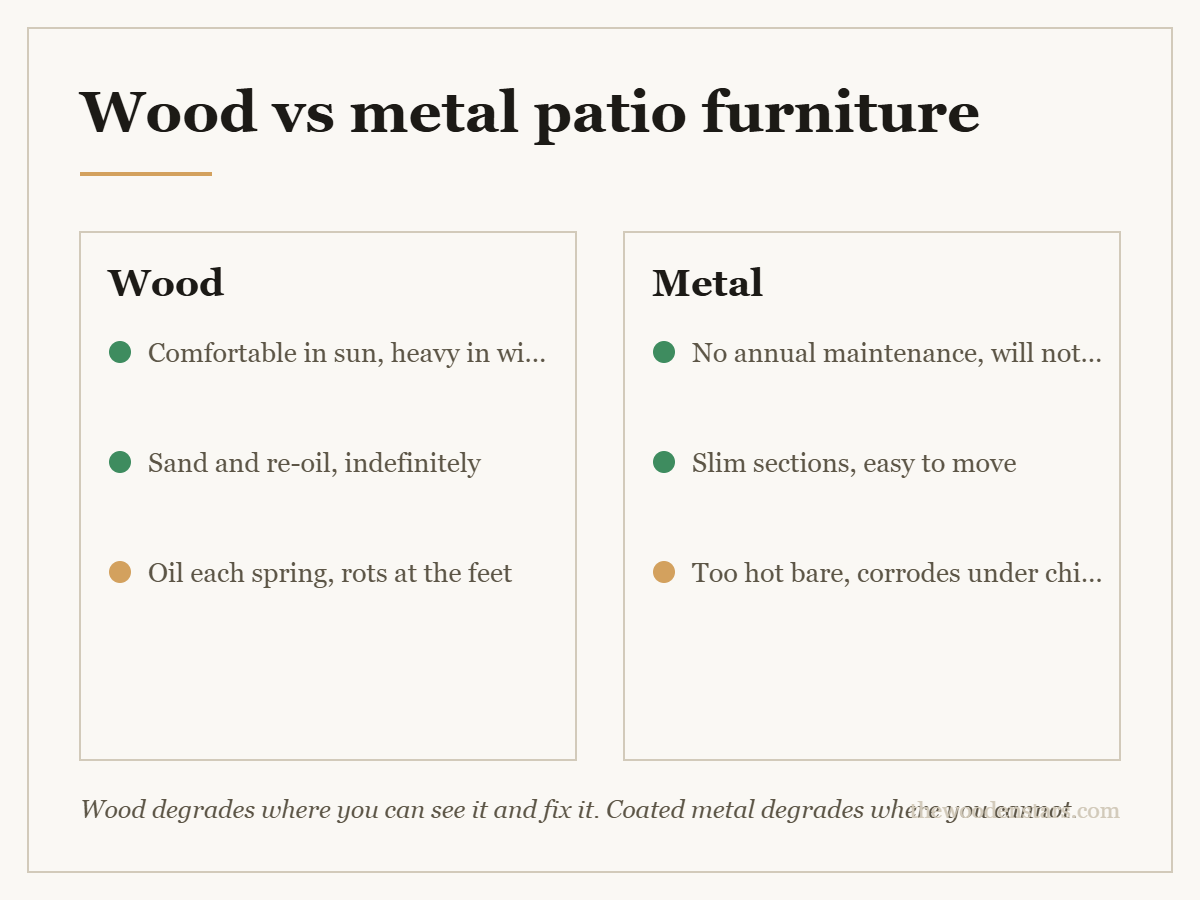
Wood vs metal patio furniture is decided outdoors by three things indoor furniture never has to face: how hot the seat gets in July, whether the wind moves it, and which way it fails — rot or rust.
Both last decades when chosen well. They ask for completely different things from you in return.
Wood — teak, acacia, eucalyptus — stays comfortable in direct sun, has the mass to resist wind, and can be sanded and re-oiled indefinitely. It asks for an afternoon of oil each spring on everything except teak. Metal asks for nothing and gives nothing back: powder-coated aluminium will not rust and will not rot, but it gets too hot to sit on in full sun, it is light enough to blow over, and once the coating chips the corrosion starts underneath where you cannot reach it. Wrought iron solves the weight and heat is still a problem. Choose wood for comfort and repairability, aluminium for zero maintenance.
Wood vs metal patio furniture: the heat nobody mentions
This is the difference people feel first and listings never state.
In direct summer sun, a dark powder-coated aluminium or steel seat reaches temperatures that are genuinely uncomfortable to sit on with bare legs — metal conducts heat into you far faster than timber does. Timber in the same sun feels warm and no more, because it conducts heat slowly.
The practical consequence: metal patio furniture usually needs cushions to be usable in summer, and cushions bring their own problem — they have to be stored, they soak, and they wear out in two to four seasons. A slatted timber seat is usable bare.
The reverse is true in cold weather, where both are unpleasant and neither is worse in a way that matters.
| Measure | Wood | Metal |
|---|---|---|
| Seat in full sun | Warm, usable bare | Too hot without a cushion |
| Weight, 6-seat set | 150 to 400 lb | 60 to 200 lb, aluminium |
| Wind | Mass resists it | Aluminium blows over |
| How it fails | Greys, checks, rots at the feet | Coating chips, corrodes underneath |
| Repairable | Sand and re-oil, indefinitely | Touch-up paint, rarely well |
| Maintenance | Oil once a year, except teak | None, until the coating goes |
| Rust stains on paving | No | From steel and iron, yes |
| Lifespan, looked after | 15 to 40 years | 10 to 25 years |
Weight, and why light furniture is a problem outside
Indoors, light furniture is convenient. Outdoors it is a liability.
A six-seat aluminium set can weigh under 100 lb in total, and a gust will move chairs across a terrace and into a window or a pool. On a roof terrace or an exposed coastal garden this is not a small risk, and it is the reason most commercial outdoor spaces use heavy furniture.
Timber gives you mass for free. A teak or acacia dining chair is 15 to 25 lb against 6 to 10 for aluminium, and the table is several times heavier again.
Wrought iron is the metal that solves this — it is the heaviest option of all and will not move. It also rusts more readily than aluminium and is punishing to rearrange.
How each one actually fails
Wood fails slowly and visibly. It greys, the grain raises, small checks open along the length, and the bottom of the legs goes first because they stand in water. Every one of those stages is repairable: sand, oil, add foot caps. A neglected acacia chair at ten years is ugly and structurally fine.
Metal fails invisibly and then suddenly. Powder coating is a sealed skin. While it is intact, nothing happens. Once it chips — a dropped tool, a stone from a mower, a scrape against paving — moisture gets underneath and corrosion spreads laterally beneath the coating where you cannot see or reach it. By the time the paint bubbles, the metal under it has gone.
That asymmetry is the strongest argument for timber: wood is repairable by anyone with sandpaper, and coated metal is not repairable at all in any durable way. Touch-up paint on a chip is a cosmetic fix, not a seal.
There is one exception worth knowing: bare or anodised aluminium has no coating to fail, forms its own oxide layer and is genuinely maintenance-free. It looks industrial, which is why it is rare on domestic furniture.
The hybrid, which is most of the market
A large share of “wood” patio sets are actually an aluminium frame with timber slats, and a large share of “metal” sets have timber arms.
This is usually a good combination rather than a compromise: the frame does not rot, the slats do not burn you, and the weight lands between the two. What to check is the junction — where timber meets metal, water sits in the joint and the fixing is doing two jobs. Stainless bolts with a nylon washer between the materials last; a plain steel screw through aluminium into timber is a galvanic corrosion problem waiting to happen.
The other hybrid is timber with a cast aluminium base on tables, which is excellent — mass low down, no rot at floor level, and a timber top.
What to check, either way
- Wood: the species, named. Teak, acacia, eucalyptus, cedar. Oil content rather than hardness predicts outdoor life — best wood to use outside and acacia against teak.
- Metal: the alloy and the coating. Powder-coated aluminium is the mainstream good answer. Powder-coated steel is heavier, cheaper and rusts once chipped.
- Fixings, on both. Stainless or coated. Plain steel bleeds rust streaks down timber and paving within a year.
- Foot caps. Timber legs wick water; metal legs trap it inside the tube. Both want caps.
- Drainage. Slats on both, or a top with a fall.
If it is acacia or eucalyptus, plan on the annual oil — is acacia good for outdoor furniture. If it is teak, you can genuinely do nothing.
Whichever material
- Teak or hardwood oil The one annual job on acacia and eucalyptus
- Furniture foot caps Timber wicks water, metal tubes trap it — both need caps
- Stainless replacement bolts What to fit when the supplied plain steel starts streaking
- Touch-up paint for powder coating Cosmetic, not a seal, but it slows a fresh chip
What to buy


For the plastic alternative, see wood against resin patio furniture. For timber choice, best wood to use outside. For the set type, dining set against conversation set. For sizing, what size patio table for 6.
Questions we get asked
Is wood or metal better for patio furniture?
Wood for comfort in sun, mass against wind and repairability. Metal — specifically powder-coated aluminium — for zero annual maintenance.
Does metal patio furniture get too hot?
In direct summer sun, yes. Metal conducts heat into you quickly, so it generally needs cushions to be usable bare-legged.
Will aluminium furniture blow over?
A six-seat aluminium set can be under 100 lb in total, so on an exposed terrace, yes. Timber or wrought iron gives you mass.
Which lasts longer?
Looked after, wood — 15 to 40 years against 10 to 25, because wood can be sanded and re-oiled while coated metal cannot be resealed.
What happens when powder coating chips?
Moisture gets underneath and corrosion spreads beneath the coating where you cannot see it. By the time the paint bubbles, the metal has gone.
Are aluminium frames with timber slats a good idea?
Usually yes. Check the junction — stainless bolts with a nylon washer, not plain steel through aluminium into timber.