How big should a deck box be? Count the cushions
The Wooden Stars is a participant in the Amazon Services LLC Associates Program. We may earn a commission when you buy through links on our site, at no extra cost to you.
How big should a deck box be? 100 to 120 gallons for a normal patio — and the reason that number is so much higher than most people guess is that seat cushions are enormous once you stack them.
Work it out from what goes in, not from the patio. A box that is too big is mildly annoying; one that is too small gets used as a step.
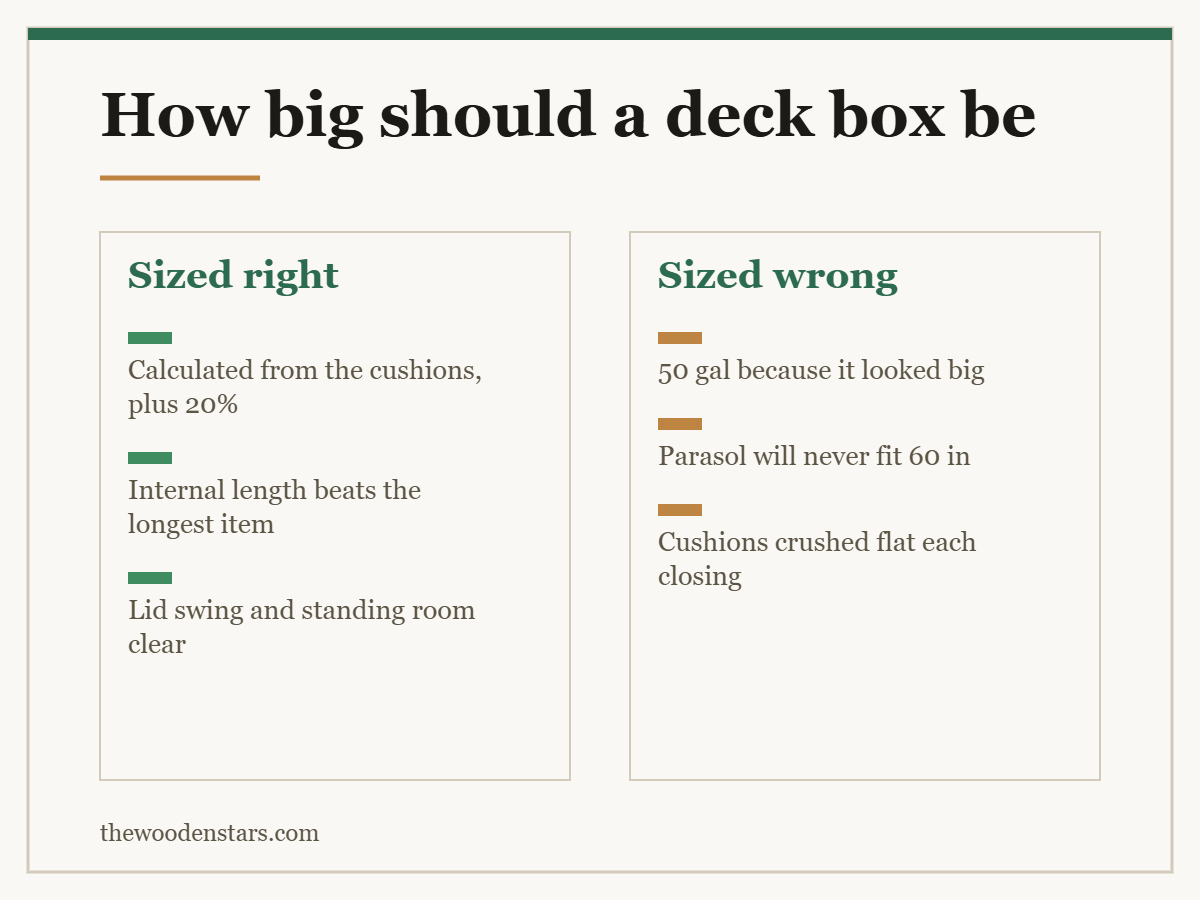
Rules of thumb: 50 to 70 gallons for cushions from a two or three-seat set, 100 to 120 for a six-seat dining set plus covers, and 150 to 200 if a parasol, a leaf blower or long tools go in too. Convert properly — one cubic foot is 7.48 gallons, so a 50 × 22 × 24-inch box is about 107. Then check the longest item against the internal length, because that is what actually fails: a folded parasol is 70 to 90 inches and fits almost no deck box. Add 20% over your calculation for the things you forgot.
How big should a deck box be: sizing from the contents
Measure what you own, in this order.
- Seat cushions. A dining seat pad is roughly 18 × 18 × 3 inches, so six of them stacked is 18 × 18 × 18 — about 3.4 cubic feet, or 25 gallons, and they must not be crushed.
- Back cushions or lounge cushions. A deep-seat back is 24 × 22 × 6. Four of them is another 7.3 cubic feet, 55 gallons. This is the item people forget.
- Covers and throws. A folded table cover is about 1 cubic foot; a couple of throws another one.
- Everything else. Barbecue tools, games, a hose reel: 2 to 4 cubic feet.
Add them, convert at 7.48 gallons per cubic foot, then add 20%. A six-seat set with deep-seat lounge cushions lands at 100 to 130 gallons without trying, which is why the 50-gallon boxes at the front of the shop disappoint so many people.
| Situation | Capacity | Typical size |
|---|---|---|
| Balcony, two chair pads | 30 to 50 gal | 40 x 18 x 18 in |
| Three-seat set cushions | 50 to 70 gal | 45 x 20 x 20 in |
| Six-seat dining set plus covers | 100 to 120 gal | 50 x 22 x 24 in |
| Deep-seat lounge cushions | 120 to 150 gal | 55 x 25 x 26 in |
| Plus parasol and garden kit | 150 to 200 gal | 60 x 28 x 28 in |
The check that catches the real mistake
Capacity is the number on the box. Internal length is the number that fails.
A folded parasol is 70 to 90 inches. A 150-gallon deck box is typically 60 inches long internally. The parasol does not fit, and no amount of gallons changes that. The same is true of long-handled tools, a folded gazebo frame and most hose reels on a stand.
So do this before buying:
- Measure your longest item and compare it with the box’s internal length, not the external.
- Measure your bulkiest item — usually a deep-seat back cushion — against internal height.
- Subtract 1 to 2 inches from every internal figure for the thickness of the walls and any internal ribs.
If the parasol has to go inside, the honest answer is usually a shed corner or a purpose-made parasol cover instead — sizing and storage for those is in what size patio umbrella you need.
Where it goes, and how much room it needs
A deck box needs a bit more floor than its footprint.
Lid swing. A hinged lid needs the space behind it to be clear to about the box’s own height, and it must not foul a windowsill, a tap or a downpipe. Gas-strut lids need less arc than plain hinged ones.
Standing room in front. Twenty-four to 30 inches, because you bend over it with both arms full.
Off the wall. Two inches of gap behind a timber box lets air move and stops the back face staying permanently damp against render.
If the patio is tight, that clearance is competing with the dining clearances in how much space around a patio table — and this is exactly where a storage bench instead of a deck box starts to make sense, because a bench needs no clearance behind and gives seats back.
Bigger is not free
Three costs of over-sizing, so you do not simply buy the largest one:
Lid weight. A 200-gallon timber lid is heavy enough that children should not open it, and heavy enough to need a strut. Check the lid stay is included, not an accessory.
Reach. Anything deeper than about 26 inches means leaning right in for whatever is at the bottom. A wide, shallower box is easier to live with than a tall one of the same capacity.
Footprint. Gallons come from length far more cheaply than from height, and length is what a small patio does not have.
The practical sweet spot for most gardens is 50 to 55 inches long, 22 to 25 deep, 24 to 26 tall — around 110 to 130 gallons, a lid one person can lift, and a bottom you can reach.
Getting the size right
- Tape measure Internal length against your longest item is the check that matters
- Vacuum storage bags Turns 55 gallons of back cushions into about 25
- Gas strut lid support Anything over about 100 gallons needs one
- Silica gel dehumidifier tubs For a large box that cannot be well ventilated
What to buy


For the seat-or-storage decision, see deck box against storage bench. For the parasol problem, what size patio umbrella you need. For materials, wood against resin patio furniture and best wood to use outside.
Questions we get asked
How big should a deck box be?
One hundred to 120 gallons for a six-seat set plus covers. Fifty to 70 for a small set; 150 to 200 if garden kit goes in as well.
How do I convert inches to gallons?
Multiply the internal inches, divide by 1,728 for cubic feet, then multiply by 7.48. A 50 × 22 × 24-inch box is about 107 gallons.
What size box holds six chair cushions?
Six 18 × 18 × 3-inch pads are about 25 gallons. Add back cushions and covers and you are at 80 to 100.
Will a parasol fit?
Almost never. A folded parasol is 70 to 90 inches and most boxes are 60 inches internally.
How much clearance does a deck box need?
Clear lid swing behind, 24 to 30 inches of standing room in front, and 2 inches off a wall for airflow.
Is a bigger box always better?
No. Past about 26 inches deep you cannot reach the bottom, and a large timber lid needs a strut to be safe.