Adirondack chair vs patio chair — Recline or upright
The Wooden Stars is a participant in the Amazon Services LLC Associates Program. We may earn a commission when you buy through links on our site, at no extra cost to you.
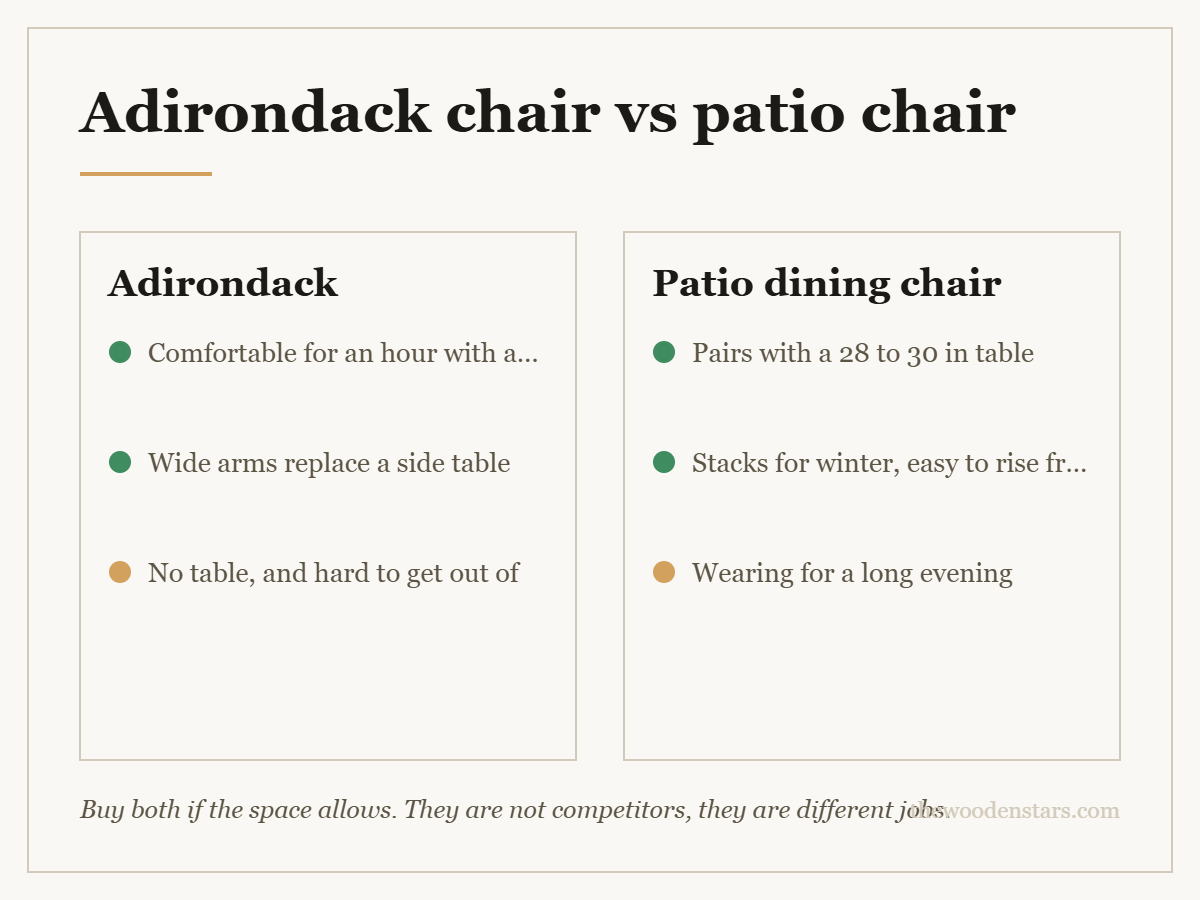
Adirondack chair vs patio chair is a choice between a chair you settle into and a chair you sit at — and the giveaway is the seat angle, which on an Adirondack slopes backwards by design.
That slope is why an Adirondack is wonderful by a fire pit and impossible at a dining table, and it is why people who buy six of them for a patio end up eating indoors.
An Adirondack chair has a rearward-sloping seat, a tall fan back and wide flat arms. The seat front sits at 14 to 16 inches and the back of the seat lower still, so you recline. It is for sitting with a drink, and it is hard to get out of — which matters more with age than anyone expects. A patio dining chair has a level seat at 17 to 19 inches and an upright back, to pair with a 28 to 30-inch table. They are not interchangeable: you cannot eat a plated meal in an Adirondack, and a dining chair is uncomfortable for an evening by a fire.
Adirondack chair vs patio chair: the seat angle
An Adirondack’s seat slopes back by roughly 10 to 15 degrees, and the back leans further still. Your hips end up below your knees.
That posture is deeply comfortable for an hour with a book. It also means:
- Your lap is not level, so a plate slides. Eating means holding the plate.
- You cannot reach a dining table — a 29-inch tabletop is at chest height from an Adirondack.
- Getting up takes a push. From a reclined seat at 14 inches you are rising from below knee height. For older users this is the deciding factor.
A patio dining chair’s seat is level at 17 to 19 inches, which puts your thighs horizontal and your feet flat. It is the same geometry as an indoor dining chair, for the same reason.
| Measure | Adirondack | Patio dining chair |
|---|---|---|
| Seat height, front | 14 to 16 in | 17 to 19 in |
| Seat angle | Slopes back 10 to 15° | Level |
| Back | Tall, reclined, fanned | Upright |
| Arms | Wide and flat, hold a glass | Narrow or none |
| Pairs with a table | No | Yes, 28 to 30 in |
| Easy to stand up from | No | Yes |
| Footprint | 32 to 38 in deep | 22 to 26 in deep |
| Stacks | No | Often |
The footprint, which is larger than it looks
An Adirondack is 32 to 38 inches deep because the back is reclined and the legs splay. A patio dining chair is 22 to 26.
Add the depth people forget: an Adirondack is used facing something — a view, a fire pit, another chair — so it needs room in front as well as behind. Two Adirondacks facing each other across a small table want about 9 feet of run.
Against that, they need almost no clearance behind: nobody pushes an Adirondack back to stand up, they lever out of it forwards. So on a deck against a railing, an Adirondack can sit closer to the edge than a dining chair can.
The wide arm is a real feature
The flat arm — usually 5 to 7 inches across — is what removes the need for a side table. A glass, a mug, a phone and a paperback all live on it.
Which is why Adirondacks are sold in pairs with a small table between them rather than in sets of six, and why a conversation set built around them behaves differently from one built around deep cushioned seating. If the arms are narrow, the chair is an Adirondack in style only.
The equivalent decision for cushioned lounge seating is in patio dining set against conversation set.
Material: the one place Adirondacks differ
Across outdoor furniture generally, timber is the comfort choice and repairable. On Adirondacks specifically, HDPE lumber — recycled plastic boards — has largely taken over, and for good reasons:
- The shape is all wide flat boards, which suits sheet material perfectly.
- The chairs are heavy in HDPE, which stops them blowing across a lawn.
- They need nothing — no oil, no sanding — for twenty years.
Timber Adirondacks in cedar or teak are lighter, warmer to the touch and can be sanded back when they grey. Cedar is the traditional choice and the softest; teak is the expensive one that lasts untreated. The comparison is in wood against resin patio furniture and best wood to use outside.
Whichever material, check the fixings are stainless — a chair in this shape has a lot of joints, and plain steel streaks rust down every one of them.
What to check before buying either
- Adirondack: the seat height at the front. Under 14 inches and standing up becomes a genuine effort. Some makers offer a “tall” version at 17 to 18 for exactly this reason.
- Adirondack: whether it folds. Folding versions store flat over winter, and the hardware is the wear point.
- Dining chair: stacking. Six chairs that stack occupy a quarter of the shed space.
- Both: arm height against the table or the side table they will sit beside.
- Both: weight. Light chairs blow over, and outdoors that is how they get damaged.
For either chair
- Seat pad for outdoor chairs Makes a slatted timber dining seat last a long meal
- Adirondack side table The pair-and-a-table arrangement these chairs are designed for
- Furniture foot caps Timber legs standing in water rot from the bottom up
- Teak or hardwood oil For cedar and acacia chairs, once each spring
What to buy


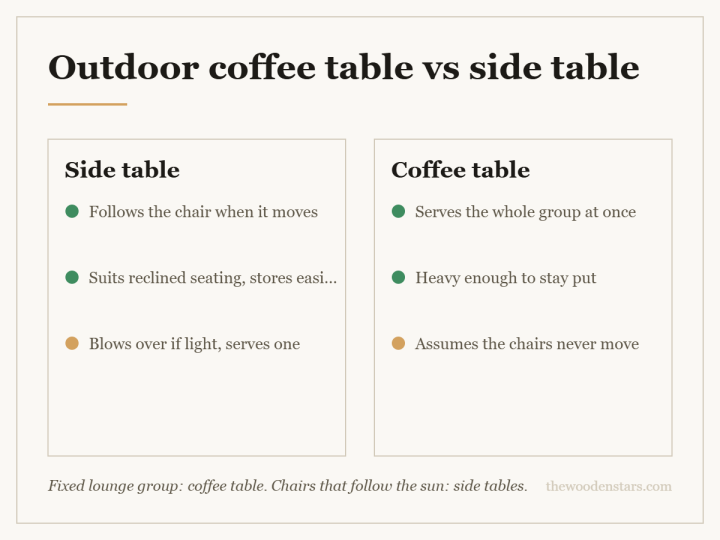
For lounge seating generally, see dining set against conversation set. For bench alternatives, outdoor bench against outdoor chairs. For materials, wood against resin and wood against metal. For a side table, outdoor coffee table against side table.
Questions we get asked
What is the difference between an Adirondack chair and a patio chair?
The seat angle. An Adirondack slopes back 10 to 15 degrees for reclining; a patio dining chair is level at 17 to 19 inches to pair with a table.
Can you eat at an Adirondack chair?
Not at a table. The seat is too low and too reclined, so a 29-inch tabletop sits at chest height and a plate slides off your lap.
Are Adirondack chairs hard to get out of?
Yes, and it is the most common regret. The seat front is 14 to 16 inches and reclined, so you rise from below knee height.
How much space does an Adirondack need?
Thirty-two to 38 inches of depth, plus room in front because it faces something. Two facing across a table want about 9 feet.
Should I buy wood or HDPE?
HDPE for this shape — heavy, maintenance-free, twenty years. Cedar or teak if you want the warmth and the option to sand it back.
Do I need a side table with one?
Usually not. The wide flat arms hold a glass, a phone and a book, which is what they are for.