Wood Filler vs Wood Putty vs Epoxy: Which One Your Repair Actually Needs
The Wooden Stars is a participant in the Amazon Services LLC Associates Program. We may earn a commission when you buy through links on our site, at no extra cost to you.
Three products sit next to each other on the shelf with almost the same name, and they are not interchangeable. Wood filler, wood putty and epoxy behave so differently that using the wrong one is the reason most furniture repairs look repaired.
The choice comes down to one question that has nothing to do with the size of the hole: does the repair need to take a finish, and does it need to hold load?
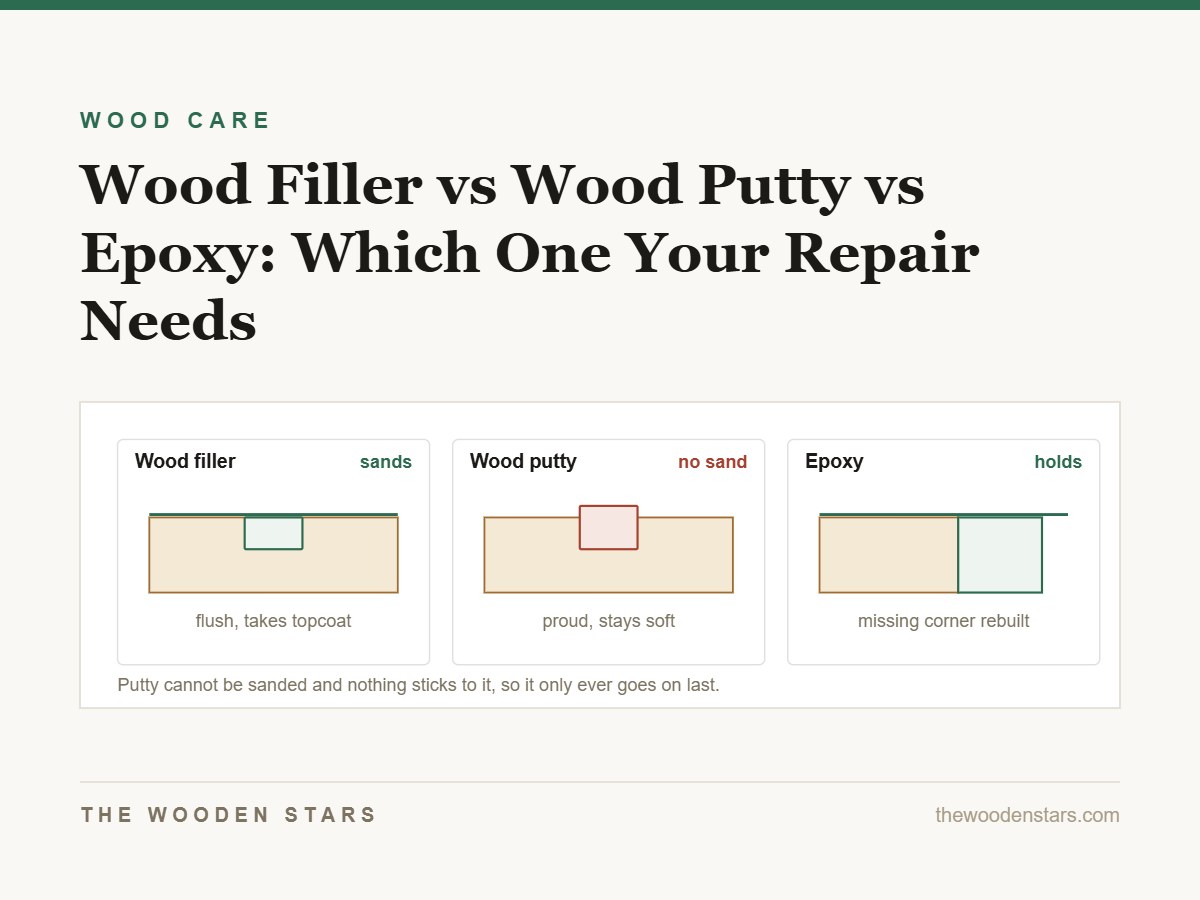
Use wood filler (water- or solvent-based, sandable, takes finish) on anything you will stain or topcoat. Use wood putty (non-hardening, oil-based, does not sand or take finish) only on already-finished surfaces as a cosmetic fill. Use epoxy when the repair has to carry load or rebuild a missing edge or corner — it is the only one of the three with structural strength.
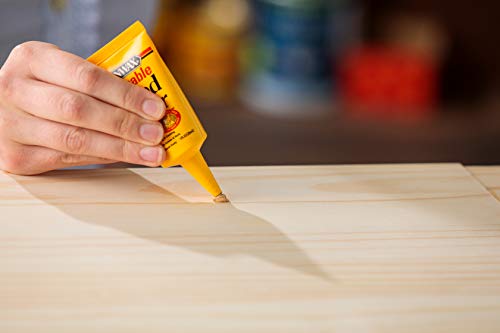
Start here: a stainable filler covers the most common repairs, and it is the one of the three you will reach for most.

Prime Minwax Stainable Wood Filler, 16 oz


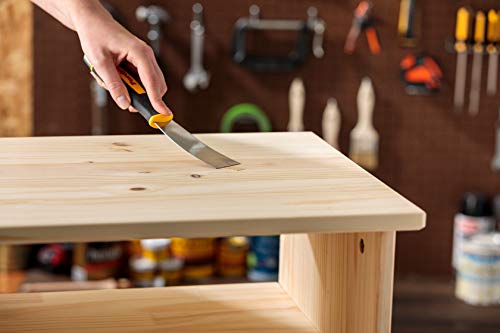
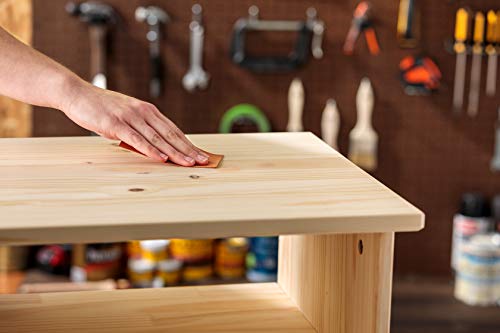
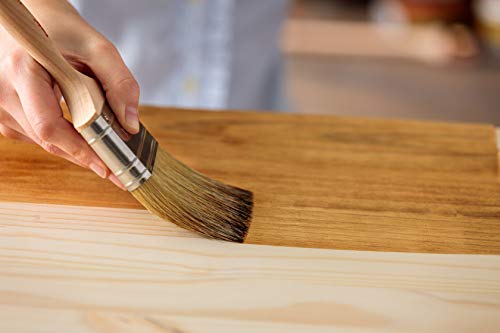
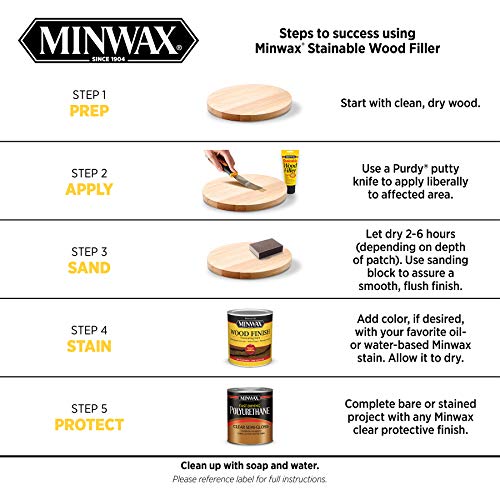
The three, side by side
| Property | Wood filler | Wood putty | Epoxy |
|---|---|---|---|
| Hardens? | Yes | No, stays flexible | Yes, rigid |
| Sandable | Yes | No | Yes, aggressively |
| Takes stain | Poorly to fairly | No | No |
| Takes topcoat | Yes | No | Yes |
| Structural strength | Low | None | High |
| Shrinks as it dries | Slightly | No | Almost none |
| Works on bare wood | Yes | No, needs a finished surface | Yes |
| Works on an edge or corner | No | No | Yes |
| Reversible | No | Yes, scrapes out | No |
The two rows people ignore are shrinks and takes stain. Filler shrinks a little, so a deep hole filled flush in one pass ends up slightly dished — the fix is to overfill and sand back, or to fill in two passes. And filler never takes stain the way wood does, because it has no grain and no pores; a “stainable” filler takes stain more evenly, which is not the same as taking it identically.
Wood filler: the default for anything you will finish
Wood filler is wood flour or cellulose in a binder. It dries hard, sands to a crisp edge, and accepts a topcoat. It is the right choice for nail holes, small gouges, screw holes you are re-drilling, and any repair that will be stained, oiled or lacquered afterwards.
Two families are worth distinguishing:
- Water-based — low odour, cleans up with water, dries fast, sands easily. Slightly weaker and shrinks a little more. The right default indoors.
- Solvent-based — harder, shrinks less, smells. Better for deeper fills and outdoor work.
- Two-part polyester (the Bondo family) — technically a filler, practically an epoxy substitute: cures in minutes, sands like hardwood, no shrinkage, will hold a rebuilt edge. Overkill for a nail hole and perfect for a chewed table leg.
On stain: the honest technique is to stain the wood first, let it dry, then fill, then colour the filler with a touch-up marker to match. Filling then staining gives you a pale patch every time, no matter what the tub says.
Wood putty: narrower than the shelf space suggests
Wood putty is pigment in an oil or solvent binder that never fully hardens. It stays flexible, which is genuinely useful — it moves with seasonal wood movement instead of cracking — but it means it cannot be sanded and nothing will stick to it.
So the rule is simple: putty goes on last, on a finished surface, in a colour that already matches. A nail hole in installed trim, a small chip in a finished table edge, a fixing hole in an assembled cabinet. If any finishing work remains to be done, putty is the wrong product, and if you have already used it, you have to scrape it all out before finishing.
Wax filler sticks are the same idea in stick form, and for small cosmetic fills on furniture they are easier to control. There is more on them in our guide to fixing scratches on wood furniture.
Epoxy: the only one with strength
Epoxy putty and epoxy paste cure into something harder than the wood around them, bond chemically to it, and can be drilled and threaded. That makes them the only correct answer in three situations:
- Rebuilding a missing corner or edge. Filler has no strength unsupported and will break off. Epoxy will not.
- Repairing something that carries load — a chair leg, a table apron, a bed rail, a hinge mortise that has torn out.
- Consolidating soft or rotted wood — a penetrating epoxy hardener soaks into punky wood and turns it solid again, and then epoxy paste rebuilds the missing volume. Nothing else does this.
The trade-offs are real: epoxy will not take stain at all (colour it before it cures, with dry pigment or sawdust from the same wood), it has a working time measured in minutes, and it is permanent. Sand it flush before it fully cures and you save yourself considerable work.
One of each, and when to reach for it
- Minwax stainable wood filler Nail holes, screw holes, anything to be finished On Amazon →
- Gorilla all-purpose wood filler Water-resistant, larger interior fills On Amazon →
- J-B Weld KwikWood epoxy putty stick Corners, edges, anything load-bearing On Amazon →
- Bondo wood filler with hardener Cures in minutes, sands like hardwood, no shrink On Amazon →
- Putty knife and 120/220 grit Filler is only as good as the sanding after it
What to buy
If you buy one, buy a stainable filler — it covers the most common repairs. If you buy two, add an epoxy putty stick, because the repair it handles is the one filler cannot do at all.
Filler for anything you will finish, epoxy putty for a corner or an edge, and the two-part for a repair that must not shrink.


Four fills, four answers
| The repair | Use | Why |
|---|---|---|
| Nail or brad hole in a piece to be stained | Stainable filler, then marker | Sands flush, colour corrected after |
| Chip in a finished table edge | Wax stick or putty | Nothing more will be finished |
| Chewed corner on a table leg | Two-part polyester or epoxy | Unsupported volume needs strength |
| Stripped screw hole | Neither — use a threaded insert | Filler will not hold a screw under load |
| Gap in a top where boards separated | Neither — it is movement | A rigid fill will crack again next season |
| Soft, punky rotted wood | Epoxy consolidant, then epoxy paste | Only epoxy re-hardens the fibres |
That last-but-one row matters on dining tables in particular. A gap opening between the boards of a solid top is seasonal movement, and filling it rigidly in winter means it splits somewhere else in summer. The real fix is the fastening system, which is covered on our dining tables hub.
Questions we get asked
Is “stainable” wood filler actually stainable?
It takes stain more evenly than non-stainable filler, which is a lower bar than it sounds. It will still be a different tone from the wood beside it, because it has no grain and no pore structure. Plan to correct the colour afterwards with a marker or a dab of tinted finish; treat the stain step as getting you close, not getting you there.
Can I make my own filler from sawdust and glue?
Yes, and for a small fill in a piece you are about to finish it often looks better than anything in a tub, because the sawdust is from the same board. Use fine dust from sanding, not shavings, and mix it with PVA to a stiff paste. It will not take stain either — but it is already the right colour.
How deep can I fill in one pass?
With water-based filler, about 6 mm before shrinkage shows. Deeper than that, fill in layers and let each dry, or switch to a two-part product that does not shrink. A single deep pass is the usual reason a filled hole reappears as a dimple weeks later.
Does epoxy work on oily woods like teak?
Less well. Teak, rosewood and other oily species resist adhesion, so wipe the repair area with acetone immediately before applying and expect a weaker bond than on oak or maple. For a load-bearing repair in teak, mechanical reinforcement — a dowel or a loose tenon — is safer than relying on adhesion alone.
Which one for a hole in a veneered surface?
Filler, and lightly. A veneer is often under a millimetre thick, so there is nothing to sand into. Fill just proud, level with a card rather than sandpaper, and colour on top. Epoxy is unnecessary and putty will stop you finishing.