Swivel vs stationary patio chairs — The base decides
The Wooden Stars is a participant in the Amazon Services LLC Associates Program. We may earn a commission when you buy through links on our site, at no extra cost to you.
Swivel vs stationary patio chairs is decided by the ground under them. A swivel needs a flat, firm surface to work; on a lawn or gravel it is a stationary chair with a mechanism that will seize.
Where the paving is good, the swivel earns its keep — outdoor seating gets turned far more than indoor seating does.
A swivel chair rotates on a bearing in its base, and the good ones also rock on a sprung C-shaped frame. It suits a fire pit or a view because you turn without dragging, and it needs firm level paving — on grass or gravel the base sinks unevenly and the rotation binds. A stationary chair has four legs, no mechanism, stacks, weighs less and lasts as long as the timber. Swivels cost 50 to 100% more, are heavier, do not stack, and the bearing is the part that fails. Buy swivels round a fire pit on a hard surface; stationary everywhere else.
Swivel vs stationary patio chairs: what the base needs
A swivel base is a ring bearing between the seat and a pedestal or a C-frame. It works when it sits level and firm.
On paving or decking that is easy, and the chair turns with a nudge of the heel.
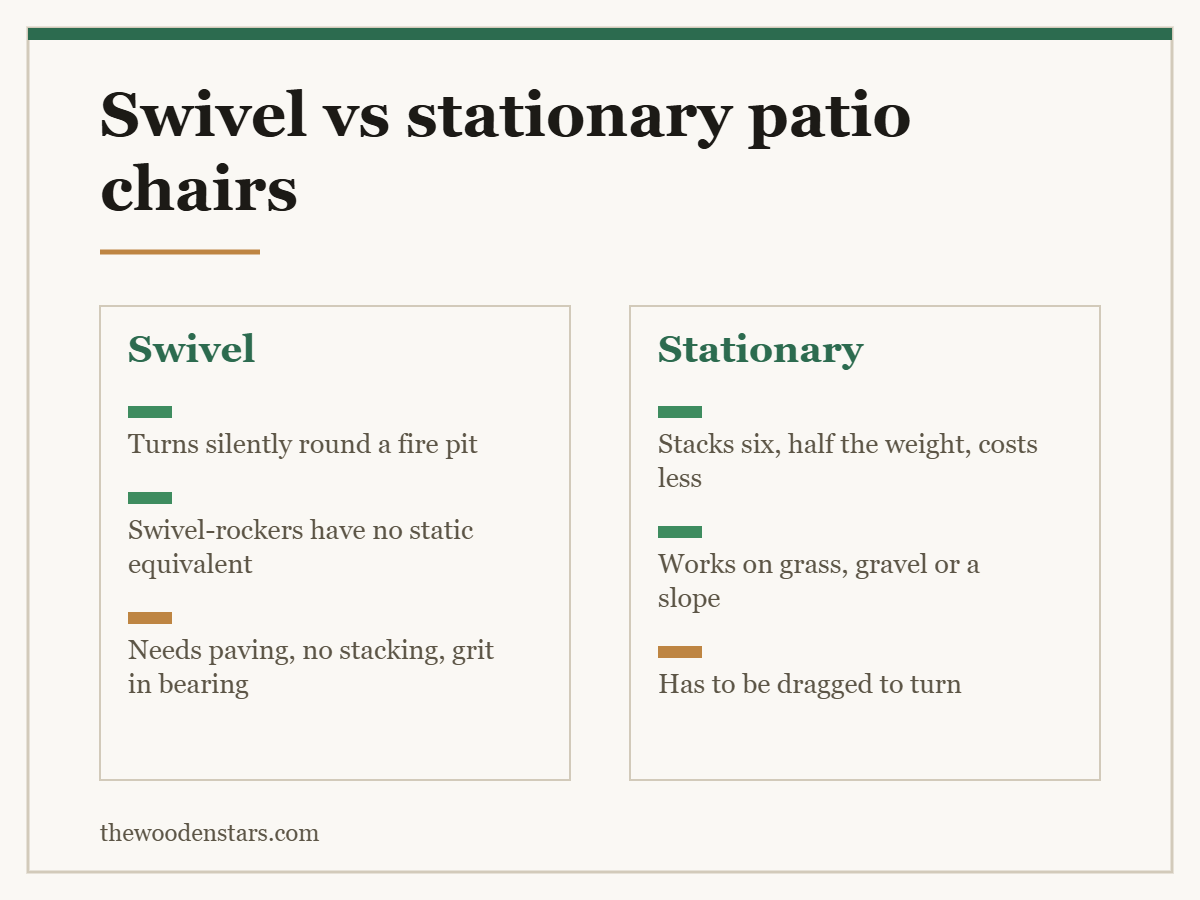
On grass, gravel or bark it is not. The base sinks unevenly, the bearing goes out of plane, and rotation starts to bind and grind. Grit gets into the race. Within a season or two you have a heavy chair that turns reluctantly, which is worse than a chair that never claimed to turn.
So the first question is not comfort or price. It is: what is the chair standing on, and will it still be level in August?
| Measure | Swivel | Stationary |
|---|---|---|
| Needs firm level ground | Yes | No |
| Rotates | 360°, or 180 on some | No |
| Rocks | Often, on a C-frame | No |
| Stacks | No | Usually |
| Weight each | 22 to 40 lb | 12 to 22 lb |
| Moving parts | Ring bearing, sometimes a spring | None |
| Price | 50 to 100% more | Baseline |
| Footprint | Same seated, more to turn | Smaller |
Where the swivel genuinely wins
Round a fire pit. This is the strongest case. People turn between the fire and the person next to them constantly, and dragging a chair on paving is loud and scratches. A swivel turns silently. See how many chairs around a fire pit.
Facing a view that moves. A terrace where the interesting thing is the sunset at one end and the barbecue at the other.
At a round table. Swivel dining chairs let people turn out of the table without pushing back, which means the 36-inch clearance behind is used less often — though you should still allow it.
Swivel-rockers specifically. The rocking motion on a C-frame is genuinely pleasant and there is no equivalent in a static chair. For a porch or a deck where people sit for hours, this is the reason to pay the premium.
What the stationary chair wins
It stacks. Six stationary chairs go into a corner in a quarter of the floor. Swivels do not stack at all, which makes winter storage four times the problem — folding against stacking patio chairs.
Weight. Twelve to 22 lb against 22 to 40. You move stationary chairs to follow the sun; swivels mostly stay where they are put.
Nothing to fail. A ring bearing full of grit is not repairable in any satisfying way — you can flush and re-grease it, and it is never as good again. A four-legged chair’s failure mode is ordinary timber ageing, which is repairable.
Price. The premium buys a mechanism, not comfort. A good stationary chair with a thicker cushion is often the better use of the same money.
It works anywhere. Grass, gravel, a sloping lawn, a bumpy old terrace.
Looking after a swivel base
If you buy swivels, three habits keep them turning:
- Rinse the base each spring before greasing. Grit is what kills a ring bearing, and it arrives as dust and pollen rather than in one event.
- Grease annually with a marine or white lithium grease. Ordinary oil washes out in the first rain.
- Keep it off soft ground. If a chair has to stand on grass, put a paving slab under it. That one slab is the difference between a five-year mechanism and a fifteen-year one.
Also check whether the base is sealed or open. A sealed bearing keeps grit out and cannot be re-greased; an open one can be maintained but needs to be. Neither is wrong, and knowing which you have decides the routine.
What to check on either
Seat 17 to 19 inches, with a 10 to 12-inch gap to the tabletop if it is a dining chair — how tall a patio table should be.
Width 22 to 28 inches, which decides how many fit — how wide a patio chair is, and the weight rating in how much weight a patio chair can hold.
Stainless fixings and foot caps on both; and on a swivel, check the pedestal foot is wide enough not to sink.
Timber notes are in best wood to use outside and the annual routine in is acacia good for outdoor furniture.
Keeping a base turning
- White lithium grease The annual job on an open ring bearing
- Furniture foot caps A wide foot is what stops a pedestal sinking into a lawn
- Felt furniture pads For stacking the stationary chairs without scuffing
- Outdoor furniture cover Swivels do not stack, so they winter under a cover
What to buy


For other chair decisions, see sling against cushion, folding against stacking and with arms against armless. For lounge seating, chaise lounge against adirondack chair.
Questions we get asked
Are swivel patio chairs worth it?
Round a fire pit on firm paving, yes — you turn without dragging. Anywhere else the mechanism costs more than it gives.
Do swivel chairs work on grass?
Not for long. The base sinks unevenly, the bearing goes out of plane and the rotation binds. Put a slab under it or buy stationary.
Can swivel chairs stack?
No. Six stationary chairs stack into a corner; six swivels need their own floor or a cover.
How much more do they cost?
Fifty to 100% more, and the premium buys the mechanism rather than comfort.
What is a swivel-rocker?
A swivel on a sprung C-frame, so it rotates and rocks. The rocking has no equivalent in a static chair and is the best reason to pay up.
How do I maintain the bearing?
Rinse the grit out each spring, then grease with marine or white lithium grease. Ordinary oil washes out in the first rain.