How wide should a porch swing be? Two seats or three
The Wooden Stars is a participant in the Amazon Services LLC Associates Program. We may earn a commission when you buy through links on our site, at no extra cost to you.
How wide should a porch swing be? 48 inches for two, 60 for two with room, and 72 for three — but the width the porch allows is set by the arc, not by the seat.
A swing needs clear air on both sides as well as front and back, and that is the measurement that decides the size far more often than the seat count does.
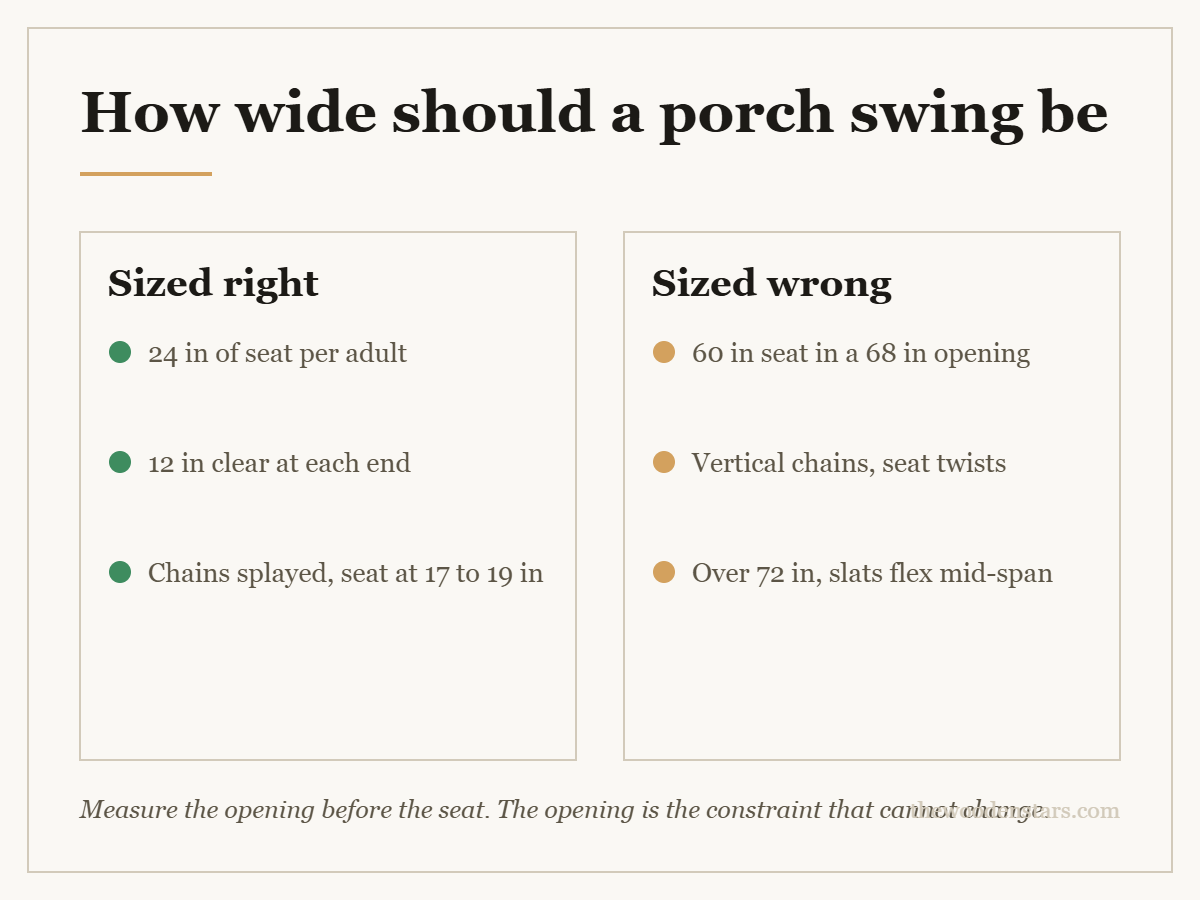
Seat widths: 48 inches seats two adults, 52 to 60 seats two comfortably or three at a push, 72 seats three. Allow 24 inches of seat per adult, the same as a bench. The porch has to give you the seat width plus 12 inches clear at each end — a swing moves and twists slightly, and a chain that catches a post is how seats get damaged. So a 60-inch swing wants an 84-inch opening. It also needs 36 inches of arc front and back, and the hangers set 2 to 4 inches wider than the seat so the chains splay.
How wide should a porch swing be: seat width by seat count
Allow 24 inches per adult, exactly as for a bench.
- 42 to 44 inches: two people who know each other well. Fine for a couple, tight for guests.
- 48 inches: two adults properly. The most common size and the right default.
- 52 to 60 inches: two with room to spread out, or three at a squeeze — this is the size most people are happiest with.
- 72 inches: three adults. Heavy, and it needs a correspondingly serious hanging point.
Longer than 72 is unusual, and for good reason: the seat slats start to flex in the middle, the weight goes up fast, and the load on the two hanging points climbs with it — see how much weight a porch swing can hold.
| Seat width | Seats | Porch opening | Seat depth |
|---|---|---|---|
| 42 to 44 in | 2, snug | 66 to 68 in | 18 to 22 in |
| 48 in | 2 | 72 in | 20 to 24 in |
| 52 to 60 in | 2 to 3 | 76 to 84 in | 20 to 24 in |
| 72 in | 3 | 96 in | 22 to 26 in |
The end clearance, which is not optional
Twelve inches of clear space at each end, between the swing and anything solid.
The reason is that a swing does not move in a perfectly straight plane. People get on and off at one end, someone sits down heavily on one side, a gust catches it — and the seat swings with a slight twist. Over a season, a swing hung tight to a post will chip the post, mark the swing arm, and put a sideways load into the chain that the hardware is not designed for.
So the arithmetic for a porch opening is: seat width + 24 inches. A 60-inch swing wants an 84-inch opening; a 48-inch swing wants 72.
If the porch is narrower than that, buy the smaller swing. Hanging a 60-inch seat in a 68-inch opening is the most common porch-swing mistake and it is not fixable afterwards.
The other three dimensions
- Seat height: 17 to 19 inches off the deck at rest, the same as any chair. You set this with chain length, so measure from the joist and buy chain to suit rather than accepting what comes in the box.
- Seat depth: 20 to 24 inches. Deeper than a dining chair because the back is reclined. Under 18 and you perch.
- Arc: 36 inches clear front and back, with the seat back 16 to 20 inches from the wall at rest — worked through in porch swing against glider.
Hanger spacing is the detail people miss: set the two hanging points 2 to 4 inches wider than the seat so the chains splay outward slightly. Perfectly vertical chains let the seat rotate; splayed chains stabilise it. That spacing is also why the porch needs more width than the seat.
What width does to the structure
A wider swing is heavier, holds more people, and puts both through two hanging points.
- 48-inch swing: seat 35 to 50 lb, two adults at 400 — design the fixing for 800 lb-plus.
- 72-inch swing: seat 60 to 90 lb, three adults at 600 — design for 1,200 lb-plus.
That is a large step, and it is why 72-inch swings are less common on domestic porches: many porch joists are fine for the first and marginal for the second. If a three-seater is what you want, check the joist before the swing. Full arithmetic in how much weight a porch swing can hold.
Width also drives mid-span flex. On anything over 60 inches, look for a centre rail under the seat slats, or slats at least 0.75 inches thick. Without it the middle of the seat dips under load and the slats crack at the fixings within a few seasons.
What to check on the swing itself
Where the chains attach. Bolted through the frame with a plate, not a screw eye into the arm. This is the weak point on cheap swings and it is the one that matters.
Bolted joints throughout, because a swing racks on every cycle and screws into end grain work loose.
Stainless or hot-dip galvanised fixings. A swing has a lot of joints and plain steel streaks rust down all of them.
The timber, named — cedar is traditional and light, acacia and teak heavier and denser. See best wood to use outside and, if it is acacia, is acacia good for outdoor furniture.
Getting the width right
- Swing hanger kit with bearings Set the hangers 2 to 4 inches wider than the seat
- Marine-grade chain Buy the length that puts the seat at 17 to 19 inches
- Tape measure Measure the opening first; it is the dimension you cannot change
- Teak or hardwood oil A swing has a lot of end grain, and it all wants a coat
What to buy


For load and fixings, see how much weight a porch swing can hold. For the free-standing alternative, porch swing against glider. For fixed seating, outdoor bench against outdoor chairs and how deep an outdoor bench should be.
Questions we get asked
How wide should a porch swing be?
Forty-eight inches for two adults, 52 to 60 for two with room or three at a push, and 72 for three.
How wide an opening do I need?
The seat width plus 24 inches — 12 inches clear at each end. A 60-inch swing wants an 84-inch opening.
Why the clearance at the ends?
A swing twists slightly as people get on and off. Hung tight to a post it chips the post and puts a sideways load into the chain.
How far apart should the hangers be?
Two to 4 inches wider than the seat, so the chains splay. Vertical chains let the seat rotate.
How high should the seat sit?
Seventeen to 19 inches off the deck at rest, set by the chain length rather than by whatever came in the box.
Is a 72-inch swing worth it?
Only if the joist is up to it — three adults plus seat is 1,200 lb of design load, and many domestic porch joists are marginal there.