Patio sectional vs separate chairs — Fixed or movable
The Wooden Stars is a participant in the Amazon Services LLC Associates Program. We may earn a commission when you buy through links on our site, at no extra cost to you.
Patio sectional vs separate chairs is a trade between a seating group that looks designed and one you can actually rearrange — and outdoors, rearranging happens far more than people expect.
Chairs follow the sun in the morning, the shade at lunch and the fire pit in the evening. A sectional does none of that.
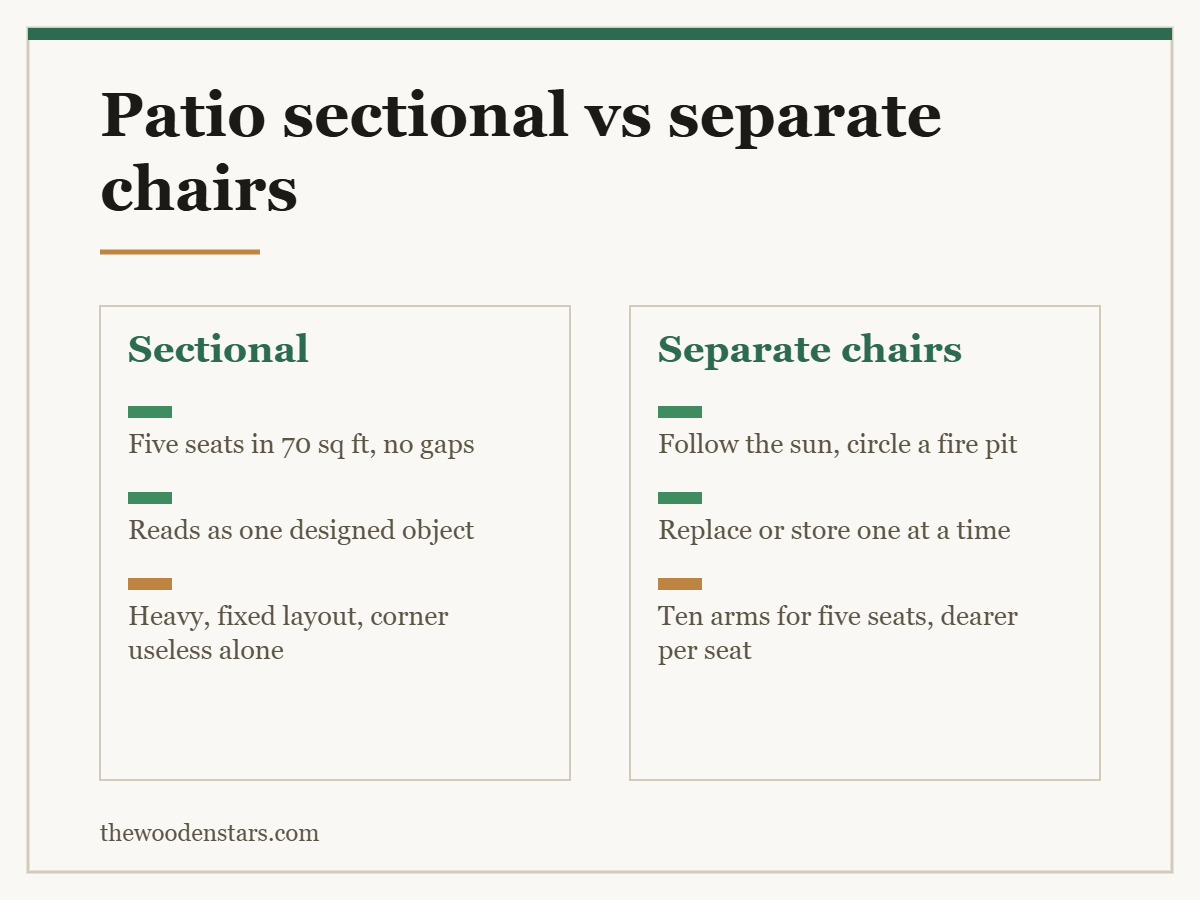
A sectional is modular seating whose pieces sit flush to form an L or a U. It gives the most seats per square foot — five in about 70 square feet — reads as one designed object, and has no gaps for things to fall through. It is fixed in practice: the modules are heavy, they only join in the ways the maker designed, and a corner piece is useless on its own. Separate chairs seat fewer per foot and cost more per seat, but each one moves, can be carried in for winter singly, and can be replaced one at a time. Most patios want a loveseat plus two chairs rather than either extreme.
Patio sectional vs separate chairs: seats per square foot
The sectional wins this clearly, and it is the main reason to buy one.
A sectional’s pieces share arms. An L of two 2-seat modules plus a corner gives five seats and has only two outer arms in total, where five separate chairs have ten. At 6 to 8 inches per outdoor arm, that is four to five feet of width the sectional does not spend.
- Five-seat sectional in an L: roughly 100 × 100 inches, about 70 square feet.
- Five separate chairs arranged in the same L, with the gaps people actually leave: 90 to 100 square feet.
The sectional also has no gaps. On separate chairs, the space between them is where phones, remotes and drinks end up on the floor.
| Measure | Sectional | Separate chairs |
|---|---|---|
| Seats in 70 sq ft | 5 | 3 to 4 |
| Arms, for 5 seats | 2 | 10 |
| Gaps between seats | None | 4 |
| Rearrange | Rarely, and only as designed | Freely |
| Move one piece alone | Heavy, and corner is useless | Yes |
| Carry in for winter | Several two-person lifts | One person, one at a time |
| Replace a damaged piece | Match the range, if still sold | Buy any chair |
| Cost per seat | Lower | Higher |
What “modular” actually means outdoors
Sectionals are sold as flexible. In practice the flexibility is narrow.
The modules only join where the maker designed them to. A corner piece has one squared side and one open; an armless middle has two open sides. You can make an L or a U, and you can separate them into free-standing lumps — but an armless middle module standing alone is a bench with no arms and an odd proportion, and a corner piece alone is unusable.
They do not stay put. Outdoors this is the practical annoyance. Modules that are merely pushed together drift apart as people sit down, leaving a gap at exactly the point where the cushions meet. Look for connector clips or brackets between modules — good sectionals have them, and it is worth checking because you cannot add them later.
Replacing one piece means the range is still on sale. Outdoor ranges turn over fast. A chair from a discontinued set is a chair; a corner module from a discontinued set is a problem.
What separate chairs genuinely buy you
They follow the sun. The single most-used feature of outdoor seating, and a sectional cannot do it.
Round a fire pit. A sectional cannot form a circle. Chairs can — see how many chairs around a fire pit.
One-person winter storage. Carrying six chairs into a shed one at a time is tedious; carrying four sectional modules is a two-person job four times over.
Replace one at a time. When a frame finally goes, you buy one chair rather than matching a range.
Mix types. Two lounge chairs plus two Adirondacks is a perfectly good group — adirondack chair against patio chair.
The arrangement most patios should buy
A loveseat plus two chairs, around a low table.
You get one fixed anchor that reads as furniture, two seats that move to follow the sun or turn to the fire, and four seats total in about 60 square feet. Nothing is a corner module you cannot use elsewhere, and everything can be carried in by one person except the loveseat.
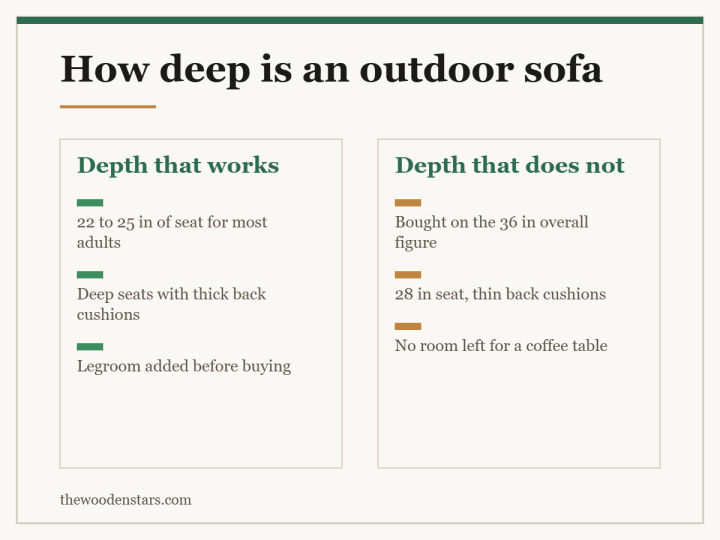
Sizing is in outdoor sofa against loveseat and how deep an outdoor sofa is; the table between them in outdoor coffee table against side table.
What to check on either
- Connector hardware between sectional modules, or accept that they drift apart.
- Slatted decks under the cushions so water drains rather than sitting under them.
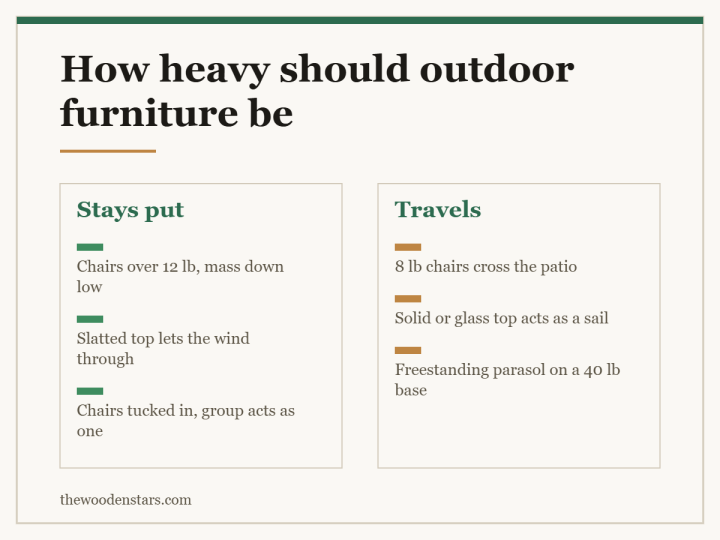
- Weight per piece. Under about 20 lb a chair blows over; over about 60 lb a module needs two people every time.
- Cushion count and whether they are included. A five-seat group is ten cushions, and they need a deck box.
- Named timber and stainless fixings — best wood to use outside, and the annual routine in is acacia good for outdoor furniture.
For either arrangement
- Sectional connector clips What stops modules drifting apart as people sit down
- Deck box for cushions A five-seat group is ten cushions to bring in dry
- Furniture foot caps Heavy modules stand in water and rot from the feet
- Outdoor furniture cover One cover for a sectional, or one per chair
What to buy


For sizing a sectional, see how big a patio sectional should be. For the two-seat option, outdoor sofa against loveseat. For reclining seats, chaise lounge against adirondack chair. For the dining alternative, dining set against conversation set.
Questions we get asked
Is a patio sectional better than separate chairs?
For seats per square foot and a finished look, yes. For flexibility, winter storage and replacing one piece, separate chairs win.
How much space does a five-seat sectional need?
About 70 square feet in an L, against 90 to 100 for five separate chairs in the same arrangement.
Are sectionals really modular?
Only as designed. A corner module is unusable alone and an armless middle is an odd bench, so the real flexibility is L or U.
Do the modules stay together?
Not unless they have connector clips. Without them they drift apart at the cushion joint as people sit down.
What if one piece gets damaged?
You need the range to still be on sale. A separate chair can be replaced with any chair.
What should most patios buy?
A loveseat plus two chairs — one anchor that looks like furniture, two seats that move to follow the sun.