Deck box vs storage bench — Store or sit
The Wooden Stars is a participant in the Amazon Services LLC Associates Program. We may earn a commission when you buy through links on our site, at no extra cost to you.
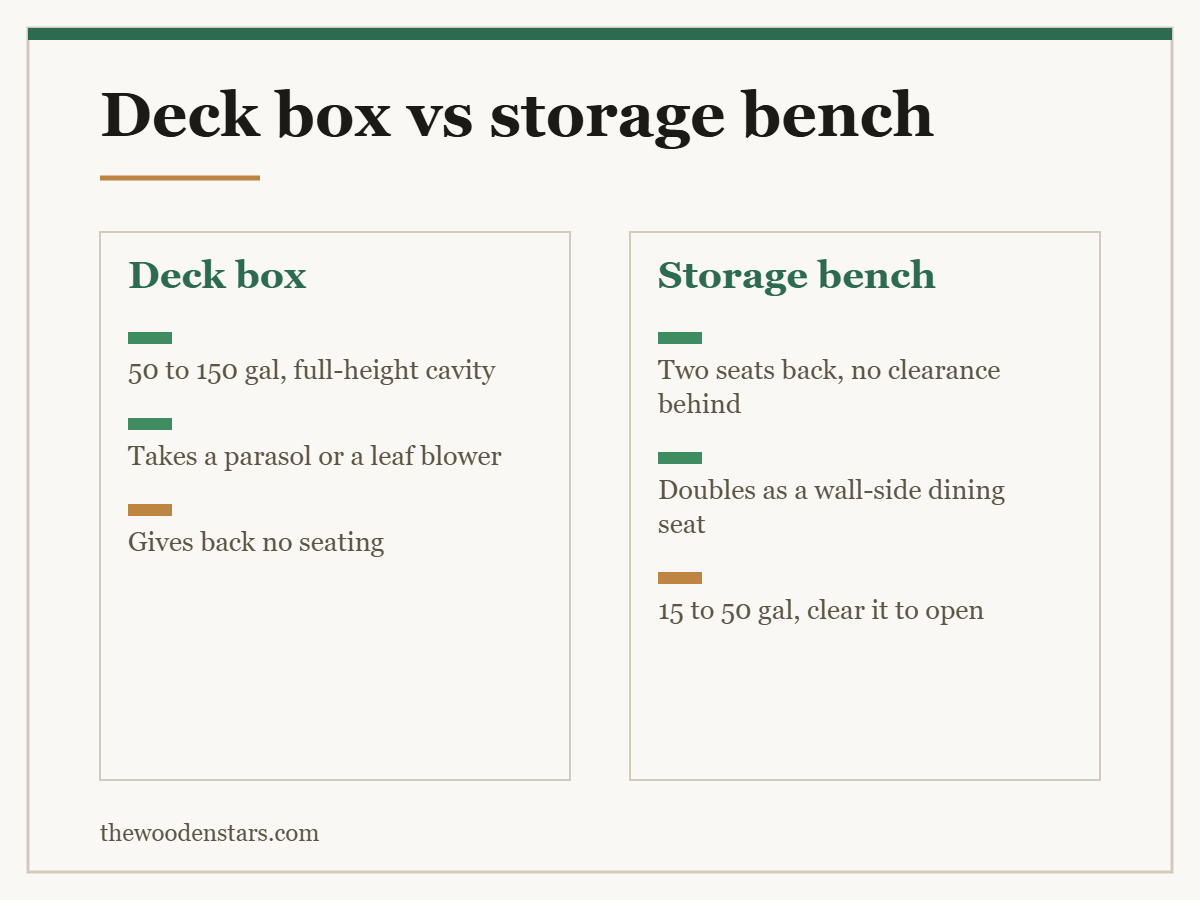
Deck box vs storage bench is a choice between storage that holds more and storage you can sit on — and the honest version is that a storage bench holds roughly half what a deck box of the same footprint does.
Whether that halving is worth a seat depends entirely on what you are putting inside.
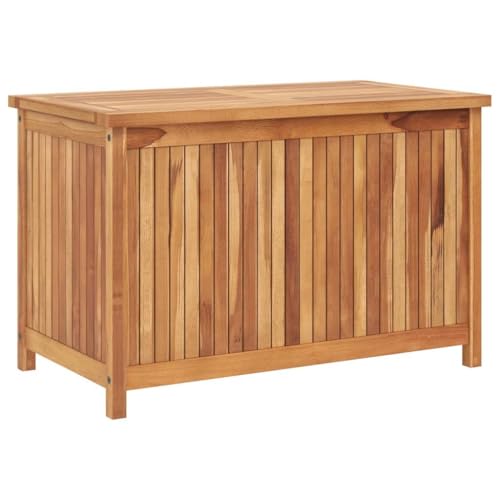
A deck box is a lidded chest, typically 50 to 150 gallons, with a tall unobstructed cavity and a light lid you open one-handed. A storage bench is a seat with a hollow base, usually 15 to 50 gallons, because the seat sits at 17 to 19 inches and the cavity has to fit under it. Cushions, covers and toys fit either; a rolled-up parasol, a leaf blower or long tools fit only the box. The bench buys back two seats, which on a small patio is worth more than the gallons. Both need drainage and ventilation, or you are building a damp cupboard.
Deck box vs storage bench: the capacity arithmetic
Take the same 50 × 22-inch footprint against a wall.
As a deck box it can be 26 inches tall, because nothing requires it to be a comfortable height. Interior volume lands around 100 to 120 gallons.
As a storage bench the seat has to sit at 17 to 19 inches, the seat boards and frame take 2 to 3, and the base rails take another 2. Usable interior depth is more like 12 to 14 inches, so volume lands around 45 to 55 gallons.
Same floor, roughly half the storage. That is not a design failure — it is what sitting height costs.
| Measure | Deck box | Storage bench |
|---|---|---|
| Typical capacity | 50 to 150 gal | 15 to 50 gal |
| Height | 24 to 30 in | 17 to 19 in seat |
| Sit on it | Lid only, if rated | Yes, it is a seat |
| Takes long items | Yes | Rarely |
| Lid weight | Light, gas struts common | Heavy seat plus cushion |
| Open with cushions on top | Yes | No, clear it first |
| Seats bought back | 0 | 2 |
| Price for the same footprint | Lower | Higher |
What actually has to go inside
Make the list before you choose, because a few items decide it on their own.
Only a deck box takes these: a folded parasol or its base, a leaf blower, long-handled tools, a rolled outdoor rug, stacked seat cushions four or five deep, a folded gazebo.
Either takes these: two or three seat cushions, throws, a table cover, children’s outdoor toys, badminton kit, barbecue tools, a hose reel.
The commonest mistake is buying a bench for cushions and finding that six chair cushions do not fit under an 18-inch seat without being squashed flat every time — and squashed-flat is how foam dies. Cushion storage is a volume problem more than people expect.
The seat you get back
On a small patio this is the whole argument on the other side.
A 50-inch storage bench seats two adults. Put it against the wall on the long side of a dining table and you have removed two chairs from the floor plan entirely, because the bench pushes back into the wall rather than into the walkway. That is a genuine saving of 36 inches of clearance on one side — see how much space around a patio table and outdoor bench against outdoor chairs.
Two practical limits:
- You cannot open it while people sit on it. Obvious, and constantly annoying in practice if the thing you store is the thing you need at the start and end of every meal.
- Cushions on top have to come off first. A deck box lid opens with the cushion still on it; a bench does not.
So the bench works best for seasonal storage — things you get out in May and put away in September — and the box works best for daily storage.
The two things both get wrong
Drainage. A sealed timber box with a tight lid is a condensation trap. Warm damp air goes in with the cushions at dusk and cannot get out. Cushions come out in spring smelling of mildew and people blame the cushions.
What to look for: a raised floor on feet or battens, drain holes in the base, and a lid that overhangs so rain runs off the outside rather than into the joint. If your box has none of these, drill four 10 mm holes in the base yourself and put it on two lengths of batten.
Ventilation. Different from drainage. Small vents high on two opposite sides let air move through. Resin boxes usually have them moulded in; timber ones often do not.
And store cushions dry. A dry cushion in a ventilated box is fine all winter; a damp one in a perfect box is mildew by February.
Timber, resin, and how long each lasts
Resin or HDPE: nothing to rot, lids stay light, vents moulded in, and the cheap ones go brittle and chalky in strong sun after four or five years. Look for UV stabilisation stated.
Timber: repairable, heavier, better looking, and it is the lid and base that fail first because they take standing water. Acacia and eucalyptus are the common species — is acacia good for outdoor furniture and best wood to use outside.
On a timber box, check three things: stainless hinges, a gas strut or lid stay so the lid does not slam onto fingers, and whether the base is solid boards or thin ply. Thin ply in a base is the single commonest failure, because that is the surface that stays wet.
Making either last
- Stainless hinges and screws Plain steel bleeds rust down timber within one season
- Gas strut lid support Stops a heavy lid slamming, and keeps it open while you load
- Vacuum storage bags How six cushions fit into a bench that holds four
- Silica gel dehumidifier tubs For a box that cannot be properly ventilated
What to buy



For sizing, see how big a deck box should be. For the seating side, outdoor bench against outdoor chairs and how much space around a patio table. For material, wood against resin patio furniture.
Questions we get asked
Is a deck box or a storage bench better?
A deck box holds roughly twice as much on the same footprint. A storage bench buys back two seats. Choose by which you are short of.
How much does a storage bench hold?
Fifteen to 50 gallons, because the cavity has to fit under a 17 to 19-inch seat.
Can I sit on a deck box?
Only if the lid is rated for it — many are, at 300 to 500 lb. Resin lids without a centre rib usually are not.
Will my cushions stay dry?
Only with a raised floor, drain holes and vents. A sealed box traps condensation and the cushions mildew.
What fits in a box but not a bench?
A folded parasol, a leaf blower, long-handled tools, a rolled rug, and cushions stacked more than three or four deep.
Timber or resin?
Resin needs no maintenance but goes brittle in strong sun. Timber lasts longer if the hinges are stainless and the base is solid board, not thin ply.