How much space around a patio table? 36 inches
The Wooden Stars is a participant in the Amazon Services LLC Associates Program. We may earn a commission when you buy through links on our site, at no extra cost to you.
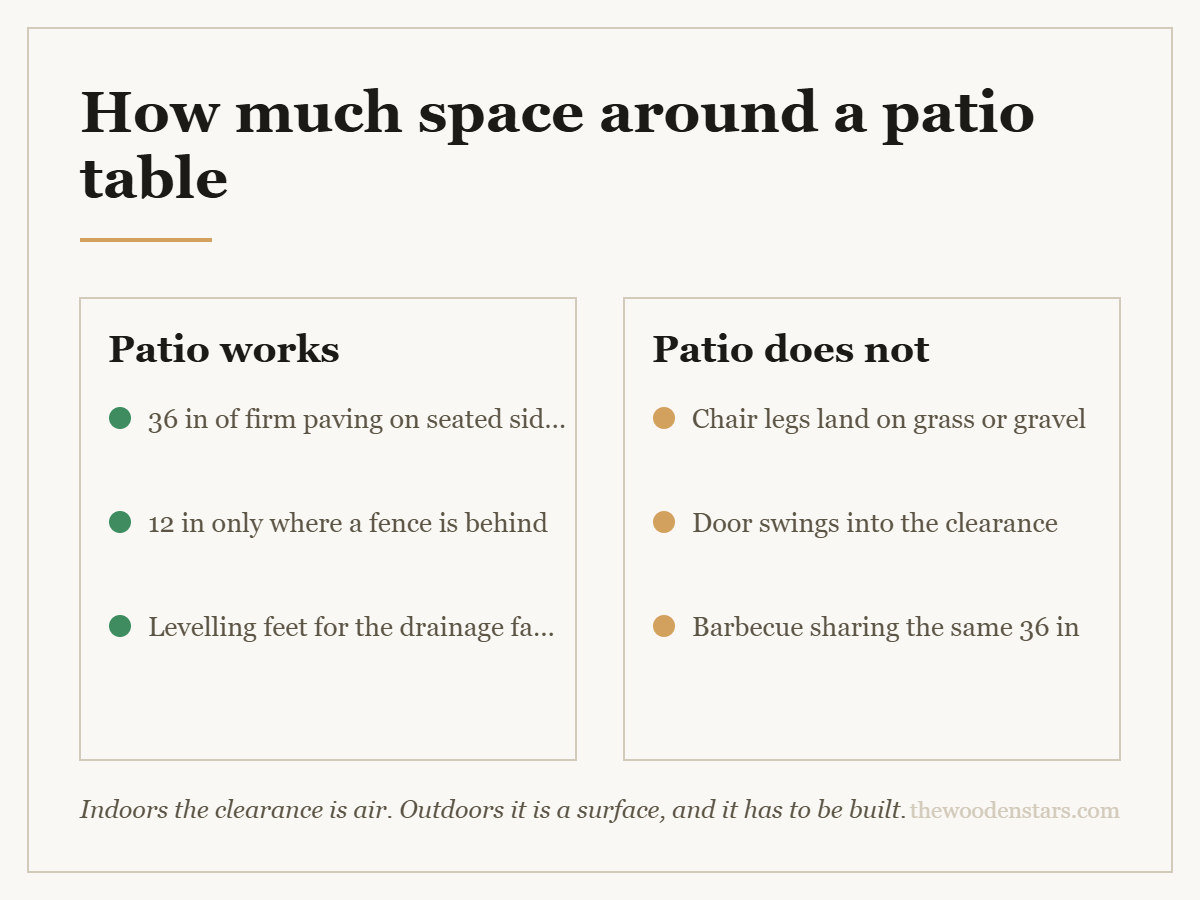
How much space around a patio table do you need? 36 inches of firm paving behind every chair someone sits in — and the word doing the work in that sentence is paving.
Outdoors the clearance has to be surface a chair leg can stand on, not just empty air. That single difference is why patios that look big enough turn out not to be.
Allow 36 inches from the table edge on every side people sit — 24 for the chair to push back, 12 for the person to stand. Where a side is against a wall, a fence or a railing and nobody sits there, 12 inches is enough. The outdoor-specific rule: that 36 inches must be firm, level surface, because chair back legs on grass, gravel or bark sink and tip. Add 48 inches where someone walks behind a seated diner, and remember that a door opening outward takes 30 inches of one side. Quick check: add 6 feet to the table’s length and width.
How much space around a patio table: the three numbers
Each figure exists for a specific action.
- 36 inches — a chair pushes back 24 inches and the person needs 12 to stand up in. This is the working number for every seated side.
- 48 inches — where someone has to walk behind a seated diner. Twenty-four for the chair, 24 for the person passing. Relevant on the route to a kitchen door or a barbecue.
- 12 inches — a side against a wall or fence with nobody sitting there. Enough to wipe the table and reach the middle.
At 30 inches on a seated side you can get out of the chair by turning sideways. Below 24 the person on that side stays put until the meal ends — which outdoors, where people get up to fetch things constantly, is worse than it is indoors.
| Situation | Clearance | Surface |
|---|---|---|
| Seated side, nobody passes | 36 in | Firm paving or decking |
| Someone walks behind a diner | 48 in | Firm paving or decking |
| Side against a wall or fence | 12 in | Any |
| Bench side against a wall | 30 in | Firm, bench tucks under |
| In front of a barbecue | 36 in | Firm, and non-combustible |
| Balcony railing behind chairs | 36 in to the railing | Deck boards |
The quick sizing check
Add 72 inches to each dimension of the table — 36 on each side — and that is the patio you need for a free-standing table:
- 42-inch round: 114 inches square, or 9 ft 6.
- 48-inch round: 120 inches, 10 ft.
- 60-inch round: 132 inches, 11 ft.
- 72 × 40-inch rectangle: 144 × 112, or 12 × 9 ft 4.
Then subtract for each side that is against something and unused. A 60-inch round in an open garden wants 11 feet square; tucked into a corner with two closed sides it wants about 8 ft 6. That allowance is usually what makes a set fit.
Sizing the table itself is in what size patio table for 6 and what size patio table for 4.
What is different outdoors
Five things eat outdoor clearance and have no indoor equivalent.
- The paving edge. Chair back legs on grass sink, on gravel skid, on bark disappear. The hard surface has to extend the full 36 inches, which often means the patio is 3 feet smaller than it looks.
- The drainage fall. Patios are laid sloping away from the house, typically 1 in 60 to 1 in 80. Over a 10-foot table plus clearance that is an inch and a half of drop — enough to make a table rock and a chair feel odd. Levelling feet fix the table: levelling feet and glides.
- The door swing. French or patio doors opening outward take up to 30 inches of one side, and it is always the busiest side.
- The barbecue. It needs its own clearance, it needs to be non-combustible underfoot, and nobody wants to sit within a couple of feet of it.
- Planters, steps and downpipes. Each one takes from the same 36 inches, and they are easy to leave off a sketch.
When the numbers do not work
In order of what to try:
Push a side against the fence. Twelve inches instead of 36 on one side gives back two feet immediately.
Put a bench on the fence side. A backless bench tucks fully under the table, so that side needs 30 inches and returns the floor completely between meals — outdoor bench against outdoor chairs.
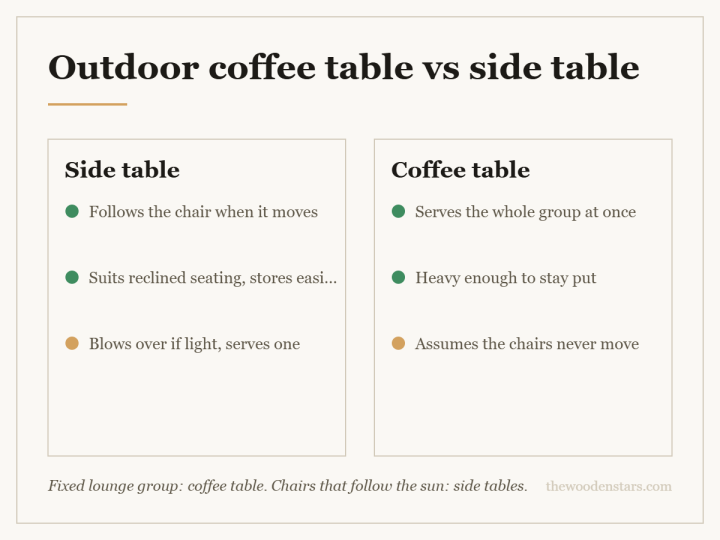
Go round instead of rectangular. A circle lets people slip past on the diagonal in a way a corner does not — round against rectangular patio tables.
Drop a seat. Four instead of six saves two feet in each direction and is the change people resist longest and regret least.
Extend the paving. If the set is right and the patio is 18 inches short on one side, a row of slabs is cheaper than the wrong furniture.
What not to do is put chairs on the grass. It looks fine in May and it is a wobbling, sinking nuisance by July.
One more clearance: the umbrella
A centre umbrella’s canopy is typically 9 to 11 feet across — wider than the table and often wider than the clearance. Check it will not foul a wall, a downpipe or overhanging branches when opened, and that the crank handle has room to turn.
A cantilever umbrella needs its base somewhere, and the base is 24 to 30 inches square and deliberately heavy. That footprint comes out of the walking route, not the seated clearance. See patio table with umbrella hole or without.
Making the space work
- Levelling feet and glides Patios slope for drainage, and every table shows it
- Laser distance measure Reads wall to fence in one go, which a tape does badly outside
- Furniture foot caps Spreads load so chair legs do not sink at the paving edge
- Outdoor furniture cover What lets a set stay in the tight spot all year
What to buy

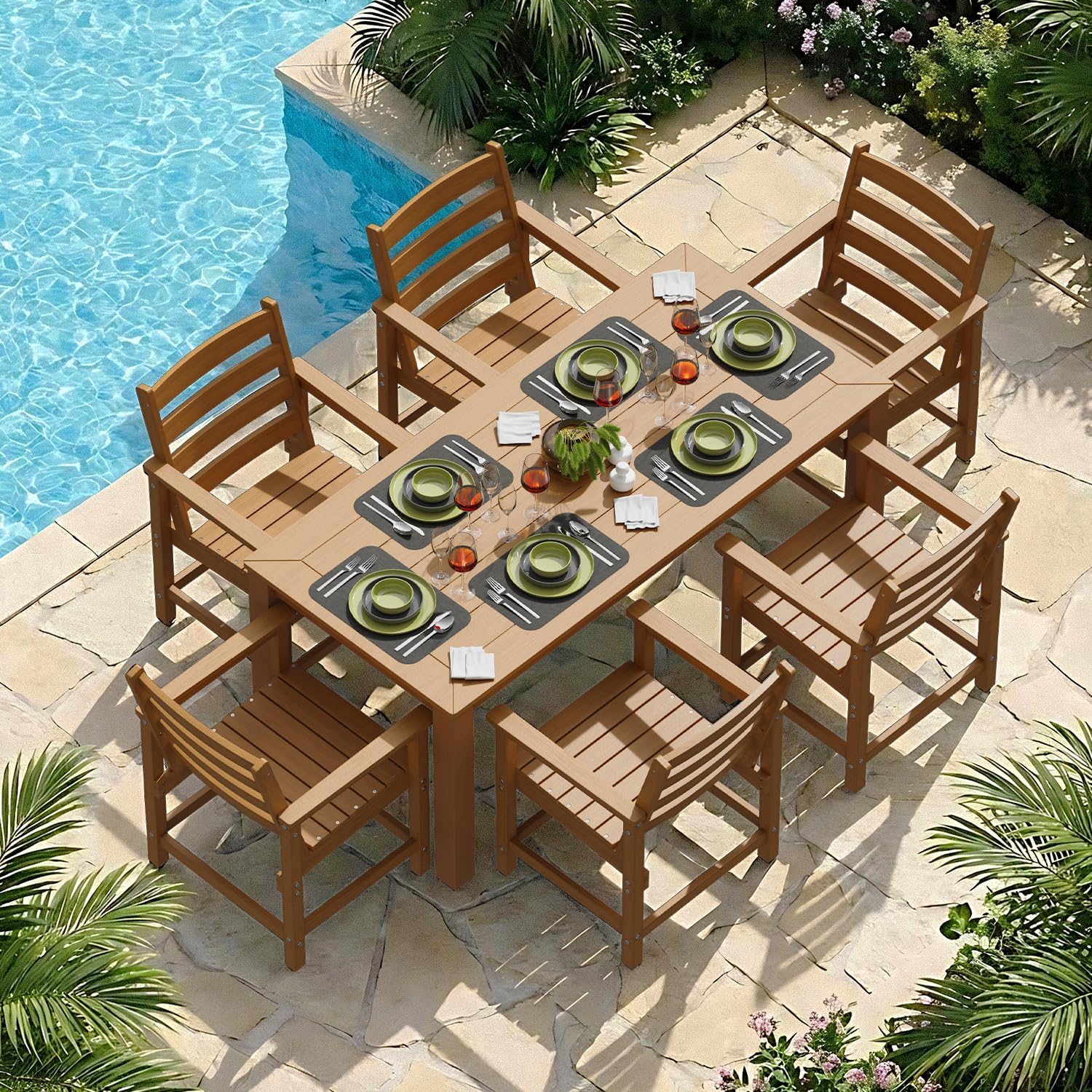


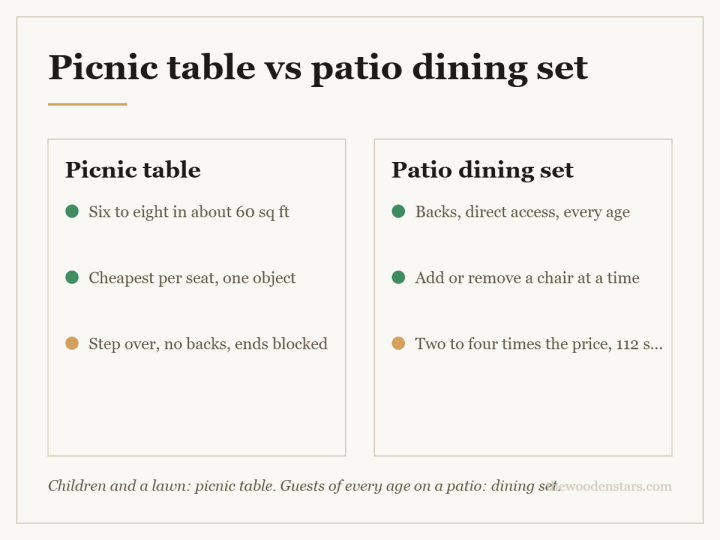
For table sizing, see what size patio table for 6, what size patio table for 4 and how many people fit at a patio dining table. For shape, round against rectangular. For a small space, dining set against bistro set.
Questions we get asked
How much space do you need around a patio table?
Thirty-six inches of firm paving behind every seated side, 48 where someone walks past a diner, and 12 where a fence is behind and nobody sits.
Why does the surface matter?
Because chair back legs on grass sink and on gravel skid. The clearance has to be paving or decking, not just empty space.
What size patio do I need?
Add 6 feet to the table’s length and width. A 60-inch round wants 11 feet square in the open.
Can I cheat any of it?
Yes — a side against a wall or fence with nobody sitting there needs only 12 inches, and a bench side needs 30.
Does the drainage fall matter?
Patios slope about 1 in 60, which over a table plus clearance is an inch and a half. Levelling feet handle it.
How wide is a patio umbrella canopy?
Nine to 11 feet — usually wider than the table. Check it clears walls, downpipes and branches when open.