Folding vs stacking patio chairs — Winter storage
The Wooden Stars is a participant in the Amazon Services LLC Associates Program. We may earn a commission when you buy through links on our site, at no extra cost to you.
Folding vs stacking patio chairs is a question about the shed, not the patio — and the answer flips depending on whether you store them flat or in a corner.
Both exist to solve winter. They solve it in opposite geometries, and one of them has a hinge that will eventually be the reason the chair is thrown away.
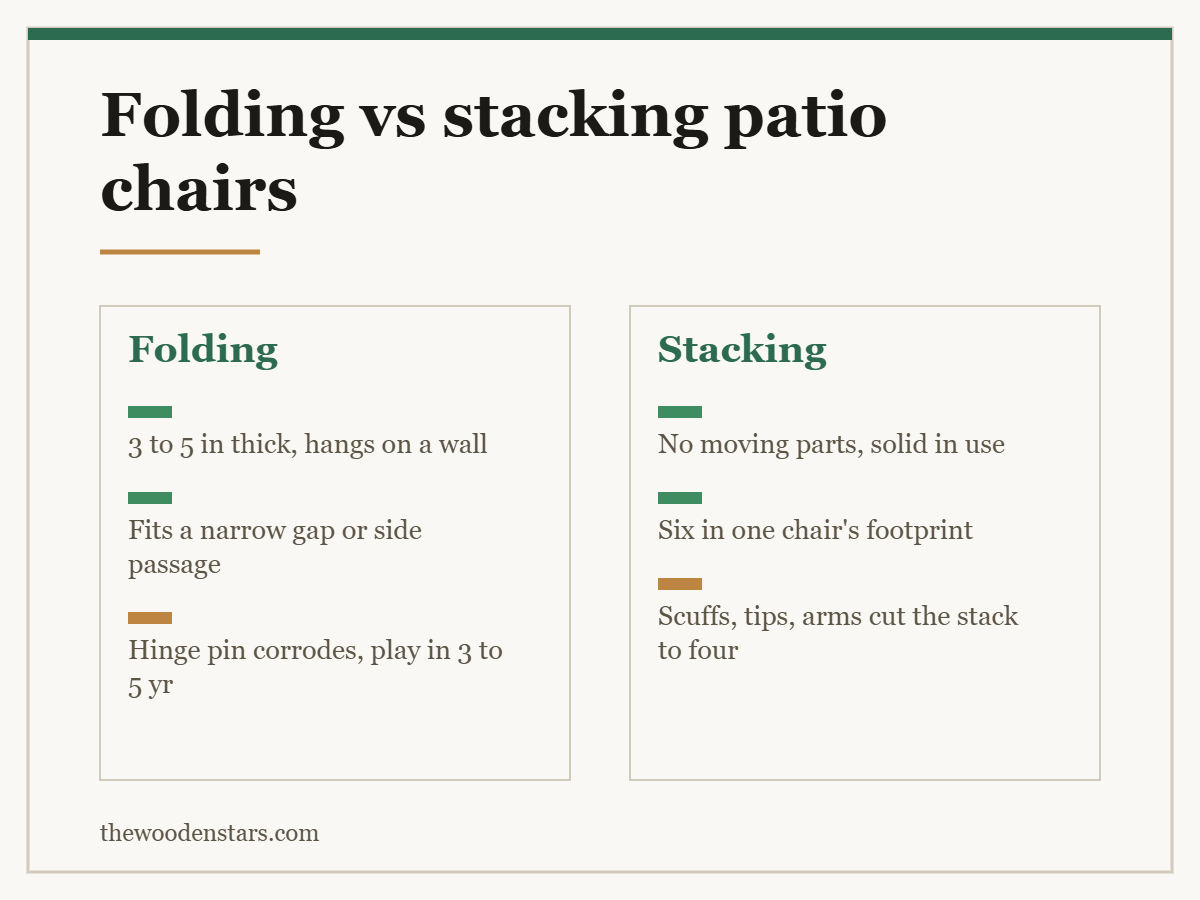
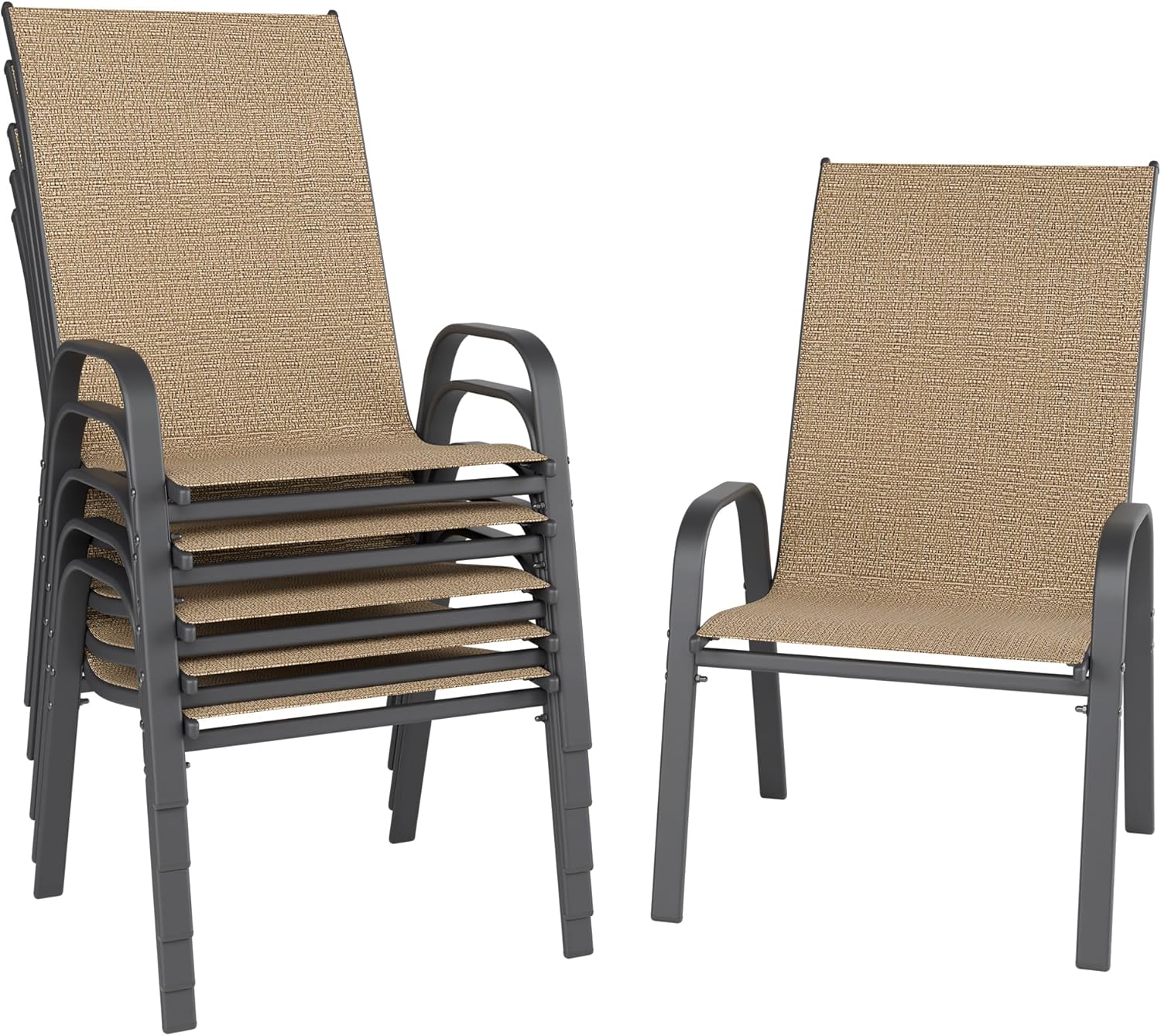
A folding chair collapses to 3 to 5 inches thick and hangs on a wall or slides behind a door — the best choice when storage is a narrow gap. Its hinge is a wear point and it is the first thing to fail. A stacking chair keeps its shape and piles vertically, typically 6 chairs in 4 feet of height over a single chair’s footprint — the best choice when storage is a corner. It has no moving parts, so it lasts as long as the timber. Stacking chairs are also sturdier in use, because nothing has to hinge. Folding wins on flat storage; stacking wins on everything else.
Folding vs stacking patio chairs: the storage geometry
This is genuinely the whole decision.
Folding collapses the chair into a flat panel — 3 to 5 inches thick, roughly 22 × 38 inches. Six of them stand against a wall in 30 inches of depth and 2 feet of width, or hang on hooks. If your storage is the gap behind a shed door, a side passage, or a garage wall, folding is the only thing that fits.
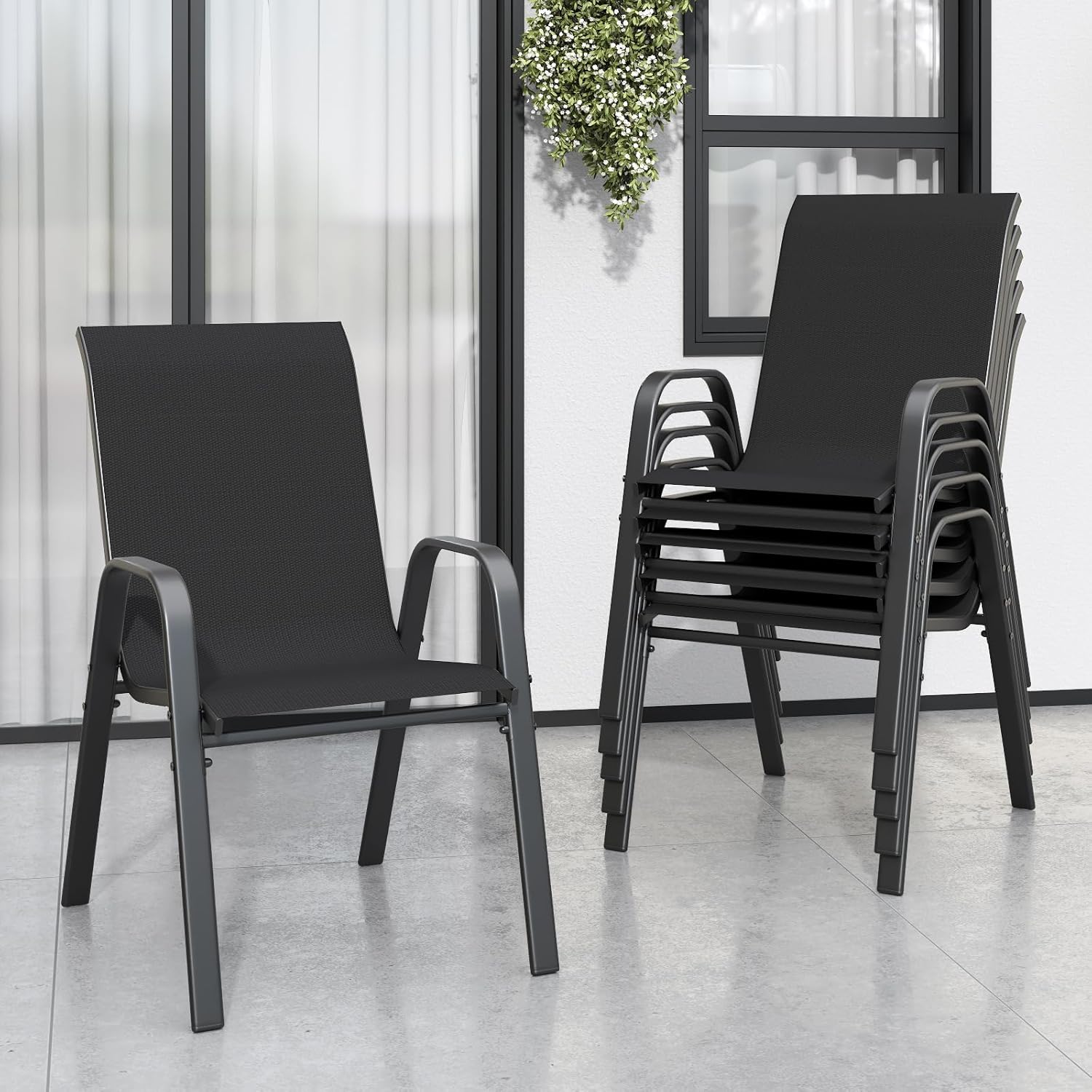
Stacking keeps the chair whole and piles it. Six chairs stack to about 4 feet high over the footprint of one — 22 × 24 inches. If your storage is a corner with height above it, stacking uses a quarter of the floor folding does.
So: measure the storage first. A narrow gap wants folding; a corner wants stacking. That is the answer for most people before any other consideration.
| Measure | Folding | Stacking |
|---|---|---|
| Folded or stacked size | 3 to 5 in thick | 6 chairs in 4 ft of height |
| Storage shape needed | A narrow gap or wall | A corner with headroom |
| Floor for six | About 5 sq ft | About 4 sq ft |
| Moving parts | Hinge, and a catch | None |
| Rigidity in use | Some flex at the hinge | Solid |
| Arms | Rare | Common |
| Lifespan | Limited by the hinge | Limited by the timber |
| Weight each | 8 to 15 lb | 12 to 22 lb |
The hinge, which is why folding chairs get thrown away
A folding chair has a pivot that carries the sitter’s weight through a single pin, and outdoors that pin gets wet.
What happens over three to five seasons: the pin corrodes, the hole in the timber elongates, and the chair develops play. Play becomes a wobble, the wobble works the joint harder, and the chair goes from “slightly loose” to “not trustworthy” quite quickly. Very few folding chairs can be rebuilt because the pin is riveted rather than bolted.
What to look for if you buy folding:
- A bolted pivot with a nut rather than a rivet. It can be tightened, and it is rare.
- Stainless or brass pins. Plain steel is what elongates the hole.
- A positive catch that locks it open. A chair held open only by geometry folds up on somebody eventually.
- Nylon or brass washers at the pivot, which stop timber grinding on timber.
A stacking chair has none of this. Its failure mode is the ordinary one for outdoor timber — greying, then the feet going — which is repairable: is acacia good for outdoor furniture.
What stacking costs you
They scuff each other. Six chairs stacked for five months rub at the contact points, and on a painted or lacquered finish that shows. Felt pads between them, or an oiled finish that can be refreshed, solve it.
The stack is unstable. Six chairs at 4 feet with a 22-inch base is a tipping risk, particularly on a sloping shed floor. Stack against a wall, or split into two stacks of three.
Arms limit the stack. Armchairs stack to four rather than six, because the arms bottom out. If you want arms and a deep stack, check the stated stack height rather than assuming.
They do not hang. A garage wall with hooks is free storage for folding chairs and useless for stacking ones.
Which to buy, in one minute
- Storage is a narrow gap or a wall: folding.
- Storage is a corner, a shed floor or a garage bay: stacking.
- The chairs stay out all year under a cover: stacking, because you are paying for a hinge you never use.
- You need spares that come out twice a year: folding — the hinge wears with use, and light use is what folding chairs are good at.
- You want arms: stacking, and expect four per stack.
- The chairs are the daily seating: stacking, for the rigidity.
A useful split for many gardens: four stacking chairs as the everyday set, two folding as the spares. The folding pair lives behind a door and comes out when there are six people.
Seat counts and the table they serve are in how many people fit at a patio dining table; the bench alternative in outdoor bench against outdoor chairs.
What to check on either
- Seat 17 to 19 inches and a 10 to 12-inch gap to the tabletop — how tall a patio table should be.
- Width 22 to 28 inches, which decides how many fit round the table — how wide a patio chair is.
- Weight rating, stated. Folding chairs are usually rated lower — how much weight a patio chair can hold.
- Stainless fixings, because plain steel streaks rust down a slatted seat faster than anywhere else.
- Foot caps, so legs are not standing in water on paving.
Storing chairs properly
- Felt furniture pads Stops stacked chairs scuffing each other over five months
- Wall storage hooks Free storage, and only folding chairs can use it
- Stacking chair cover One cover over a stack beats six individual covers
- Teak or hardwood oil An oiled finish refreshes where a lacquer just scratches
What to buy


For other chair decisions, see sling against cushion patio chairs, with arms against armless and swivel against stationary. For the set question, dining set against separate table and chairs.
Questions we get asked
Are folding or stacking patio chairs better?
Folding if your storage is a narrow gap or a wall; stacking if it is a corner. Stacking lasts longer because it has no hinge.
How much space do six of each need?
Six folding stand in about 2 feet of wall and 30 inches of depth. Six stacking pile 4 feet high over one chair’s footprint.
Why do folding chairs fail?
The pivot pin corrodes and elongates its hole, so the chair develops play. Most pins are riveted, so it cannot be rebuilt.
Do stacking chairs damage each other?
They scuff at the contact points over a winter. Felt pads between them, or an oiled finish that can be refreshed, solves it.
Can chairs with arms stack?
Usually four rather than six, because the arms bottom out. Check the stated stack height.
What is a good compromise?
Four stacking chairs as the everyday set and two folding as spares behind a door.