How much weight can a patio chair hold? 250 to 800 lb
The Wooden Stars is a participant in the Amazon Services LLC Associates Program. We may earn a commission when you buy through links on our site, at no extra cost to you.
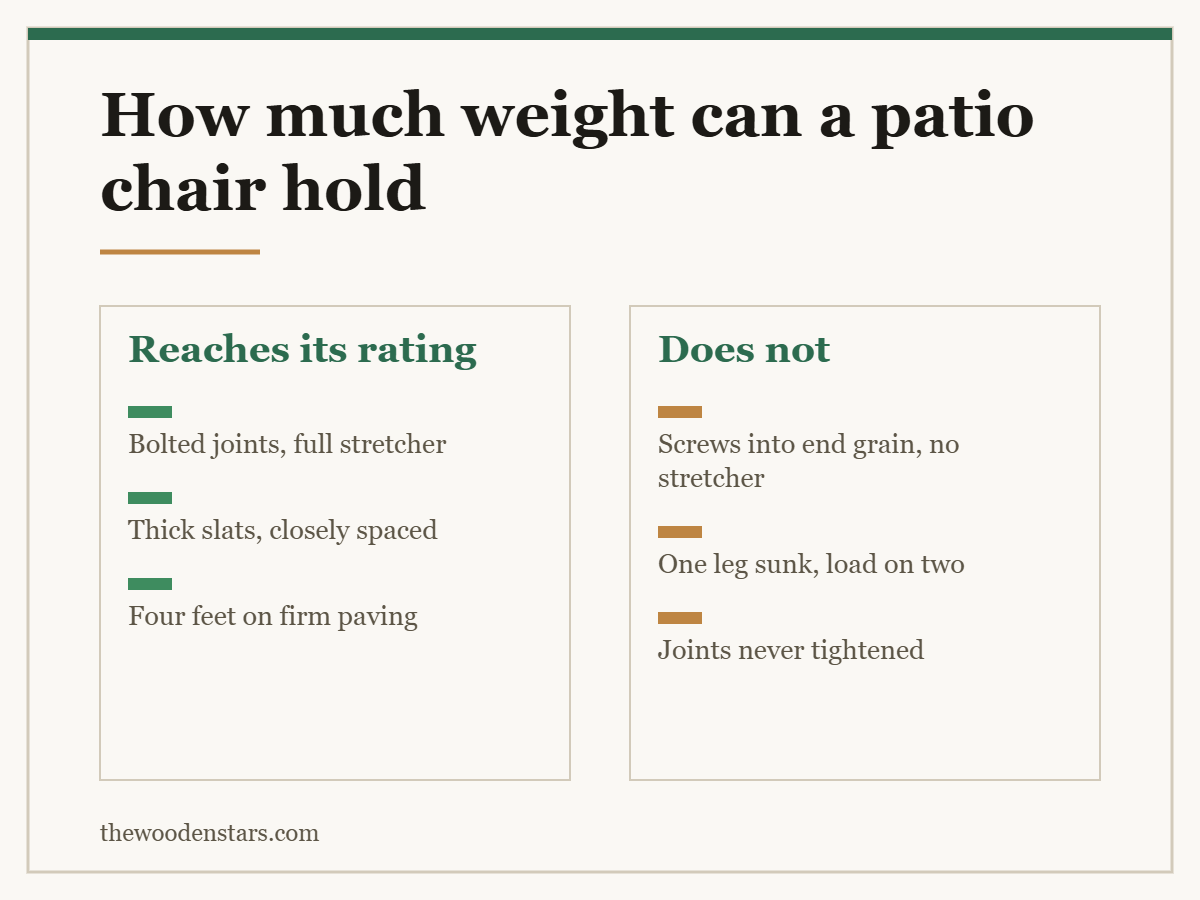
How much weight can a patio chair hold? 250 to 800 lb, and the spread is so wide that the rating tells you more about how the chair is built than any other number on the listing.
It is also the figure most often missing from outdoor chair listings entirely — and when it is missing, assume the bottom of the range.
Typical ratings: 225 to 300 lb on folding and light moulded chairs, 300 to 400 on ordinary timber dining chairs, 400 to 600 on solid hardwood with bolted joints, and 600 to 800 on heavy Adirondacks and HDPE lumber. Ratings are static: dropping into a chair applies two to three times body weight momentarily, so rate for roughly double the heaviest regular user. The three things that set the number are leg-to-seat joints, seat slat thickness, and whether the frame has a stretcher. Outdoors, add one more: legs on soft ground fail well below the rating.
How much weight can a patio chair hold, by type
- Folding timber or moulded plastic: 225 to 300 lb. The hinge or the single-piece moulding is the limit.
- Standard timber dining chair: 300 to 400 lb. Doweled or screwed joints, slim sections.
- Solid hardwood, bolted, with a stretcher: 400 to 600 lb.
- Adirondack in cedar or HDPE: 600 to 800 lb. Wide flat boards and a low, splayed stance.
- Bar stool: 250 to 350 lb, and the tall ones are lower rated than they look.
Two patterns are worth noticing. Lower and wider is stronger — an Adirondack’s splayed legs and low seat put less bending into every joint than a tall upright chair does. And folding is always the weakest, because the load passes through a pin.
| Feature | Weak | Strong |
|---|---|---|
| Leg-to-seat joint | Screwed into end grain | Bolted, or mortise and tenon |
| Stretcher between legs | None | Full stretcher or an H-frame |
| Seat slats | Under 0.75 in, wide gaps | 1 in or more, closely spaced |
| Stance | Tall and upright | Low and splayed |
| Moving parts | A folding pin | None |
| Material | Thin tube, particleboard | Solid hardwood, HDPE lumber |
Why static ratings understate the load
A published figure is what the chair holds standing still. Nobody sits down slowly.
Dropping into a chair applies two to three times body weight for a fraction of a second, and it applies it unevenly — usually to the back two legs. Leaning back onto two legs concentrates everything into two joints. Outdoors, people also sit down on chairs that are on a slight slope, which adds a sideways component the rating never contemplated.
So the working rule is the same as for beds and bunks: rate for roughly double the heaviest regular user. A 250 lb-rated folding chair is not a chair for a 200 lb adult who sits down normally; it is a chair for occasional light use.
The same arithmetic for larger furniture is in how much weight a bed frame can hold.
The outdoor factor nobody rates: the ground
Every published rating assumes four legs on a flat, firm floor.
On grass or gravel, one leg sinks. The chair racks, the load moves to two legs and one diagonal, and a 400 lb chair behaves like a 200 lb one. This is how outdoor chairs actually break — not by overload, but by being loaded out of square.
Three fixes, all cheap:
- Wide foot caps. They spread the load and stop a 1-inch leg acting as a spike. They also keep timber out of standing water, which is where rot starts.
- Keep the chairs on paving. Including where they push back — the clearance has to be hard surface, which is the point made in how much space around a patio table.
- Tighten annually. A chair that has been racking all summer has loose joints by autumn, and a loose chair fails far below its rating.
Reading a listing that gives no rating
Most outdoor chair listings do not state one. Judge it from the construction instead:
Look at the leg-to-seat joint. If you can see screw heads going into the end of a leg, that is the weak point and the chair is at the bottom of its class. A bolt with a visible nut, or a mortise and tenon, is the strong version.
Look for a stretcher. A rail between the front legs, or an H between all four, transforms a chair’s rigidity. Its absence is the commonest reason a timber chair loosens in two seasons.
Look at the slats. Under 0.75 inches, widely spaced, is where a seat cracks. One inch and closely spaced is what carries weight.
Look at the material honestly. “Solid wood” is not a specification; the species is — best wood to use outside and what engineered wood actually is.
If you need a genuinely heavy-duty chair
Adirondacks in HDPE lumber are the strongest common outdoor chair — 600 to 800 lb, wide boards, low splayed stance, no joints to loosen. See chaise lounge against adirondack chair and wood against resin patio furniture.
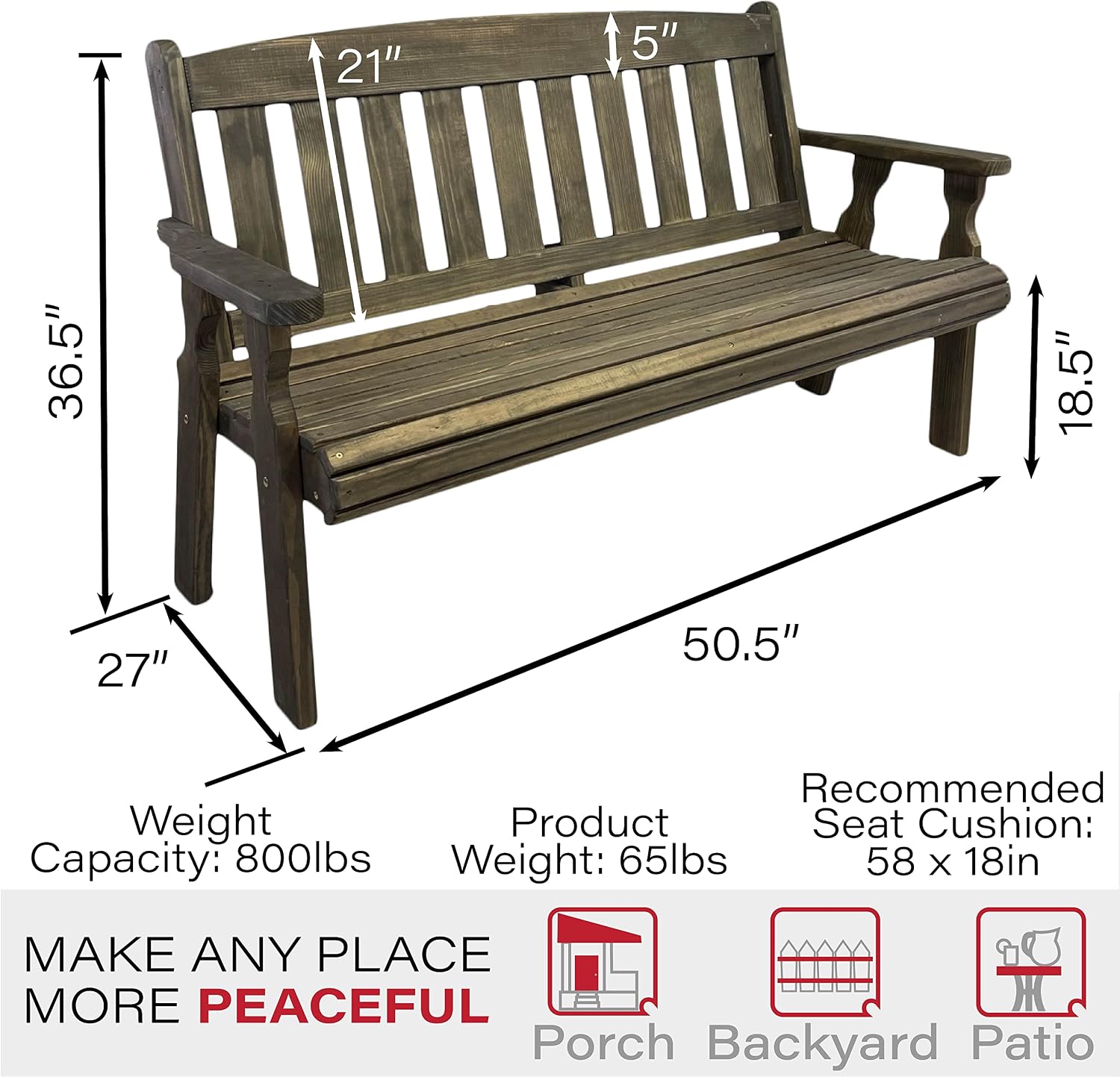
A bench spreads load across a long frame and is usually rated 600 to 800 lb for two or three people — outdoor bench against outdoor chairs.
What to avoid: folding chairs as everyday seating, and anything with a stated rating under 300 lb that will be used daily.
Keeping a chair at its rating
- Furniture foot caps Spreads load so a leg does not act as a spike on soft ground
- Wood glue for loose joints The leg-to-seat joint is the one that opens first
- Stainless replacement bolts Plain steel corrodes and elongates its hole
- Hex key set Ten minutes each spring keeps the published rating real
What to buy


For chair sizing, see how wide a patio chair is. For chair types, sling against cushion, folding against stacking and arms against armless. For the bench alternative, outdoor bench against outdoor chairs.
Questions we get asked
How much weight can a patio chair hold?
Two hundred and fifty to 800 lb. Folding chairs sit at 225 to 300; bolted hardwood reaches 400 to 600; Adirondacks and HDPE reach 800.
How much margin should I leave?
Rate for roughly double the heaviest regular user, because sitting down applies two to three times body weight momentarily.
What if the listing gives no rating?
Assume the bottom of the class, then judge the leg-to-seat joint, the stretcher and the slat thickness.
Why do outdoor chairs break below their rating?
Usually because a leg has sunk into soft ground, so the load passes through two legs and a diagonal instead of four.
Which outdoor chair is strongest?
An Adirondack in HDPE lumber — wide boards, a low splayed stance and no joints to loosen.
Are folding chairs safe for everyday use?
For occasional use, yes. As daily seating they are the weakest common type and the pin wears with every fold.