Table Leveling Feet and Glides: Thread Sizes, Types and What Actually Fits
The Wooden Stars is a participant in the Amazon Services LLC Associates Program. We may earn a commission when you buy through links on our site, at no extra cost to you.
Levelling feet are the cheapest upgrade you can make to a wooden table, and the most common mistake when buying them is ordering the wrong thread. There are only a handful of sizes in circulation, but they are not interchangeable, and a 3/8-16 stud will not go into an M8 insert no matter how convincing it looks in the photograph.
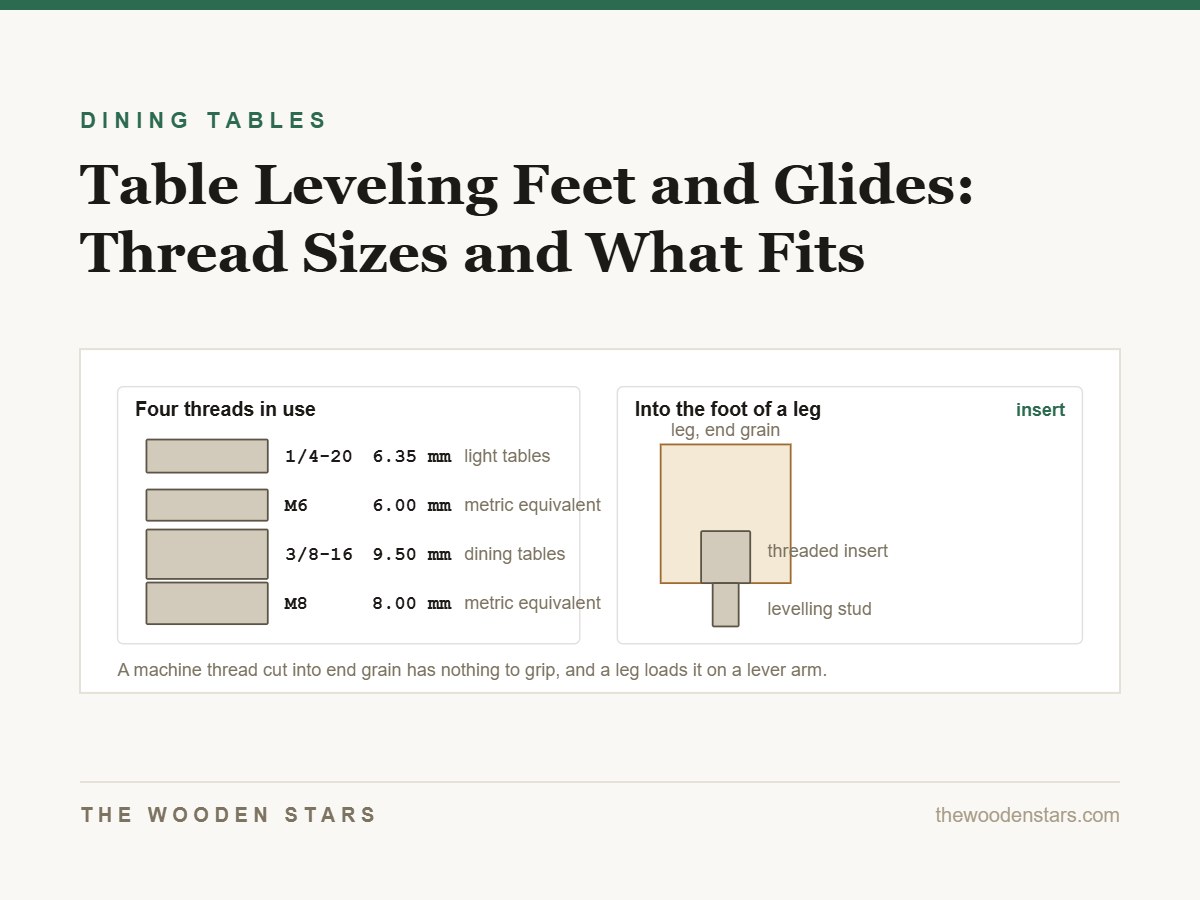
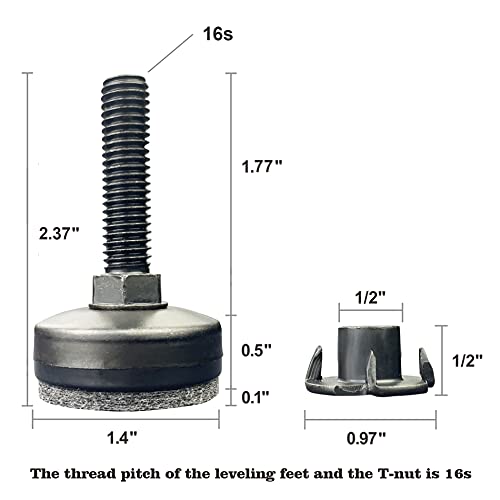
Measure the existing stud or hole before ordering. The four sizes that cover almost all wooden furniture are 1/4-20 and M6 for light tables and benches, and 3/8-16 and M8 for dining tables and anything heavy. If your legs have no fitting at all, you will also need a threaded insert or T-nut — the stud must never thread directly into end grain.
Start here: 3/8-16 is the thread most dining tables want, and this is the set to buy if your legs already have inserts.

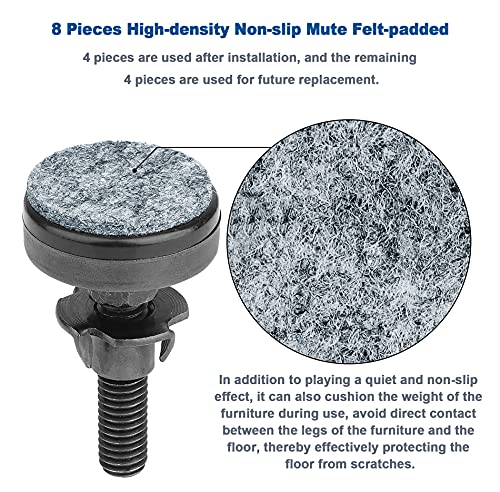
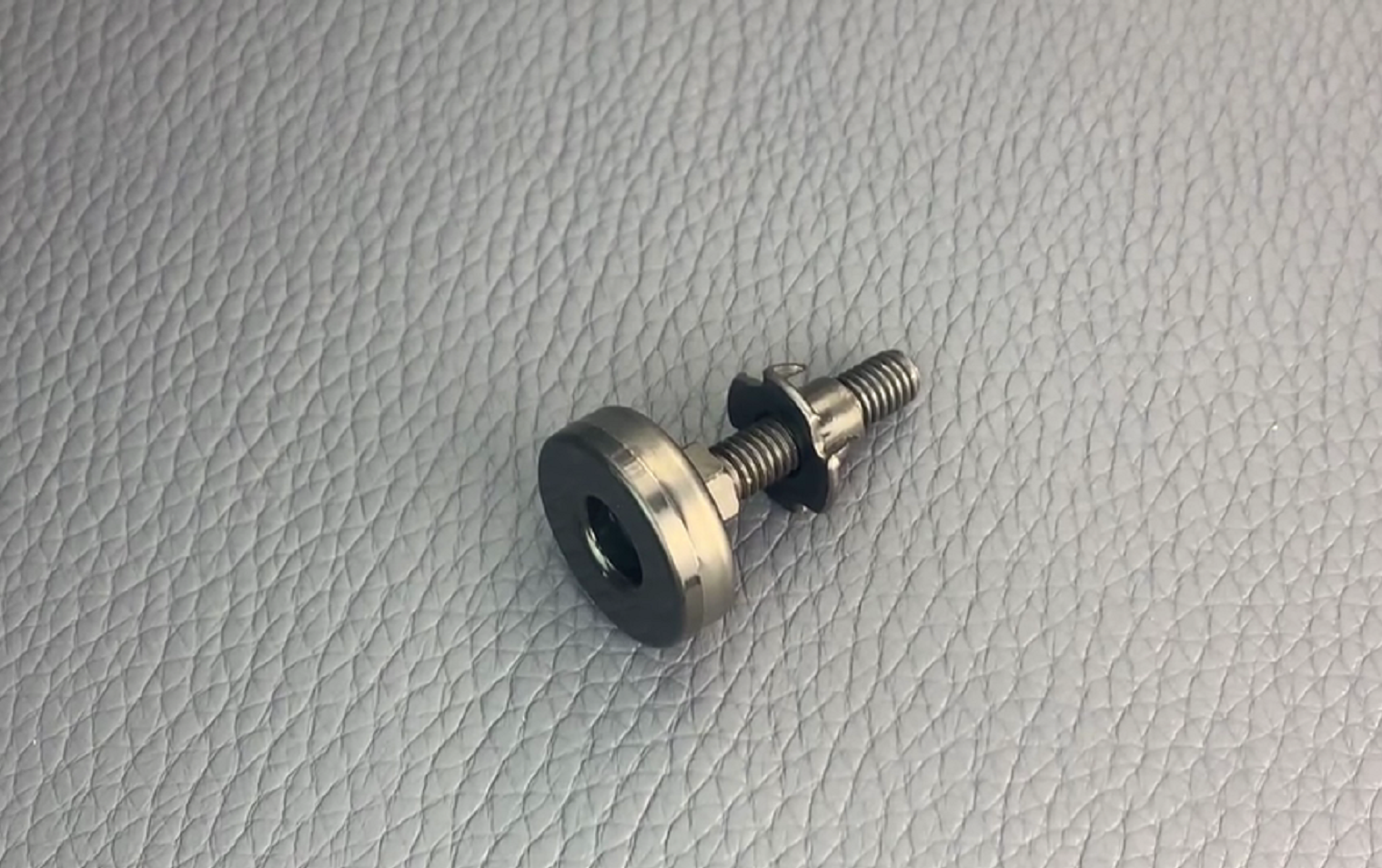
Prime 3/8" Threaded Leveling Feet Adjustable Table/Furniture Feet Levelers Screw on Heavy Duty Desk/Chair/Cabinet/Dresser/Bench Leg Leveler Screw in with Threaded Inserts(3/8-16,Large Base,Black,4 Pack)







The four families of foot
| Type | How it attaches | Adjusts? | Best for |
|---|---|---|---|
| Felt pad | Self-adhesive | No | Hard floors, light tables, temporary |
| Nail-in glide | Small nails into the leg | No | Chairs and benches on hard floors |
| Screw-in levelling foot | Threaded stud into an insert | Yes | Dining tables, desks, anything on an old floor |
| Bolt-through leveller | Bolt with a lock nut through a plate | Yes, wide range | Heavy tables, islands, metal bases |
| Furniture slider | Self-adhesive or nail-in, low friction | No | Carpet, or tables that get moved often |
The distinction that matters most is adjusts or does not adjust. A pad or a glide sets the leg length permanently; a levelling foot lets you set it after the table is in place, and re-set it when you move house. On any table you intend to keep, the adjustable version is worth the extra work of fitting inserts.
Measuring the thread you need
Turn the table on its side and look at what is in the bottom of each leg.
- An existing stud sticking out. Measure its diameter with a caliper. 6.35 mm is 1/4 inch; 9.5 mm is 3/8 inch; 6.0 mm and 8.0 mm are metric M6 and M8. The half-millimetre matters.
- A threaded hole. Measure across the hole, then count threads: 20 per inch is 1/4-20, 16 per inch is 3/8-16. Metric inserts are usually marked.
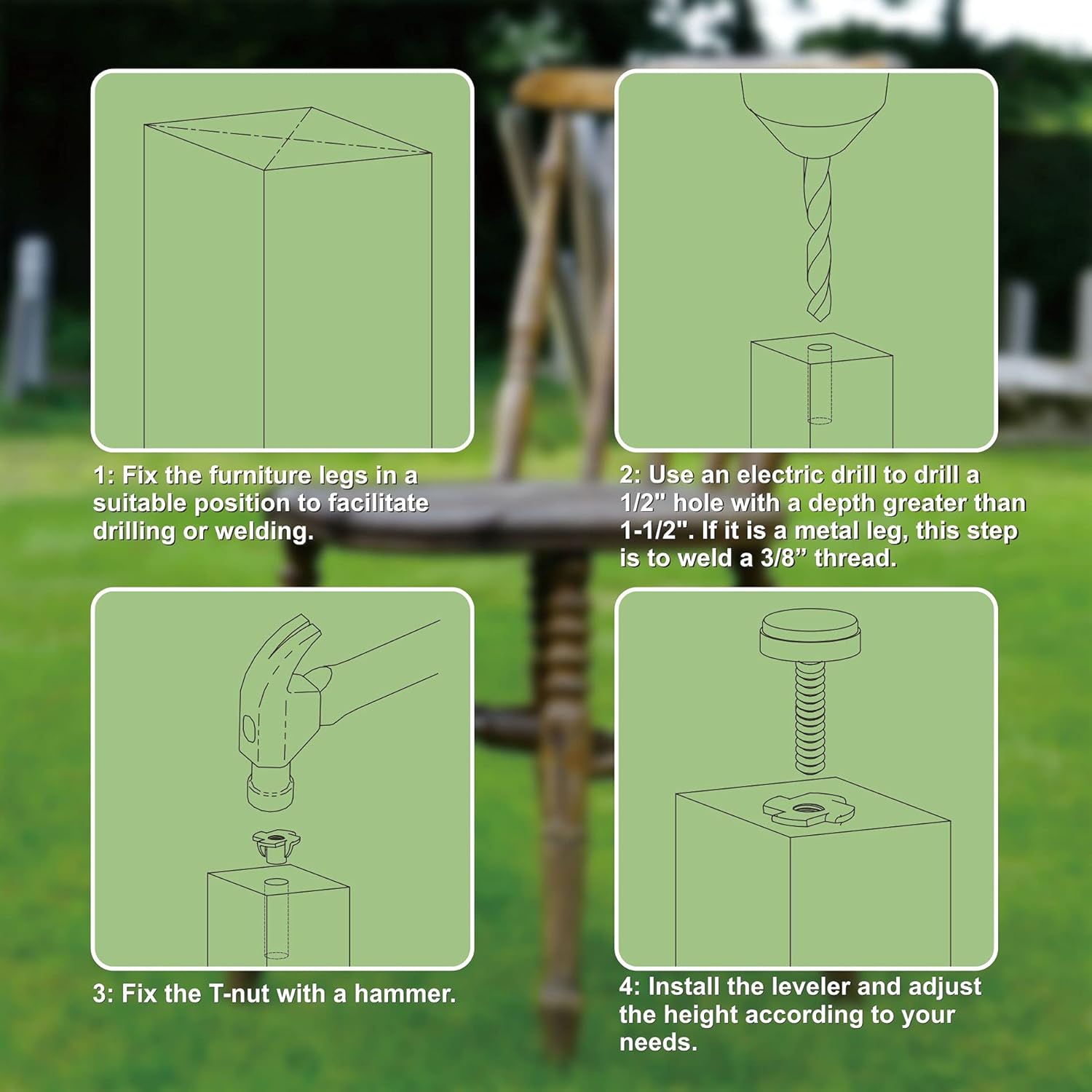
- A plain hole with no thread. Somebody removed a T-nut, or there never was one. Measure the hole and fit an insert to suit.
- Nothing at all — solid wood. You are drilling and fitting an insert. Choose the thread first, then buy the drill size the insert specifies.
Imperial and metric look almost identical at a glance, and mixing them cross-threads the insert on the first turn. If you are not certain which you have, a cheap digital caliper removes the guesswork permanently — it is the same tool you need for measuring drawer slides and for telling solid wood from engineered panels.
Fitting an insert into a wooden leg
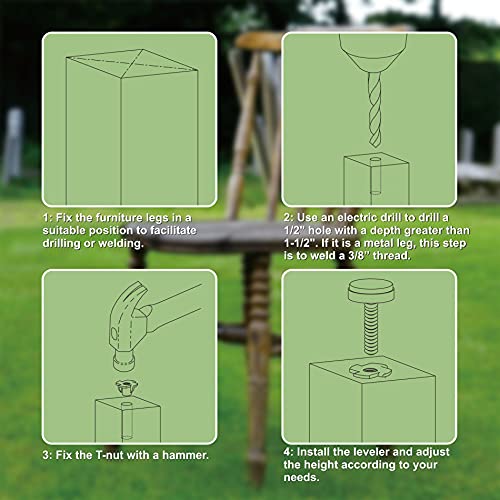
The critical rule: a machine thread cut directly into wood will strip. Wood has no shear strength across the fibres at that scale, and a table leg carries a large point load. The fitting has to be metal-in-wood, and the metal comes in two forms.
| Fitting | Fitted how | Holds in | Notes |
|---|---|---|---|
| Screw-in threaded insert | Screwed into a pilot hole with a hex key | End grain and face grain | Neatest, strongest in hardwood |
| T-nut | Hammered in, prongs bite the wood | Face grain, needs a flat seat | Cheaper, can pull out under tension |
| Press-in insert | Pressed into a precise hole | Hardwood only | Needs an accurate hole |
For a table leg — which is end grain at the bottom — a screw-in insert is the right choice. Drill the pilot hole the insert specifies, square to the foot, and drive it in with a hex key until it is flush or very slightly below. Going in crooked is the failure mode; a drill guide or a square held against the leg is worth the trouble.
How much adjustment range you need
More than you think, and less than the longest stud available.
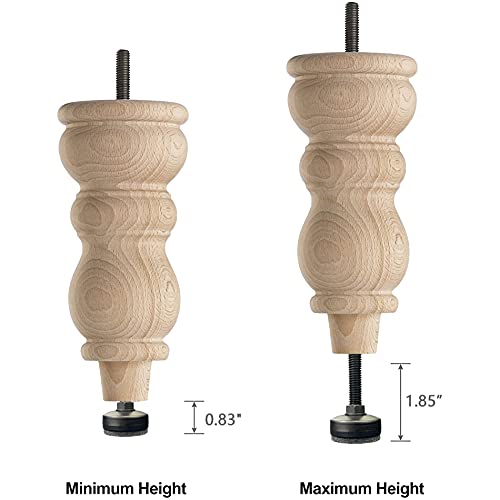
- 10 to 15 mm handles a normal floor and a normal table. Most people never use more than 5 mm.
- 20 to 25 mm for old timber floors, sloping kitchens, and anything that will sit on tile with an uneven bed.
- Beyond 25 mm and the stud starts to look like a stilt and behaves like one — the leverage on the insert rises and the table feels springy. If you need that much, level the floor, not the table.
Also check the base diameter of the foot. A small metal foot concentrates load and dents softwood floors; a wider nylon or rubber base spreads it. On a heavy oak table on an engineered floor, base diameter matters more than the thread does.
Felt pads: still worth fitting, on top of everything else
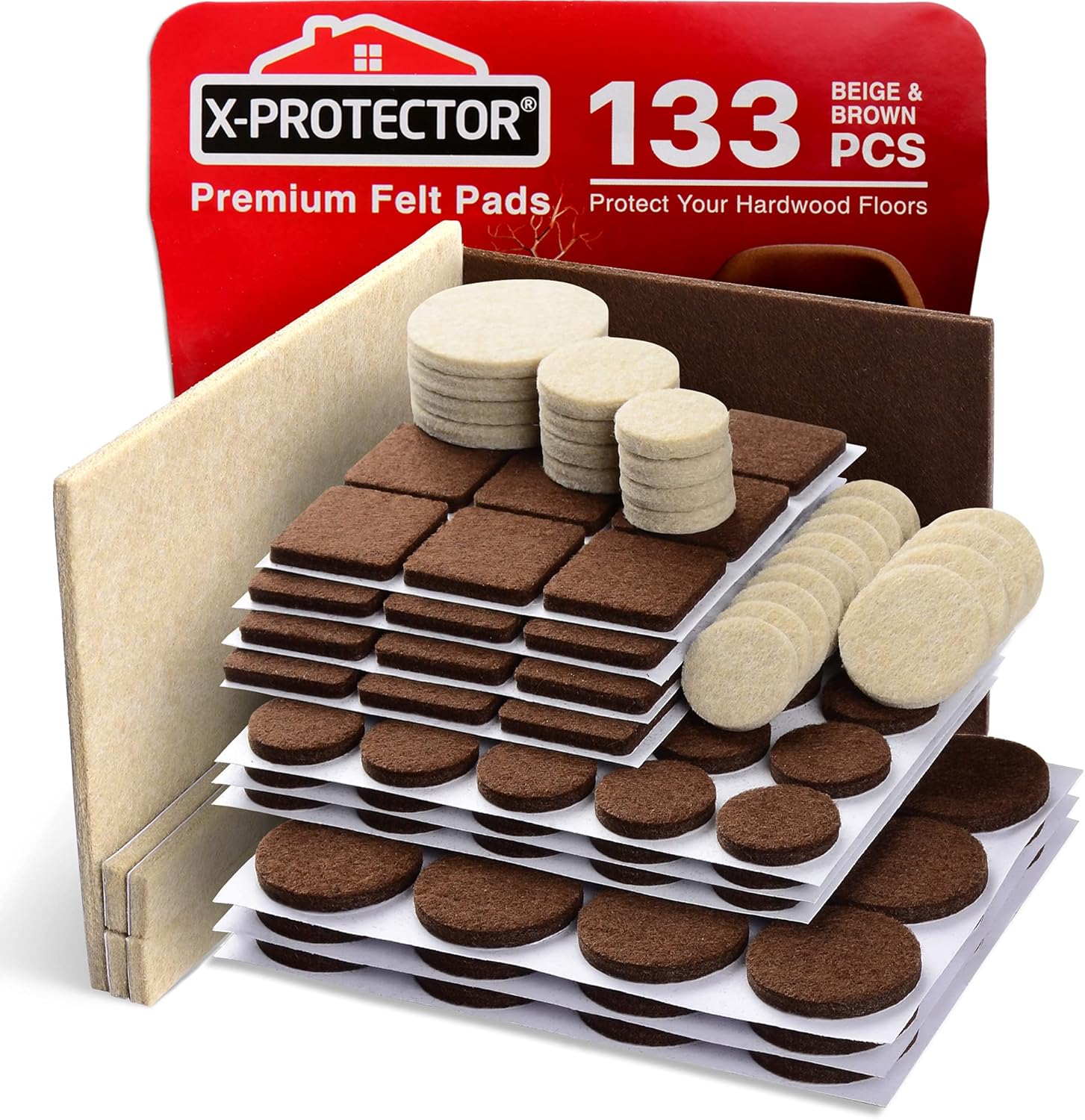
Even with levelling feet, felt on the contact face is worth having — it protects the floor and it silences the small scrape when someone shifts their chair. Two practical points: buy pads slightly larger than the foot rather than the same size, because pads compress and spread; and replace them as a set, because one new pad among three flattened ones is a 2 mm wobble.
What to buy for a levelling job
- Levelling feet, 3/8-16 thread The size most dining tables want On Amazon →
- Heavy-duty adjustable levellers Wider base, for heavy tops and kitchen islands On Amazon →
- Levelling feet with T-nuts, 1/4-20 Lighter tables, benches, desks On Amazon →
- Felt furniture pads, assorted Protect the floor and quiet the contact On Amazon →
- Threaded inserts to match Never thread a stud straight into wood
What to buy
Match the thread to your legs before anything else. The heavy-duty version earns its price on a thick top or a kitchen island.

Where these parts also solve the problem
Levelling feet turn up as the answer to several problems that do not look like levelling problems:
- A table that rocks in one spot only — the floor, and the reason to check the floor before the table. Our guide to fixing a wobbly dining table puts this first for exactly that reason.
- A bookcase that leans forward — usually the floor slopes toward the room, and two levellers at the front bring it back plumb, which matters more here than anywhere because a leaning bookcase is a tipping hazard.
- A desk with one high corner — a wobbling desk under a keyboard is far more annoying than a wobbling table. See fixing a wobbly wooden desk.
- A bed frame that creaks on one side — a frame not sitting evenly loads its joints unevenly. Levellers are a legitimate part of the bed squeak diagnosis.
Questions we get asked
Can I screw a levelling stud straight into the wooden leg?
You can get it to hold for a while, and it will strip. End grain gives a machine thread almost nothing to grip, and a table leg carries a concentrated load with a lever arm. Fit an insert — it is one extra step and it is the difference between a repair and a recurring problem.
Do I need all four adjustable, or just the short leg?
All four. Levelling by extending one leg puts that leg’s insert under more load than the others and leaves you no room to adjust in the other direction if the floor moves. Fitting four also means the table sits on four identical contact faces, which is why it stops rocking.
Metric or imperial — how do I tell without a caliper?
Compare against a known bolt from a hardware store, or count threads over 25 mm with a fingernail: 20 threads per inch (1/4-20) feels noticeably finer than M6’s 1 mm pitch. If the furniture was made in Europe or Asia it is more likely metric; North American furniture is more likely imperial. It is a guess either way — measuring is cheap.
Will levelling feet mark my floor?
A bare metal foot on a soft floor will. Choose a foot with a nylon or rubber base, or fit a felt pad to the underside of the foot. On engineered and laminate floors, base diameter matters: spread the load over as much area as the design allows.
My table has a metal base. Do the same rules apply?
The thread rules do, and the insert rules do not — metal bases usually have a welded nut or a tapped hole already, so you just need the right thread and the right length. Check whether the base has slots for the top’s movement, though: a rigid steel base bolted hard to a solid top is the classic cause of a cracked table top.