Solid Wood, Engineered Wood or Veneer: Five Ways to Tell Before You Buy
The Wooden Stars is a participant in the Amazon Services LLC Associates Program. We may earn a commission when you buy through links on our site, at no extra cost to you.
“Solid wood” is the most abused phrase in furniture retail. It is used for solid timber, for glued-up staved panels, for plywood with a real wood face, and — in listings that ought to know better — for particleboard with a printed paper surface. The difference matters, because it decides whether the piece can be sanded, refinished, re-drilled, repaired, or moved twice without falling apart.
You can settle the question in about thirty seconds, in a showroom or in your own house, without tools. Two of the five tests below need nothing at all.
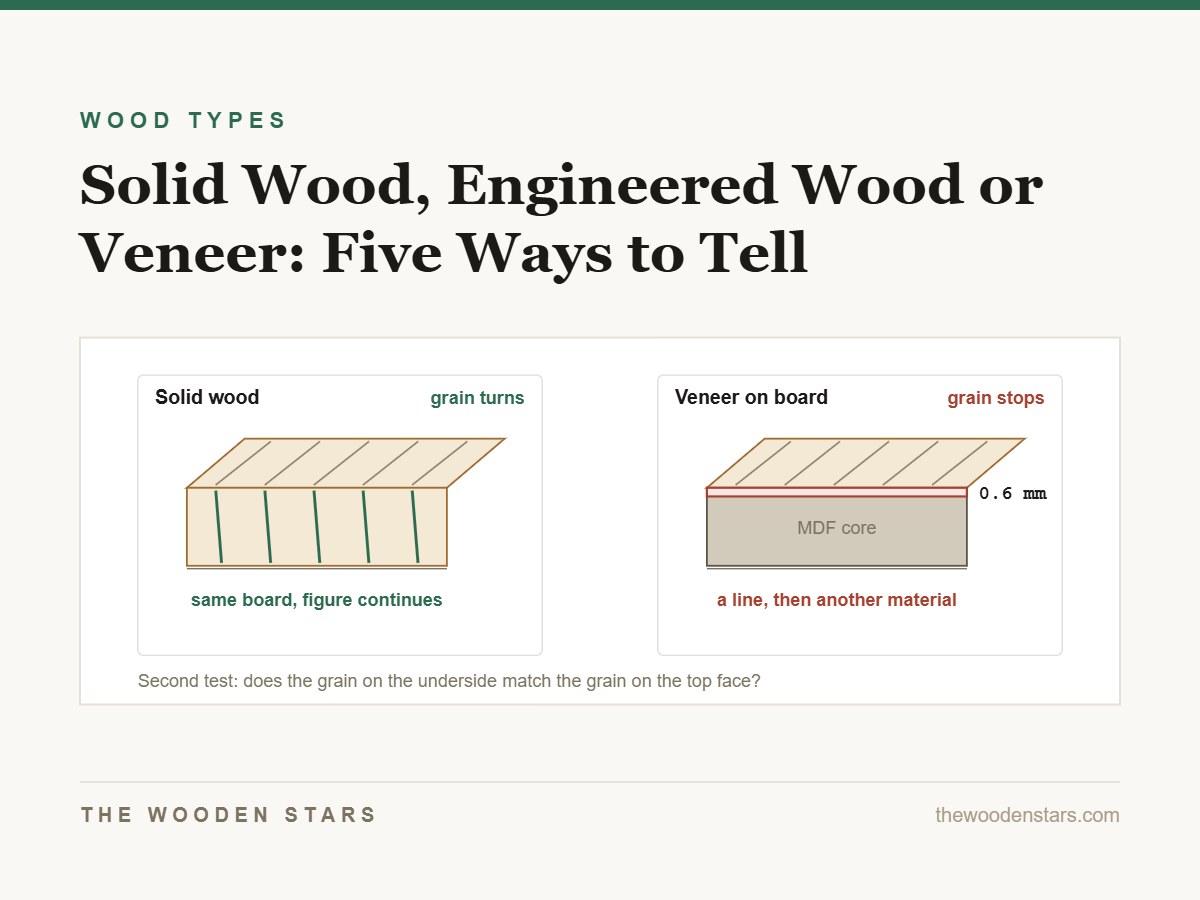
Look at the edge first: on solid wood the grain pattern on the top runs over the edge and continues down it. On veneer you see a thin line then a different material. Then check whether the grain on the top matches the grain on the underside — on solid wood it does, on a veneered panel it does not. Those two tests alone identify most furniture correctly.
Start here: a caliper turns the thickness test from a guess into a number, and 18 mm exactly means a board product.

Prime Kynup Digital Caliper, Caliper Measuring Tool, Stainless Steel Micrometer











The five materials you are choosing between
| Material | What it is | Can be refinished? | Moves seasonally? |
|---|---|---|---|
| Solid timber | One piece of wood per component | Yes, many times | Yes, significantly |
| Staved / glued panel | Narrow boards glued edge to edge | Yes | Yes |
| Veneer on plywood | Thin real wood over layered ply | Very lightly, once | Barely |
| Veneer on MDF | Thin real wood over fibreboard | No, practically | Barely |
| Melamine / laminate | Printed paper or foil over board | No | No |
Two clarifications that clear up most confusion:
- A staved panel — a butcher-block-style top of narrow boards glued together — is genuinely solid wood. It is also more stable than a single wide board, because alternating the boards’ grain direction cancels out some of the cupping. It is not a lesser material.
- Veneer is not a cheat. Fine antique furniture is veneered, often over solid wood, because veneer allows figured timber that would be unstable in the solid. What matters is what is under the veneer: plywood is a good substrate, MDF is a mediocre one, particleboard is a poor one.
The five tests
1. The edge — free, and decisive
Look at where the top surface meets the edge. On solid wood, the grain lines you can see on the top continue over the corner and run down the edge, because it is the same piece of wood. On a veneered panel, the top’s grain stops at the corner and the edge shows either a thin dark line (the glue and the veneer’s thickness) or an edge banding with its own, unrelated grain pattern.
The giveaway: an edge whose grain pattern repeats, or that has a perfect straight-line grain while the top is figured, is edge banding.
2. Top versus underside
Turn the piece over, or look underneath a shelf. On solid wood, the grain on the underside mirrors the grain on top — same knots, same figure, in the same places. On a veneered panel, the underside is either a different, cheaper veneer, or bare board, or nothing like the top.
This is the test that catches the well-made veneers that pass test one.
3. Thickness, measured
Solid wood furniture components run to certain thicknesses because that is what stock is milled to. Panel products run to their own set, and they are metric and precise.
| Measured thickness | Points to |
|---|---|
| 18 mm exactly | MDF or particleboard (the standard panel thickness) |
| 16 mm exactly | Particleboard, common on flat-pack |
| 19 mm / 3/4 in | Solid wood, or plywood |
| 25 mm / 1 in | Solid wood |
| 20–22 mm, slightly irregular | Solid wood, planed |
| Perfectly uniform to 0.1 mm across the piece | Panel product |
A digital caliper makes this test conclusive: solid wood varies by a few tenths of a millimetre across a panel because it was planed and has moved since. A board product does not vary at all.
4. Weight and sound
MDF is heavier than solid softwood and about as heavy as hardwood, so weight alone is a weak test — but the sound is a good one. Tap the middle of the panel with a knuckle: solid wood rings slightly and the pitch varies as you move; MDF gives a dead, dull thud that is identical everywhere; a hollow-core panel sounds obviously hollow in the middle and solid at the edges.
5. Moisture behaviour
The slowest test and the most conclusive if you already own the piece: solid wood moves with the seasons and board products do not. If a drawer or door binds in August and is fine in February, it is solid wood. If gaps between panels open and close through the year, solid wood. If nothing ever changes, it is a board product.
A moisture meter makes this immediate rather than seasonal — solid wood reads 6 to 12 per cent depending on the season and where the piece lives, and readings vary across a board; MDF reads uniformly and behaves differently from timber.
Two tools that settle it
- Digital caliper Thickness to 0.1 mm; 18 mm exactly means board product On Amazon →
- Wood moisture meter Distinguishes real timber behaviour from fibreboard On Amazon →
- Your own knuckle The tap test costs nothing and is genuinely useful
What to buy
This is a diagnosis article rather than a parts article, so the box is deliberately short — two tools, and you do not need either for the first two tests.
You need neither tool for the first two tests. The caliper settles thickness, the meter settles whether it is real timber.

Reading the listing, not just the furniture
When you are buying online and cannot touch the piece, the description usually gives it away if you know the vocabulary.
| What it says | What it usually means |
|---|---|
| Solid wood | Sometimes true — check for a species name |
| Solid acacia / solid oak | Genuinely solid, named species |
| Engineered wood | MDF, particleboard or plywood |
| Manufactured wood | Particleboard or MDF |
| Wood composite | Particleboard |
| Wood veneer | Real wood face over a board substrate |
| Oak finish / oak-effect | Printed to look like oak; no oak involved |
| Wood and metal | Check which part is which |
| Rubberwood / hevea | Genuinely solid hardwood, often good value |
| Acacia | A genus, not a species — quality varies widely |
Two entries deserve a note. Acacia is a genus of over a thousand species, so “acacia” tells you almost nothing about density or stability; the same word covers excellent furniture timber and mediocre plantation stock. And rubberwood (hevea) has an unglamorous name and is a perfectly respectable, dense, stable hardwood — a plantation by-product harvested after the tree stops producing latex, which makes it one of the better-value solid woods on the market.
Which to buy, honestly
- Buy solid wood for anything you want to repair, refinish, or keep for decades: table tops, bed frames, chairs, anything that takes structural load. It moves, so it needs to be built to accommodate movement — which is why table top fasteners matter so much.
- Buy veneer on plywood for large flat panels where stability matters more than repairability: wardrobe doors, cabinet sides, wide desk tops in humid rooms. It will not cup.
- Accept MDF in carcass backs, drawer bottoms and painted components, where nothing will be sanded and no fixing carries load.
- Avoid particleboard anywhere a screw carries weight — shelf pin holes crush, fixings strip, and it does not survive two house moves. See shelf pins and supports for what that failure looks like in practice.
Questions we get asked
Is veneer always worse than solid wood?
No. Veneer over plywood is more dimensionally stable than solid wood and allows figured timber that would crack in the solid — which is why museum-quality antique furniture is veneered. The problem is not veneer, it is veneer over cheap substrates, and it is that the veneer is often too thin to survive one sanding.
How thick is furniture veneer?
Modern commercial veneer is typically 0.6 mm and can be as thin as 0.3 mm. Antique veneer is often 1.5 to 3 mm, which is why old veneered pieces can be refinished and new ones cannot. A scratch deeper than half a millimetre on a modern veneer has already reached the substrate.
Can I tell by price?
Loosely, and it is unreliable in both directions. Expensive furniture is often veneered on purpose, and inexpensive rubberwood or pine furniture is often genuinely solid. Price tells you about brand and finish quality more than about material. Use the edge test.
Does solid wood always cost more to own?
It costs more to buy and usually less to own, because it can be repaired. A solid wood table with a water ring is a ten-minute fix; the same ring on a thin veneer over MDF is permanent. Repairability is the real argument for solid wood, more than looks or feel.
What about “solid wood” that is actually finger-jointed?
Finger-jointed or block-board timber — short lengths glued end to end — is solid wood and is structurally fine, often more stable than a single long piece. It looks busy where the joints show, which is why it is usually used in painted furniture or in components that do not show. Not a red flag; just a cosmetic choice.

