Dining tables with storage — Where it goes and what it costs you
The Wooden Stars is a participant in the Amazon Services LLC Associates Program. We may earn a commission when you buy through links on our site, at no extra cost to you.
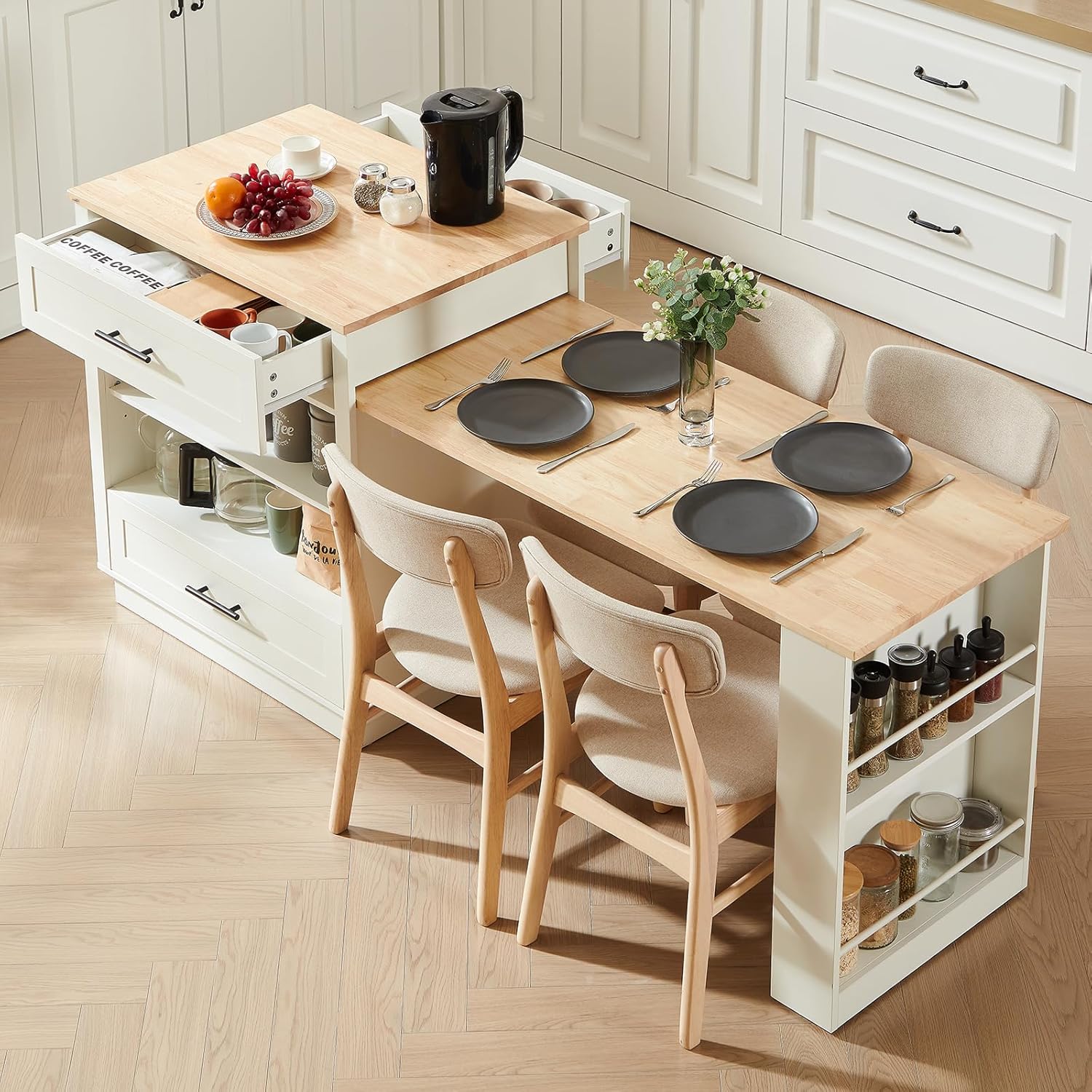
A dining table with storage sounds like free volume: the table is already there, so a shelf or a drawer underneath costs nothing. In practice every cubic foot you add underneath comes out of the space where somebody’s knees go.
That trade is worth making in a small kitchen and worth refusing in a dining room. The deciding number is knee clearance, and it is the one measurement these listings almost never state.
Storage under a dining table takes one of three forms. A lower shelf between the legs holds the most — usually 2 to 4 cubic feet — and sits low enough to clear knees, but it is open, so whatever goes there is on display. An apron drawer is shallow by necessity, 2 to 4 inches, and only fits mats and cutlery. A storage pedestal or cabinet base holds the most of all and is the one that removes seating — you cannot sit where the cabinet is. Whatever you pick, keep 24 to 26 inches of knee clearance from the floor to the underside of whatever is lowest, and allow 24 inches of table edge per person.
The three shapes, and who each one suits
A lower shelf
A fixed shelf spanning the legs, 6 to 10 inches off the floor. It is the most generous of the three and the least intrusive, because it sits below the height where legs actually are.
The contents are visible, so this suits baskets, a fruit bowl, cookbooks or serving dishes you do not mind seeing. It does not suit clutter.
An apron drawer
A drawer in the rail under the top. The apron is typically 3 to 5 inches deep, so a drawer inside it is 2 to 4 — enough for placemats, cutlery, napkins and a pack of cards.
It costs nothing in comfort as long as the apron was going to be there anyway. Where it hurts is on a table with no apron, because adding one to carry a drawer drops the clearance for everybody.
A cabinet or pedestal base
A closed box under one end or in the middle. Holds the most, hides everything, and takes at least one seat out of service — you cannot put a chair where the cabinet is.
This is a kitchen-table shape rather than a dining-room shape, and in a small kitchen it is often the right answer.
Knee clearance, the number to hold on to
A dining table top is 29 to 30 inches from the floor and typically an inch or so thick. Seated at a 18-inch chair you want 24 to 26 inches from the floor to the lowest thing under the table.
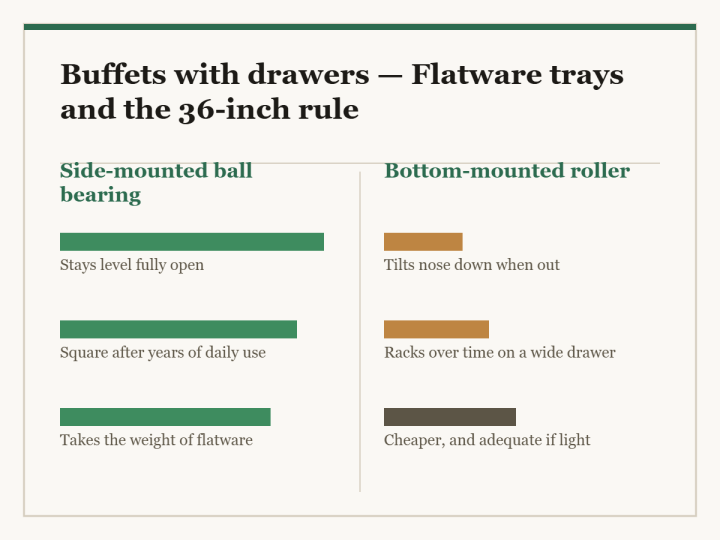
Work it out from the listing like this: table height, minus top thickness, minus apron depth, minus anything hanging below the apron. A 29-inch table with a 1-inch top, a 4-inch apron and a drawer box flush with the apron gives you 24. The same table with a drawer hanging an inch below the apron gives you 23, and tall diners will feel it.
Cross-brace stretchers do the same thing lower down. Structurally they are sensible, and they are at shin height.
| Type | Volume | Knee clearance | Seats lost |
|---|---|---|---|
| Lower shelf | 2 to 4 cu ft, open | Unchanged | None |
| Apron drawer | Under 1 cu ft | Minus 1 to 2 in | None |
| Trestle box | 1 to 2 cu ft | Unchanged, but a foot rail | None |
| Cabinet base, one end | 3 to 6 cu ft, closed | Unchanged at the other seats | One or two |
| Bench with a lift lid | 3 to 5 cu ft | Unchanged | None, but the seat rises |
Sizing the table itself
Storage does not change the seating arithmetic, and the seating arithmetic is what people get wrong.
- 24 inches of table edge per person. A 60-inch rectangular table seats two a side comfortably, not three.
- A leg or a pedestal at a corner removes that seat. Check where the legs land relative to where you want chairs.
- 36 inches of clear floor on every side people use, measured from the table edge.
- Depth 36 to 40 inches for a rectangular table if you want serving dishes down the middle.
Full sizing tables are in how wide a dining table should be and what size dining table seats 8. For round tables, how many chairs fit a 60-inch round table.
What the top is made of
A dining top takes heat, spills, and something dragged across it every day. It wears more like a worktop than like a coffee table.
Solid timber sands out a burn or a deep scratch and refinishes repeatedly. The counterpart is movement: a wide solid top expands and contracts with the seasons, and if it is fixed down rigidly the joints open. That failure is exactly what when a dining table top cracks at the seams is about.
Veneer on a stable core stays flat across a wide span and refinishes once. On a table with a storage base — where the frame is stiffer than usual — this is often the more sensible choice.
Laminate over particleboard cannot be repaired, and the failure point is the edge band lifting and letting water into the core. Around a storage shelf, where things get pushed in and out, that edge takes more knocks than usual.
The vocabulary is in what engineered wood actually is, and finishes in the best finish for a solid wood table top.
When to put the storage somewhere else
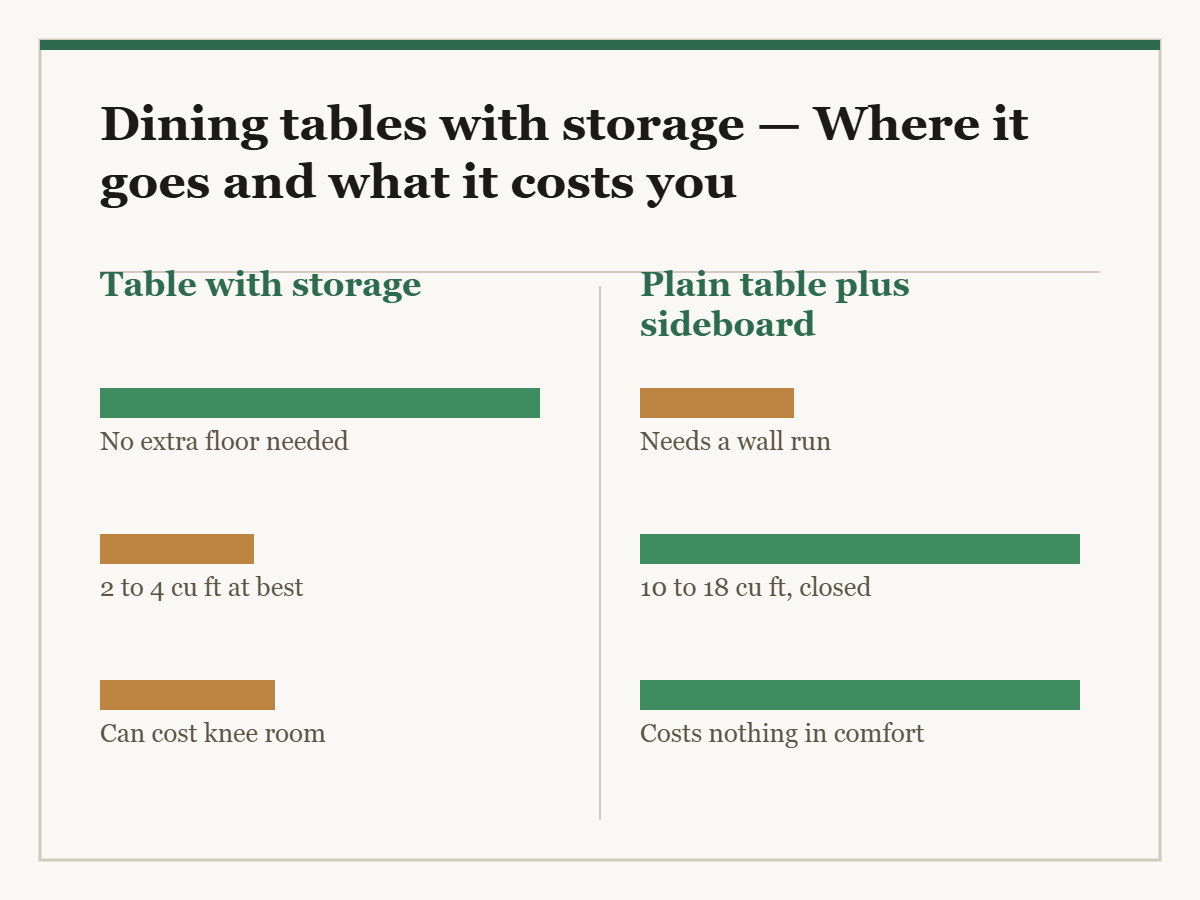
Four cubic feet under a table is a modest amount — roughly one large basket. A sideboard along the wall holds ten to eighteen, behind doors, at a height where you can actually reach it.
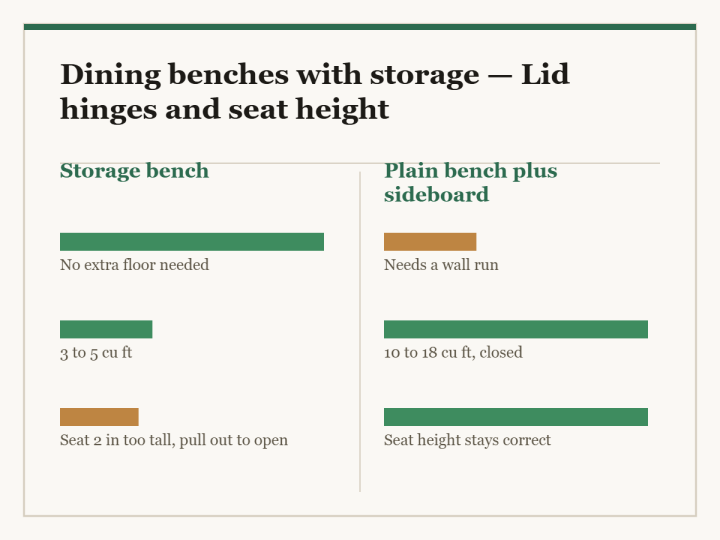
If the room has a wall to spare, the honest answer is a plain table and a sideboard with storage, or a buffet with drawers if you want flatware trays. The differences between those names are untangled in credenza against sideboard against buffet.
If the room has no spare wall, under-table storage is the right compromise — just take the shelf rather than the drawer, because it does not cost you anything.
Worth having anyway
- Levelling feet A table with a shelf or a cabinet base shows every dip in the floor
- Felt pads Storage bases are heavier and get dragged rather than lifted
- Hardwax oil Repairs a mark on a solid top in ten minutes
- Drawer organiser tray An apron drawer is shallow, so dividers are what make it usable
What to buy

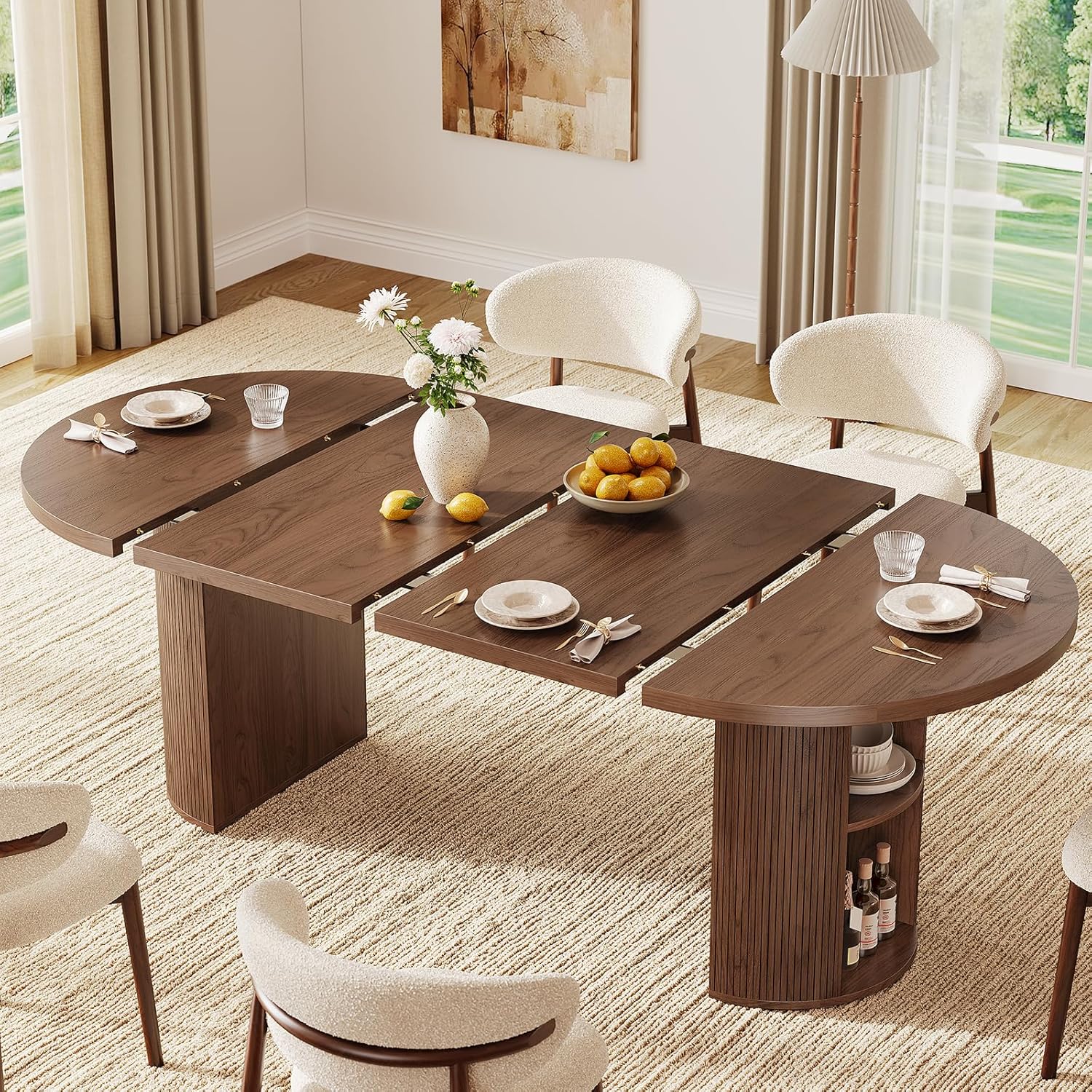

For the seating side of the same problem, see dining sets with storage and dining benches with storage. In a small kitchen, start from dining tables for small spaces or an extendable dining table, which buys space a different way.
Questions we get asked
How much does a dining table with storage actually hold?
A lower shelf gives 2 to 4 cubic feet. An apron drawer gives well under one. A cabinet base gives 3 to 6, at the cost of a seat.
How much knee clearance do I need?
Twenty-four to 26 inches from the floor to the lowest thing under the table — apron, drawer box or stretcher, whichever hangs lowest.
Does a lower shelf get in the way?
No. It sits 6 to 10 inches off the floor, below where legs are. It is the only one of the three that costs nothing in comfort.
How deep is a drawer in the apron?
Two to 4 inches, limited by the apron itself. It suits mats, napkins and cutlery, and nothing with height.
Is a table with storage better than a sideboard?
Only if you have no wall to spare. A sideboard holds three to four times as much, behind doors, at a reachable height.
How many people fit at a 60-inch table?
Six — two a side and one at each end — on the basis of 24 inches of edge per person. Check where the legs land first.