How to Fix a Wobbly Dining Table: Five Causes, in the Order to Check Them
The Wooden Stars is a participant in the Amazon Services LLC Associates Program. We may earn a commission when you buy through links on our site, at no extra cost to you.
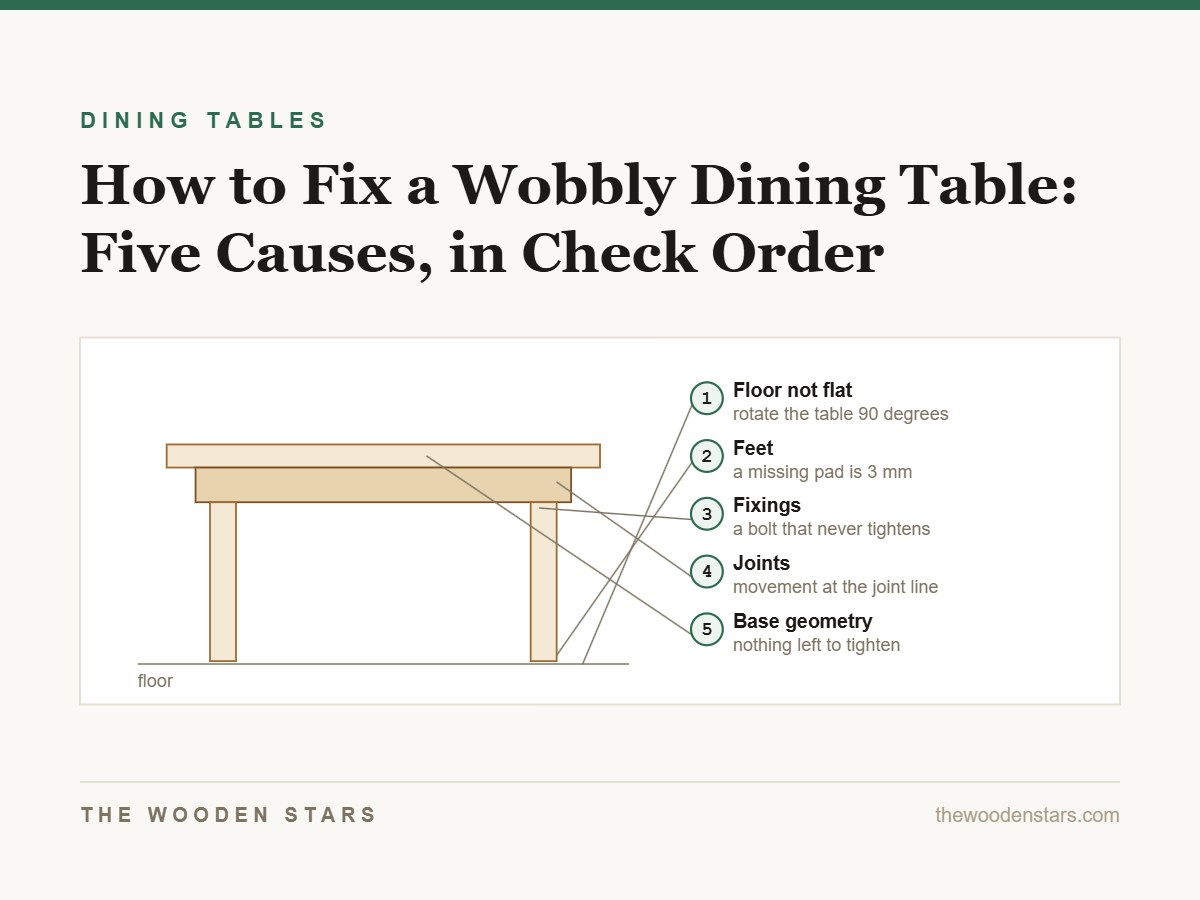
A wobbling dining table has five possible causes, and they are worth checking in a fixed order, because four of the five are quick and the fifth is not. Most people start with the fifth.
The order matters for a second reason: the cheap causes mask the expensive ones. A table on an uneven floor and with a loose leg joint feels like one problem. Level it first, and you find out whether you still have a problem at all.
Check in this order: 1) the floor, with a spirit level; 2) the feet, for a missing or compressed glide; 3) the fixings, for a loose bolt or bracket; 4) the joints, for a glue line that has let go; 5) the base geometry, for a design that racks. Four out of five wobbles stop at step two or three, and both are fixed with parts that cost less than a takeaway.
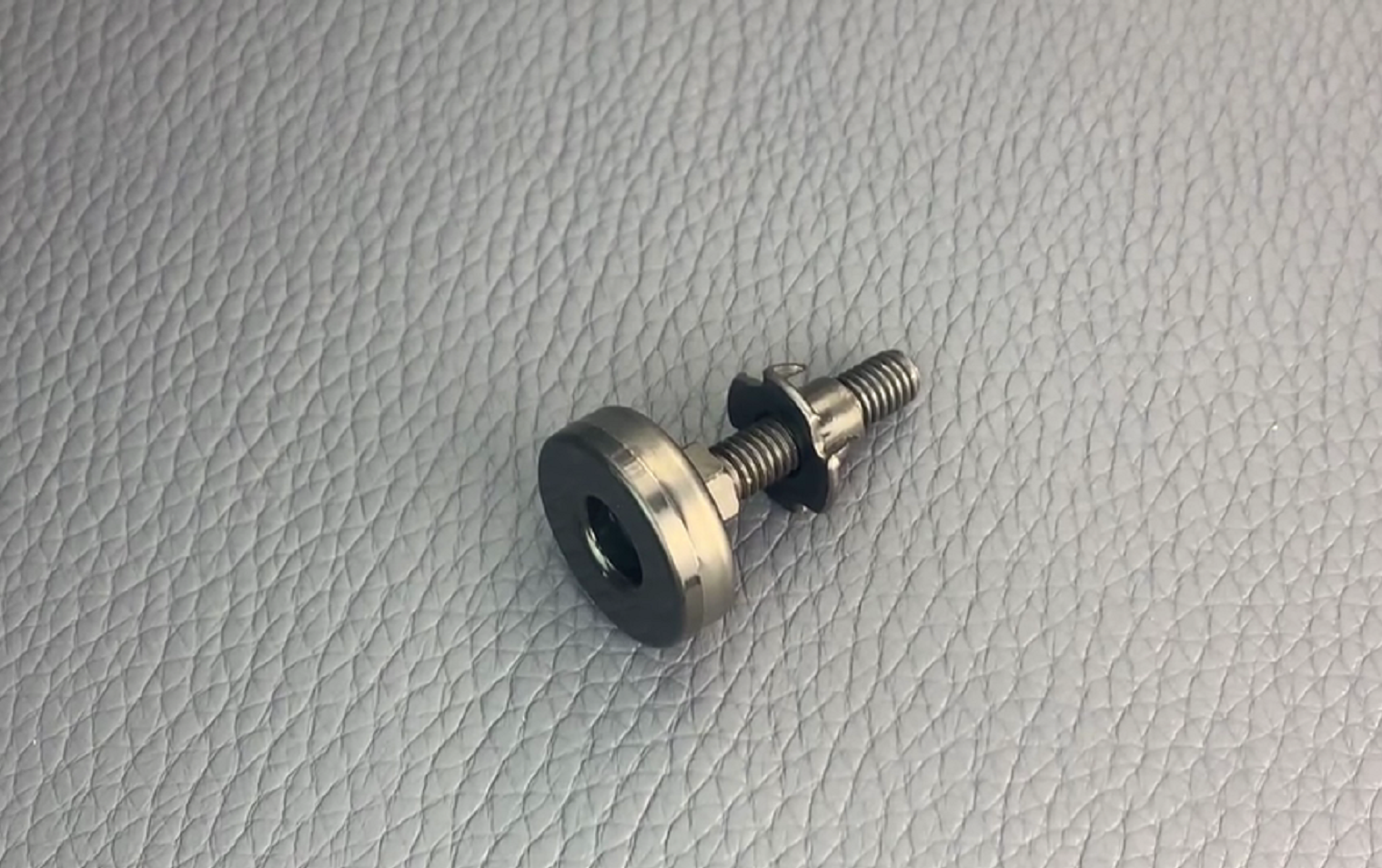
Start here: levelling feet fix the most common cause, and unlike a shim they survive the table being moved.

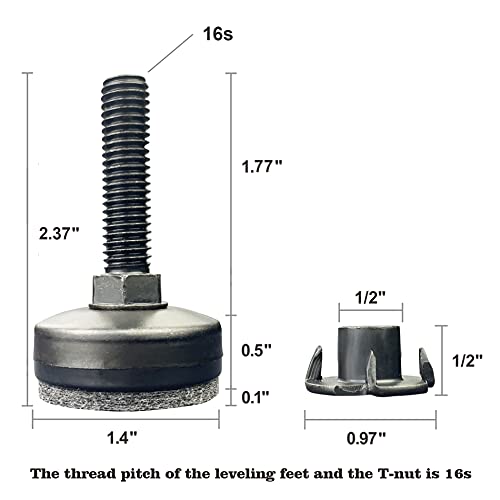
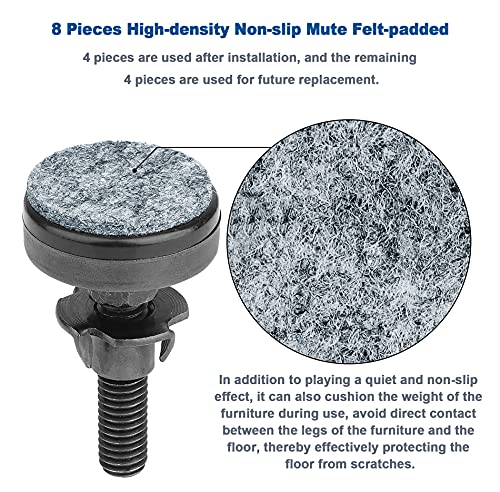
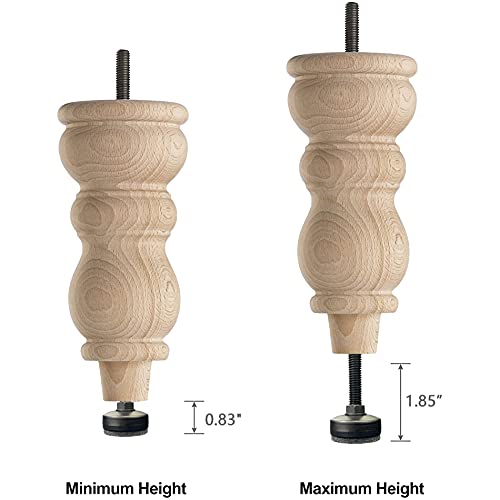
Prime 3/8" Threaded Leveling Feet Adjustable Table/Furniture Feet Levelers Screw on Heavy Duty Desk/Chair/Cabinet/Dresser/Bench Leg Leveler Screw in with Threaded Inserts(3/8-16,Large Base,Black,4 Pack)







Step 1: Is it the table or the floor?
Rotate the table 90 degrees and see whether the wobble moves with it. If the wobble stays in the same corner of the room, the floor is not flat. If it follows the table, the table is at fault.
Then put a straightedge or a spirit level across the top in both diagonals. A table can be perfectly square and still rock if one leg is 2 mm short — and 2 mm is invisible to the eye.
Step 2: The feet
This is the single most common cause and the one most often skipped. Check each foot for:
- A missing felt pad or glide on one leg. One pad off is typically 3 mm of difference, which is more than enough to rock a table.
- A compressed pad — felt flattens, and it flattens most under the leg that takes the most weight.
- Grit trapped under a pad, which does the opposite and lifts one corner.
- A foot that has splayed or split, which is a repair rather than an adjustment.
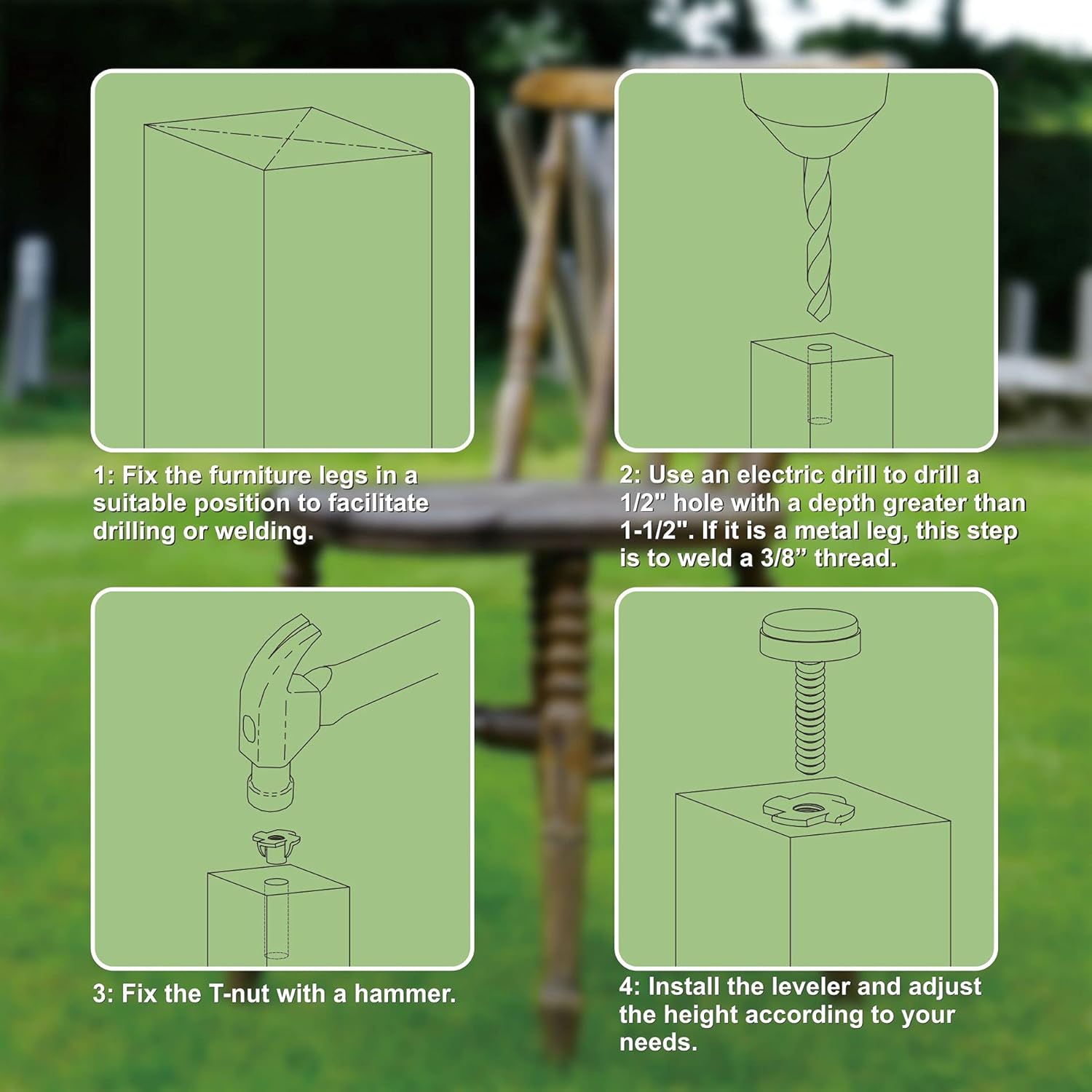
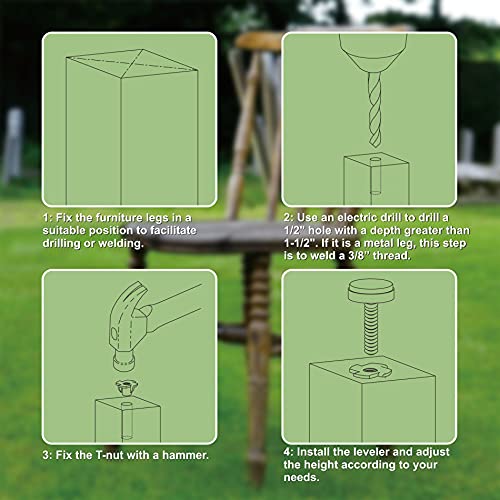
The permanent answer is adjustable levelling feet: a threaded stud in a T-nut or insert, with a locking nut. You set the table dead level once and never think about it again, and it survives being moved to a different spot on an old floor. On a table you will keep, this is a better investment than any amount of shimming.
| Table type | Common thread | Adjustment range needed |
|---|---|---|
| Light dining table, four legs | 1/4-20 or M6 | 10–15 mm |
| Heavy dining table, thick legs | 3/8-16 or M8 | 15–25 mm |
| Trestle or pedestal base | 3/8-16 or M10 | 20–30 mm |
| Bench | 1/4-20 or M6 | 10 mm |
| Kitchen island / counter height | 3/8-16 | 25 mm plus |
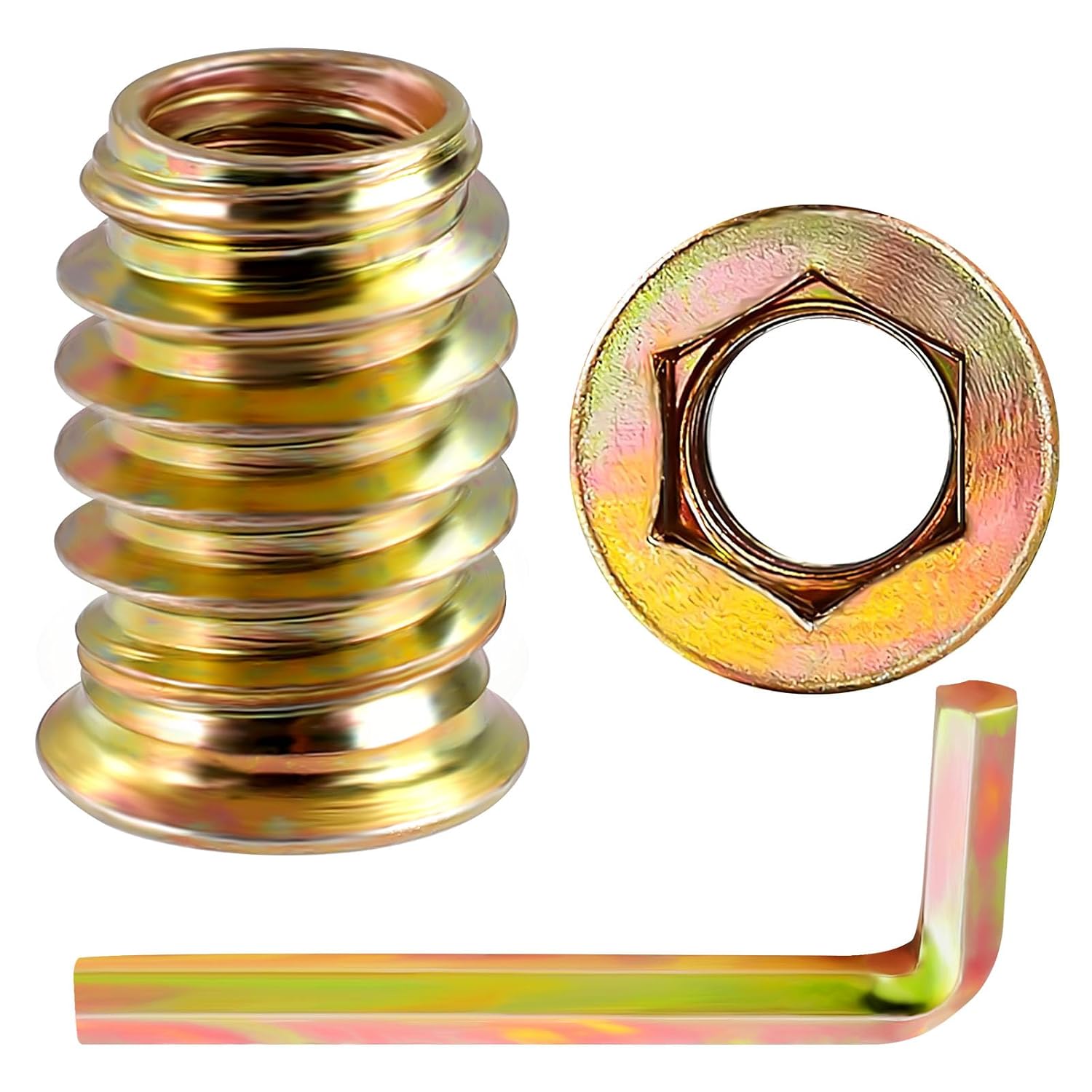
Two practical notes: fitting a levelling foot into solid wood needs a threaded insert or a T-nut, because a stud screwed straight into end grain will strip. And it is worth fitting all four even though only one needs adjusting — otherwise you are levelling by lengthening one leg, which changes the geometry.
Step 3: The fixings
With the table on its side, check every bolt and bracket that holds a leg to the apron or the base to the top. Look for:
- A bolt that turns freely and never tightens — the insert or T-nut behind it has stripped.
- A bracket with an oval hole where the screw has been working back and forth.
- Corner blocks missing entirely. Many tables ship with them and many lose them.
A stripped insert is fixed by drilling out the hole and fitting a larger threaded insert, which gives you a stronger fixing than the original. A worn bracket hole is fixed by moving the bracket slightly and using a new screw into fresh wood, or by fitting a bigger bracket.
Step 4: The joints
Grab a leg and try to rock it against the apron. Any movement at the joint line, however small, is a failed glue joint, and no amount of tightening elsewhere will fix it. Corner brackets are a legitimate reinforcement and a poor substitute — they take load off the joint but they do not make it tight.
The proper repair is to take the joint apart, clean off the old glue and re-glue, which we cover step by step in re-gluing a loose chair or table joint. The important part is that fresh glue does not bond to old glue, so injecting glue into an assembled joint usually fails.
Step 5: The base wants to rack
Some bases are inherently unstable and no repair changes that. A trestle base with no lower stretcher racks side to side. A four-leg table with a very shallow apron has almost no leverage at the joint. A pedestal with a small footprint relative to a big top will always feel lively.
What helps: a stretcher between the trestles, deeper corner blocks, steel corner braces on all four inside corners, or — on a pedestal — a wider foot. What does not help: tightening things harder.
What this repair actually takes
- Stainless steel corner brackets Reinforce a leg-to-apron joint that racks On Amazon →
- Adjustable levelling feet, 3/8″ The permanent answer to an uneven floor On Amazon →
- Threaded inserts for wood, 3/8-16 So a levelling stud has something solid to bite On Amazon →
- Titebond III wood glue For the joint that has actually let go On Amazon →
- Spirit level and a straightedge Step one, and the step people skip
What to buy
Feet first, because that is step two of five. Brackets and inserts only if the wobble is still there once the table sits level.


The extendable-table exception
Tables with extension slides wobble in a way that has nothing to do with the five causes above. When the table is extended, the load path runs through the slides, and geared or friction runners have play in them by design. Symptoms:
- Wobble only when extended — the slides, not the base. Check that both runners are engaged the same amount and that no leaf pin is holding the halves apart.
- Sagging in the middle when extended — the table needs a centre leg, and many extendable tables come with one that gets left in a cupboard.
- Grinding or sticking — dry slides. A dry PTFE or wax lubricant, not oil, which attracts dust.
Questions we get asked
Can I just put a folded coaster under the short leg?
It works and it will move. If the table stays in one spot on a hard floor and you glue a shim to the foot, that is a legitimate permanent repair. If the table gets moved, or the floor is carpeted, the shim shifts and the wobble returns — which is what levelling feet exist to solve.
Should I add corner brackets to a table that is not loose yet?
On a table with a shallow apron and long legs, yes — it is cheap insurance and it is invisible. On a well-made table with deep corner blocks already, you are adding screws into wood for no benefit. Look before you fit.
My table wobbles diagonally, not side to side. Does that mean anything?
It usually means two opposite joints have loosened rather than one, which points to racking load rather than a single failure — someone has been leaning on the table, or it has been dragged across a floor by the top. Check all four joints, reinforce all four corners, and lift rather than drag from now on.
Is a wobble bad for the table, or just annoying?
Bad for it. Every rock works the loose joint a little further open, and a joint that is moving is a joint that is wearing its own socket oval. A wobble that takes ten minutes to fix now is a workshop repair in two years.
How level does a dining table actually need to be?
Level enough that a glass does not creep, which in practice is within about 1 mm over the length. You do not need laser accuracy — you need all four feet in contact at the same time, which is a different and easier target. Sight along the floor line rather than chasing a bubble.