Sideboards with storage — Depth, height and what fits inside
The Wooden Stars is a participant in the Amazon Services LLC Associates Program. We may earn a commission when you buy through links on our site, at no extra cost to you.
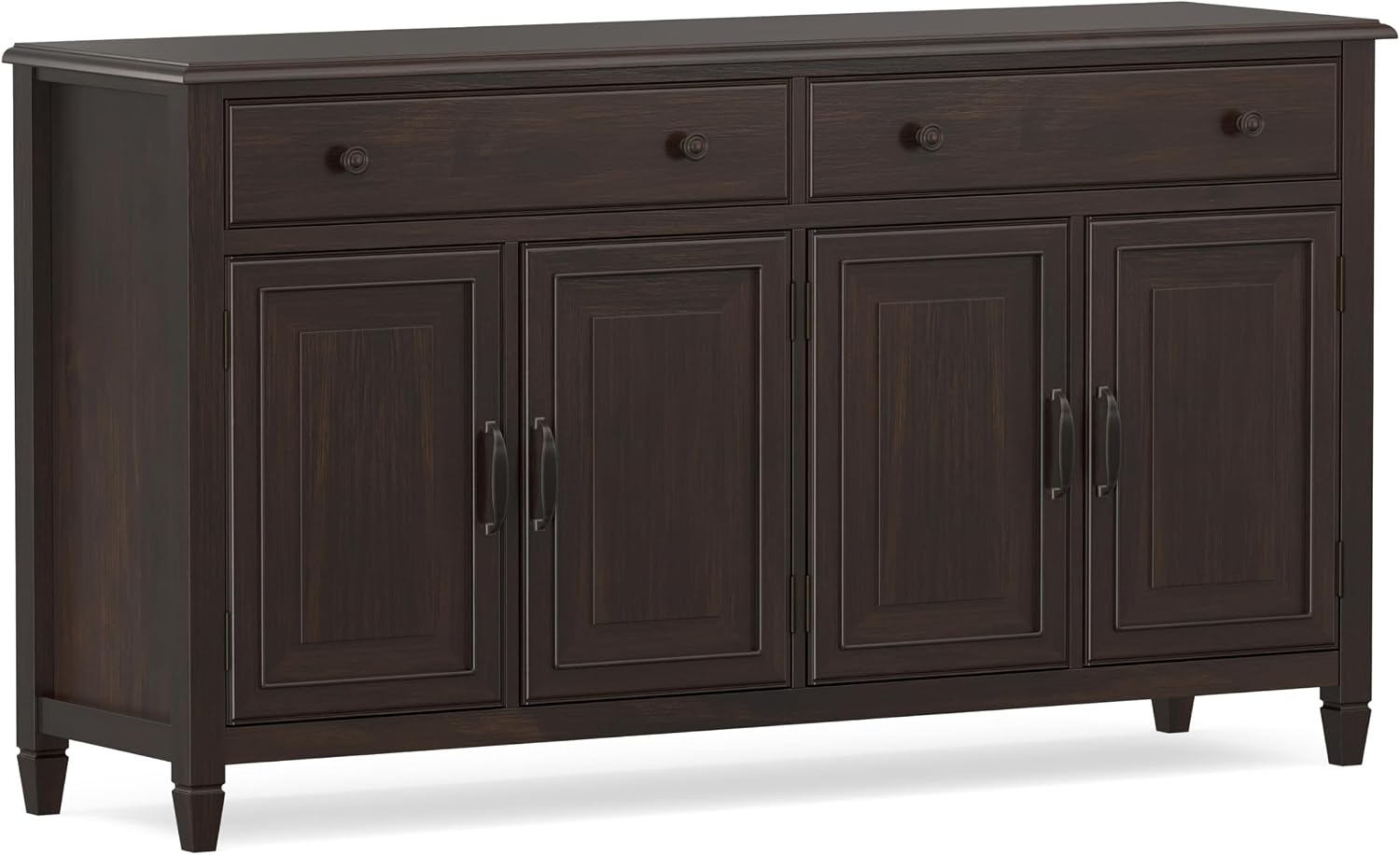
A sideboard is the most useful cabinet in a dining room and the one people buy on looks alone. It is a long, waist-high box against a wall — and how much it actually holds depends almost entirely on two numbers the listing photographs hide.
Those numbers are internal depth and shelf position. Get them right and one cabinet swallows everything a dining room accumulates. Get them wrong and you own a very attractive plinth for a lamp.
A sideboard is 30 to 36 inches high and 15 to 20 inches deep, usually 48 to 72 inches long. Real usable volume is 10 to 18 cubic feet, which is three to four times what fits under a dining table. What decides whether it works: internal depth of at least 15 inches, because a dinner plate is 10 to 11 and a serving platter is 14 to 18; an adjustable shelf rather than a fixed one at mid-height; and a top at 34 to 36 inches if you want to serve from it standing up. Anchor it if it is tall and shallow, and check the back panel, which is what stops a long carcase racking.
Depth is the number that decides everything
A sideboard is deliberately shallower than a kitchen base unit, because it sits in a room people walk through. That shallowness is also its main limitation.
- A dinner plate is 10 to 11 inches across. Fits flat in almost anything.
- A dinner plate stored on edge in a rack needs about 12 inches of depth. Fits in most.
- A large serving platter is 14 to 18 inches. Needs a 16-inch internal depth at minimum, and often has to go in diagonally.
- A stack of table linen is whatever you fold it to, which is why linen is the thing sideboards are best at.
External depth minus about 1.5 inches gives you the internal figure. A 16-inch sideboard has roughly 14.5 inside, which is the point where platters start being a problem.
Height, and what you use the top for
Sideboards come in a band, and the band matters because the top is a working surface.
30 to 32 inches is a low, mid-century proportion. It looks light in a room and it is too low to serve from comfortably — you stoop.
34 to 36 inches is counter height. If you will put serving dishes on it during a meal, or carve on it, this is the one. It is also the height at which a lamp and a mirror above it sit correctly.
The taller the cabinet relative to its depth, the more it wants anchoring. A 36-inch cabinet only 15 inches deep, with a heavy drawer at the top, tips more easily than the numbers suggest — see anti-tip kits for dressers.
| Measure | Common range | What to pick |
|---|---|---|
| Height | 30 to 36 in | 34 to 36 if you serve from the top |
| Depth | 15 to 20 in | 16 minimum for platters |
| Length | 48 to 72 in | Allow 4 in less than the wall run |
| Internal volume | 10 to 18 cu ft | Three to four times an under-table shelf |
| Top clearance to a mirror | 8 to 12 in | Above the tallest thing you put there |
Inside: shelves, drawers and what they each cost
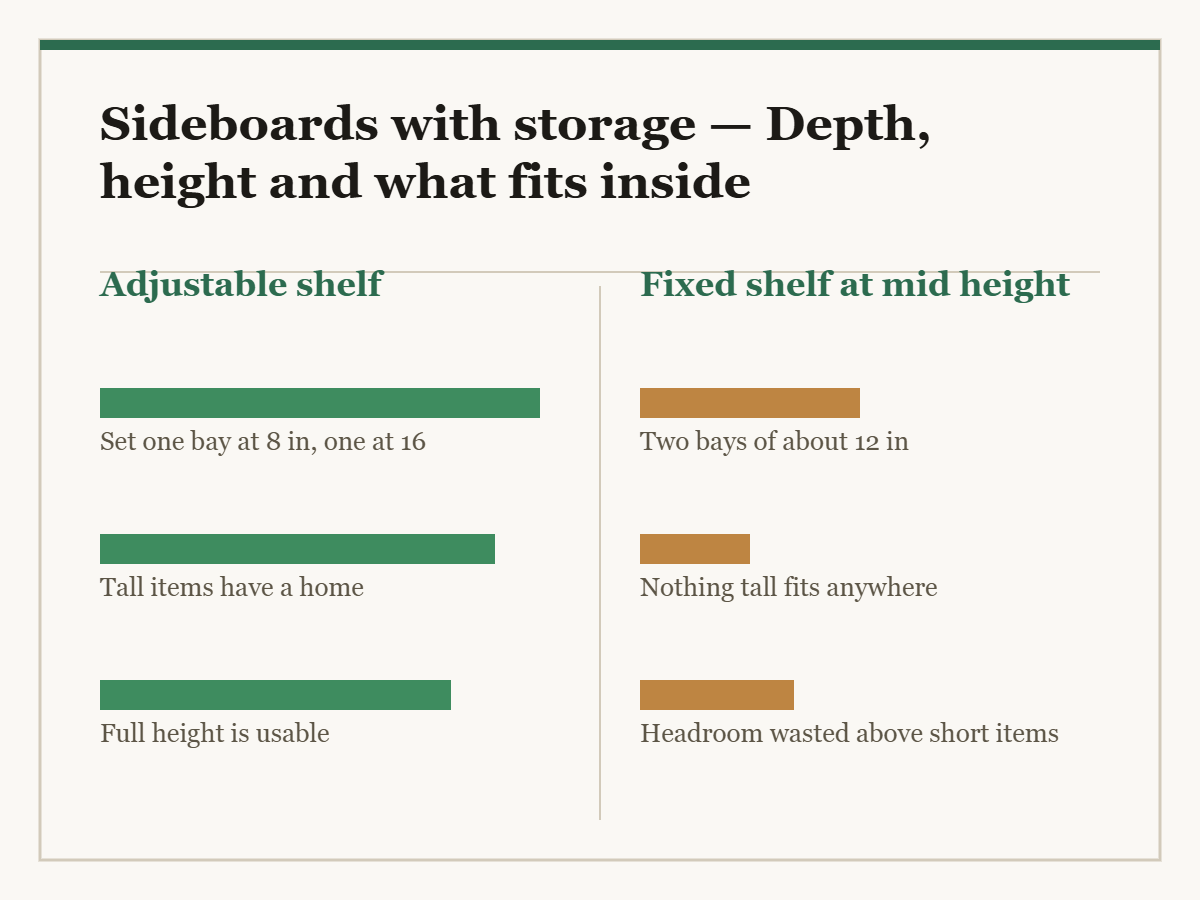
A fixed shelf at mid-height
Cheapest to build and the most limiting. It splits the cabinet into two bays of roughly 12 inches, neither of which takes a stand mixer, a tureen or a stack of chargers.
An adjustable shelf
The same shelf on pins in a drilled row. One bay at 8 inches for plates and one at 16 for tall things is a different cabinet entirely, for a few pounds’ difference in manufacture. Pin sizing is in shelf pins and supports.
A top drawer bank
Two or three shallow drawers across the top, over cupboards. This is the classic arrangement and it is right, because flatware and napkins want to be shallow and at hand, while everything bulky wants a cupboard.
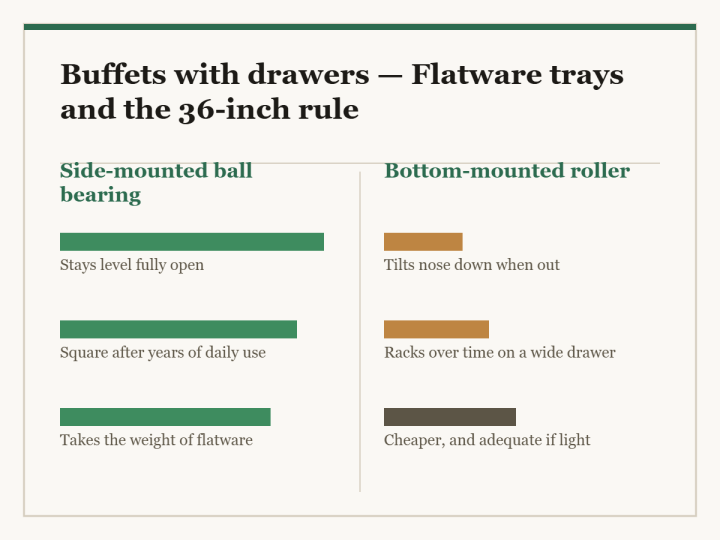
Check the runners. Drawers in this position get opened daily; side-mounted ball-bearing runners are what lasts, and how to measure drawer slides covers replacing them when they do not.
The back panel and the long-span problem
A sideboard is long and shallow, which is the proportion most likely to rack — to lean out of square along its length. What resists that is the back.
A plywood back in a groove triangulates the carcase. Thin hardboard pinned to the back edges is the norm and works until the pins loosen, which announces itself as doors that stop lining up.
The other long-span issue is the shelf itself. A 60-inch cabinet with a single shelf across the full width, loaded with crockery, will bow in the middle unless it has a centre divider or a thick front edge. Same mechanism as a bookshelf, and the same fixes — how to fix a sagging bookshelf.
Sideboard, buffet or credenza?
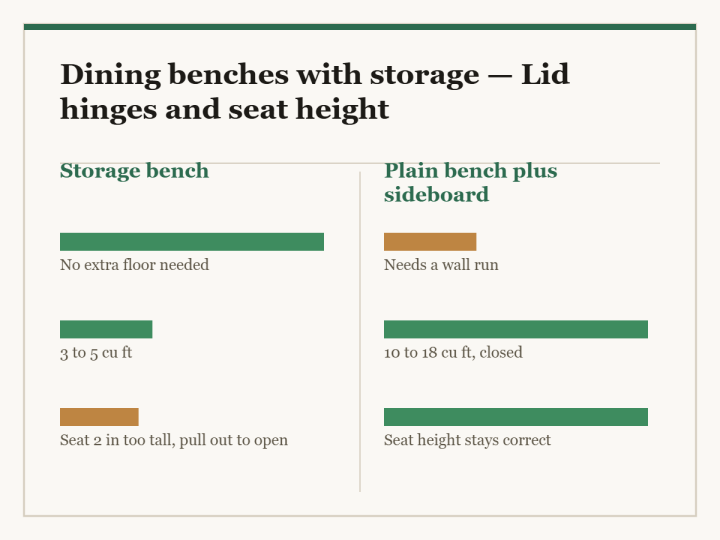
The three words overlap and retailers use them interchangeably, but there are real tendencies. A buffet leans taller with a drawer bank for flatware; a credenza is often lower, longer and used outside the dining room; a sideboard sits between them.
The full untangling, with the dimensions that actually separate them, is in credenza against sideboard against buffet. If you are choosing between a sideboard and a chest of drawers for the same wall, credenza against dresser is the closer comparison, and credenza against console table covers the shallow end.
What it is made of
The top of a sideboard takes hot dishes, wet glasses and a lamp base dragged across it. The carcase carries a lot of weight on a long span.
Solid timber refinishes, which matters on a surface that gets used during meals — see the best finish for a solid wood table top and how to remove water rings, because a sideboard collects them.
Veneer on a stable core is the right answer for long doors and a long top, both of which want to stay flat. Laminate over particleboard is common at the bottom of the range and cannot be repaired; the failure is the edge band lifting where the doors are handled. Definitions are in solid wood against engineered wood against veneer.
After delivery
- Anti-tip strap A 36-inch cabinet only 15 inches deep tips more easily than it looks
- Levelling feet A long carcase shows every dip in the floor as doors that will not line up
- Shelf pins Converts a wasted mid-height shelf into two usable bays
- Felt pads Under lamps and trays, because this top gets things dragged across it
What to buy


If you want flatware trays specifically, see buffets with drawers. To add display shelving above the same cabinet, hutches with storage. For the version that lives in a living room under a television, media consoles with storage. Storage at the table instead is covered in dining tables with storage.
Questions we get asked
How much does a sideboard hold?
Ten to 18 cubic feet, which is three to four times what fits on a shelf under a dining table, and all of it behind doors.
How deep should a sideboard be?
At least 16 inches externally. Dinner plates need about 11, but serving platters are 14 to 18 and are the thing that will not fit.
What height should I get?
Thirty-four to 36 inches if you will serve from the top. Thirty to 32 looks lighter in the room but is low to work at.
Fixed shelf or adjustable?
Adjustable, every time. A fixed shelf at mid-height leaves two bays of about 12 inches, and nothing tall fits in either.
What is the difference between a sideboard and a buffet?
Mostly convention. A buffet tends to be taller with a bank of flatware drawers; a credenza tends to be lower and longer. The dimensions overlap heavily.
Does it need anchoring to the wall?
If it is 34 inches or taller and under 18 deep, yes — particularly with a loaded drawer at the top.